Fossils of honeybees are rare. We are talking exceptionally rare.
Most known specimens sit in European and Chinese deposits, sitting tens of millions of years older than anything we really understand about their recent history. They are from the Oligocene or Miocene epochs. Older stuff. Much older.
Then there are the Pleistocene and Holocene fossils. Those are young. Very young. But they don’t tell us about extinction. They belong to species that are still buzzing around today.
That leaves a gap. A two-million-year void in the evolutionary record for the genus Apis.
Enter Apis aibai.
This new fossil, pulled from volcanic rock in Japan, slots perfectly into that missing slot. It is the youngest known extinct honeybee species. It is also the oldest confirmed member of the subgenus Apis — the specific lineage that includes our favorite Western honeybee, Apis mellifera, and its closest kin.
The discovery was announced by Dr. Yui Takahashia nd Dr. Jun-ichi Takahashis from Keio Yochisha and Kyoto Sangyo University, respectively. Their work appears in ZooKeys.
The Fossil Record Gap
To understand why this matters, you have to look at the taxonomy. Apis isn’t a single monolith. There are at least nine extant species. They split into three subgenera: Micrapis, Megapis, and Apis.
The distribution is messy. Apis mellifera owns Europe, Africa, the Middle East, and parts of Central and western Asia. The other eight species? Primarily Asian.
Their ranges overlap in the tropical and subtropical belts of South and Southeast Asia. It is a dense, competitive zone.
Only one species, Apis cerana, pushes north into temperate zones. And yes, A. cerana is the only native honeybee in Japan.
The fossil record, however, has been biased. Mostly Eocene and Miocene rock. Europe and China again. A handful of Pleistocene outliers, but nothing to anchor the subgenus Apis specifically before the Pleistocene started.
Genomic studies disagreed. Mitochondrial DNA suggested the subgenus arose in the Late Miocene.
The rocks didn’t support the genes. Or so we thought.
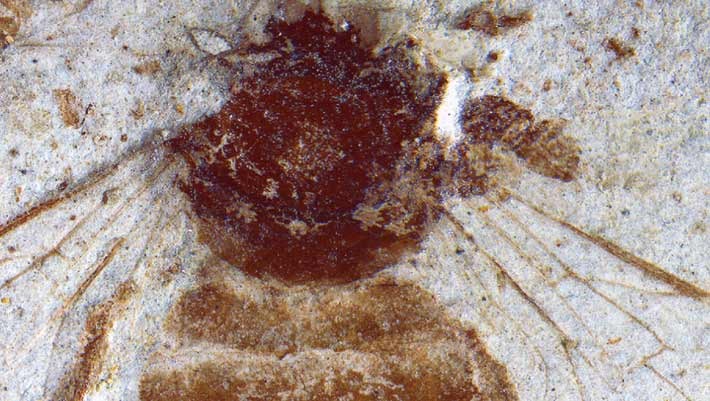
A Worker in Whitish Siltstone
The specimen in question comes from the Teragi Group.
These are volcanic and lake-deposited layers in Hyogo prefecture. The rock is whitish, tuff-rich siltone. The preservation is decent. Not amber-locked perfection, but clear enough for science.
The fossil is a worker bee. Roughly 10 mm long.
You can see the wings. You can see the hind legs. You can see body segments.
This detail allows for direct comparison with living species. That is crucial when you are dealing with a ghost from 2.5 million years ago.
Dating puts Apis aibai between 2.8 and 22 million years ago. Late Pliocene. Early Pleistocene.
That specific time range is the bridge.
Clues from Wing Veins
How do you identify a bee fossil that is dead?
Wing vein patterns. Leg structure. These traits persist through evolution. They don’t change overnight.
The researchers compared A. aibai to extant species. The resemblance was strongest to Apis nigrocincta.
Apis nigrocincta lives today only in the Philippines and Indonesia. It is a tropical bee. It stays warm.
But A. aibai is from temperate Japan. In the Late Pliocene.
This suggests Apis nigrocincta -related bees had a much wider distribution in the past. They reached temperate zones. They thrived where we didn’t think they could.
“This suggests that the Apis nigrocincta -related extinct group… historically had a wider distribution, ranging to temperat Japan of the Late PlioceneEary Pleistocene age”
The researchers proposed something interesting. An evolutionary hypothesis.
That this extinct, widespread group might be the ancestral bees for Apis cerana.
Think about it. A. cerana is Japan’s only native honeybee today. If its ancestors were a tropical lineage that pushed north, adapted to temperate climates, and left behind fossils like A. aibai, that changes how we view its history. It wasn’t just a cold-hardy outlier from the start. It might have migrated and evolved from tropical relatives.
Bridging the Divide
For years, there was a disconnect.
Paleontologists looked at rocks. They saw old European and Chinese bees. They saw recent Pleistocene survivors.
Geneticists looked at DNA. They saw a Late Miocene origin for the Apis subgenus.
The fossils didn’t confirm the genetics. The genetics didn’t have a fossil counterpart.
Apis aibai fixes that.
It provides physical evidence for the genetic timeline. It proves the subgenus was present before the Pleistocene. It bridges the gap between molecular clocks and physical remains.
The paper, published in ZooKeys, details the holotype from Hyogo. It connects the dots across millions of years.
Apis aibai is more than a rock with wings. It is proof that honeybees were diversifying, migrating, and adapting long before our current species took shape.
The temperate zones of Japan once hosted tropical relatives. They went extinct, or migrated, or evolved into something else.
We found them in the silt. We named them Aibai.
What happened to their descendants? Did they fade into the A. cerana lineage we see today? Or did they vanish entirely, leaving only DNA as their tombstone?
The record is clearer now. But the full story? That is still emerging from the stone.