It wasn’t on the radar. Not really.
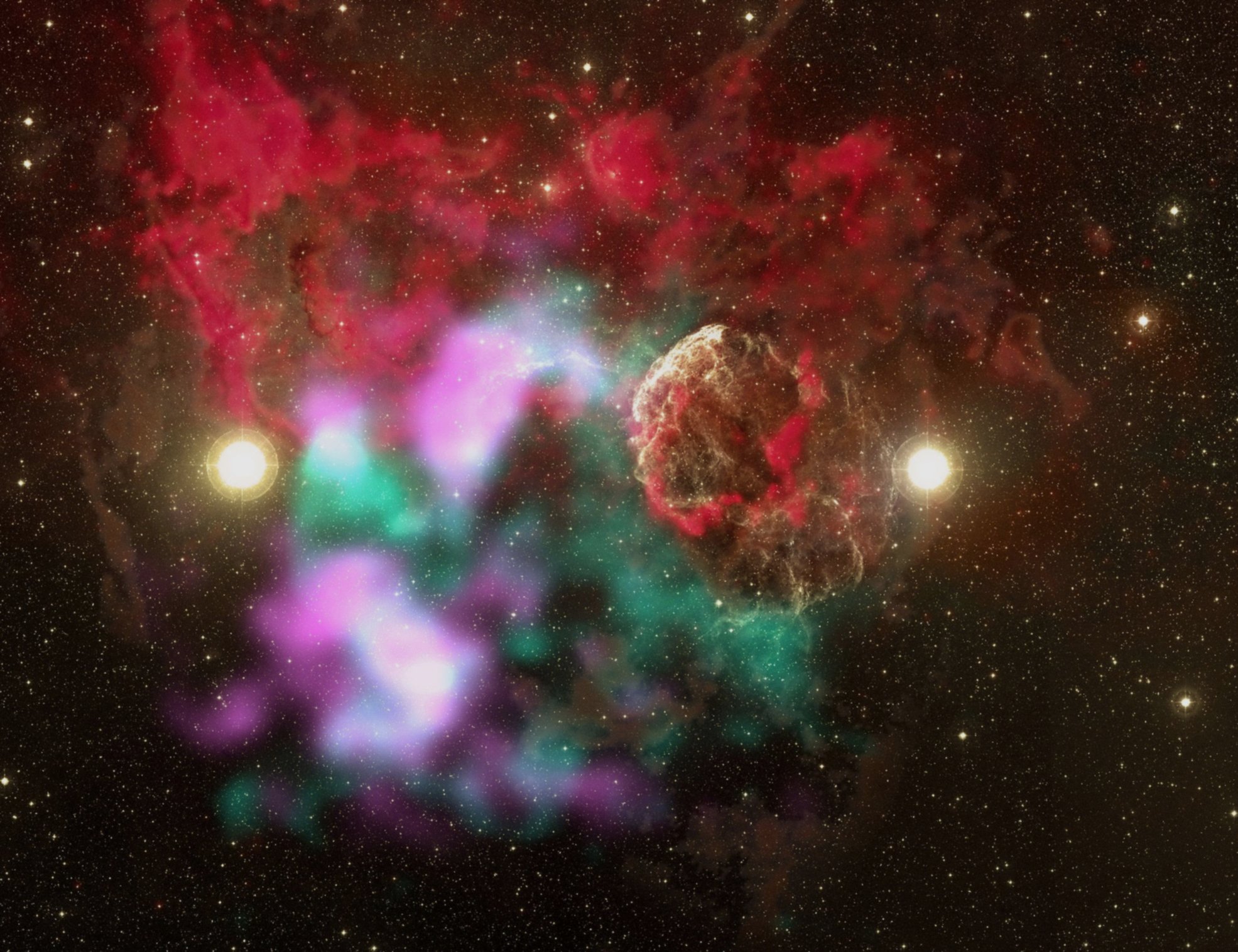
Astronomers weren’t hunting for a cosmic unicorn. They were looking at a faint, overlooked patch of sky next to one of the Milky Way’s most famous stellar graveyards. Instead, they found something that breaks the textbook: two separate supernova remnants left behind by a single binary star system.
This is the first confirmed case of a binary supernova remnant. Two stars, orbiting each other for millions of years, died. They died far apart in time. And their wreckage remains locked in a gravitational embrace that defies simple explanation.
The discovery sits in the shadow of IC 443. Better known as the Jellyfish Nebula, that remnant is a staple of galactic study. It’s one of the clearest examples of proton acceleration, a key driver of cosmic rays. G189.6+3?3 sits right next to it. Faint. Quiet. Ignored. Until now.
The Fermi Clue
The team, led by Miltiadis Michailidis from Stanford University, didn’t stumble on this by accident. Well, not entirely. They spent 16 years digging through data from NASA’s Fermi Gamma-ray Space Telescope.
Their initial goal was simple: characterize G189.6.3.3. Understand what it was. Who blew it up? When?
They combined gamma-ray data with X-ray, radio, UV, and optical observations. The signal was weak. Hard to pin down. But the pattern that emerged was strange.
Instead of a uniform glow, the northern half of G189.6.3 was dominated by accelerated protons. The southern half? Electrons.
A clean split. A distinct boundary.
Why? It came down to geography. The northern edge of the remnant crashes into a dense cloud of hydrogen gas. Fast protons slam into that dense material, producing gamma rays. The southern half has no such cloud. The physics changes. Electron-driven processes take over. UV data confirmed the northern shock wave slowed after hitting the gas. The pieces fit.
But that just explained the remnant itself. It didn’t explain the neighbor.
Not a Coincidence
IC 443 interacts with that same gas cloud.
If two objects interact with the same environmental structure, they are likely at the same distance. Same space. Same time. Same history?
Coincidence happens. In astronomy, it happens all the time. To rule it out, the researchers ran a simulation. They created 1 million hypothetical binary star systems. They calculated the odds of two unrelated supernova remnants ending up this close together by pure chance.
The odds ranged from 1 in 1,00 to 1 in 100 depending on the method.
Low probability. High certainty of a connection.
The two remnants are related. They share an origin.
The Timing Gap
Here is where it gets messy. And real.
Binary stars usually blow up nearly simultaneously. Both collapse. Both explode. One after the other.
These two did not.
The team estimated the timing of the blasts. The difference? Tens of thousands of years.
That gap makes sense, if you think about mass. In a binary system, one star is often heavier. It burns faster. It dies first. It explodes as a supernova. Its companion survives. It lives for thousands, maybe tens of thousands of more years. Eventually, it goes too.
So, star one blew up. Star two kept orbiting the debris. Then star two blew up.
Two supernova remnants from one binary pair. Separated by time. Linked by gravity and proximity.
Why This Matters
We have computer models. We have theories. Massive binary stars live. They interact. They explode.
This system offers a chance to test them. Not with abstract math. With real data.
Michailidis sees the payoff clearly. By measuring the distance between the explosion centers of the two remnants, astronomers can calculate the actual energy released in each supernova.
Until now? That number was a guess. Theoretical estimates only.
“Now we can actually test it,” Michailidis said.
The next step is hunting. Looking for other pairs like this across the galaxy. Why is this one so distinct? Why did we miss it until Fermi’s gamma-ray eyes looked deeper?
There might be more out there. Hidden in the noise. Waiting to be found.