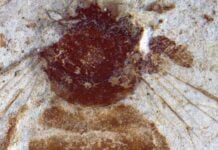
Long before humans walked the planet, plants were quietly doing the heavy lifting for the Earth’s carbon cycle. They sucked up carbon dioxide. They locked it into their tissues. And when they died, that carbon stayed put, preserved in rock.
For years, scientists relied on the oceans to tell us what the atmosphere looked like millions of years ago. Marine fossils. Shell fragments. Sediment layers. Reliable, sure. But they have limits. Their resolution gets fuzzy past the Middle Eocene, about 45 million years ago. And before that? The record largely vanishes.
This is where a new approach from researchers at the University of Michigan changes the game. By analyzing fossilized plant matter from Wyoming, Nathan Sheldon and Katarina Keating have opened a door to the deep past. Specifically, they’ve shown that how fossilized plants can reveal Earth’s past atmosphere is not just theoretical—it’s measurable, and it’s accurate.
The Carbon-13 Clue
The key here isn’t the plants themselves. It’s the isotopes. Specifically, Delta Carbon-13 (δ¹³C).
Carbon-12 is lighter. Carbon-13 is heavier. Plants prefer the lighter isotope when they photosynthesize. So, the ratio of these two carbons in a leaf fossil tells a story. A shift in that ratio reflects how carbon moved through the global carbon cycle. It’s a flux meter.
Traditionally, researchers used marine proxies for this. Ocean sediments. Foraminifera shells. These records stretch back to the Cretaceous Period, around 145 million years ago. But the signal gets noisy. Suboptimal resolution plagues the data. We can’t see clearly. And we certainly can’t see older records with any confidence.
The gap is problematic. The time between the K-Pg extinction (the dinosaur-killing event) and the modern day holds lessons for our current climate crisis. The Paleocene and Eocene epochs saw global warming spikes that look eerily familiar. If we want to predict where we’re heading, we need to understand how the carbon cycle behaved when the planet was hot.
But without good data, we’re flying blind.
Wyoming’s Time Capsule
Sheldon, Keating, and their team went digging in the Hoback Basin of Wyoming. They didn’t just scratch the surface. They went meters underground, pulling samples from rock formations dated between 50 and 60 million years ago. That places them squarely in the late Paleocene and early Eocene.
They extracted terrestrial organic matter. They analyzed it for δ¹³C.
The logic is simple but powerful. Plants trap CO₂ from the air. If the air had a certain isotopic signature, the plants reflect it. When those plants become fossilized, that signature remains. It’s a direct link to the atmospheric carbon flux at that exact moment in geological time.
But did it match the marine data? Or was it just local noise?
The researchers compared their terrestrial readings against global terrestrial records found in the literature. Then, they cross-referenced everything with marine organism fossils from the Cenozoic period, going back 66 million years. They needed to know if land plants were a valid proxy for atmospheric δ¹³C on a global scale.
The result was striking.
A Match Made in Geological Time
The atmospheric δ¹³C values reconstructed from Wyoming plants aligned closely with those derived from ancient marine organisms.
This isn’t a marginal correlation. It’s a validation. It proves that fossilized plants can reliably reconstruct ancient atmospheric conditions with a fidelity that rivals the ocean records. And since plants existed long before modern marine proxies offer clear data, this extends our timeline significantly.
The team dug into the specifics to see what was happening to the climate during these shifts. They compared the reconstructed values to a baseline.
Volcanoes are a major source of carbon, releasing it at a steady δ¹³C value of roughly -5.4‰.
Around 53 million years ago (Eocene), the atmosphere showed a value of -6.30‰. That’s lower. It means there was an abundance of lighter Carbon-12 in the air. More light carbon usually correlates with warmer temperatures. The planet was hot.
Then, look at the late Paleocene, around 57 million years ago. The value flipped to -4.37‰. Higher. Heavier. This suggests that light carbon was being sequestered elsewhere—likely locked away in the oceans or buried in sediment. This removal of light carbon left the heavier isotopes behind in the atmosphere. The net effect? A cooling climate.
Both the land and sea records showed this same shift. A common process was at work. Global carbon fluxes were driving the temperature changes. The plants and the plankton told the same story.
Rainfall Complications
It wasn’t all smooth sailing. The team noticed something odd when comparing their Wyoming data to other sites globally.
The results varied by rainfall.
Sites that were historically wetter showed readings with less heavy carbon. The drier sites, including the Hoback Basin, matched the expected marine-derived values.
Why does precipitation matter? Likely because water availability affects how plants take up carbon and how organic matter decomposes before it gets buried. If you’re in a wet zone, the signal gets diluted or altered.
The researchers are clear about this limitation. To get accurate how fossilized plants reflect carbon fluxes readings, scientists need to account for precipitation. Wet sites might require adjustment or exclusion from certain models.
But this doesn’t break the method. It refines it.
Why This Matters Now
“We provide a method for understanding the sources and sinks of CO2 for as long as plants have existed,” Sheldon and Keating wrote.
That’s a big statement.
Currently, we rely on marine records to trace the carbon cycle through the Cenozoic and Mesozoic. But those records are sparse in certain time windows. They have constraints. They have gaps.
This new approach using fossilized plant matter can fill those gaps. It supplements the marine data. It works in data-poor regions. And crucially, it enables reconstructions for periods where marine constraints simply don’t exist.
We are facing unprecedented changes in atmospheric CO2. Understanding the mechanisms of the past is no longer just academic. It’s a survival skill. We need to know how the planet responded when carbon levels spiked. We need to know where the heat went. And now, thanks to the fossilized leaves of Wyoming, we have a clearer map of the deep past.
The plants remember. We just have to read them right.