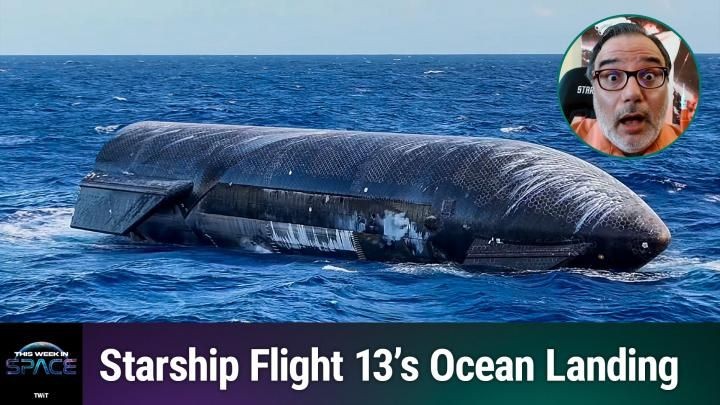
Starship floated. For days.
It sounds like a sci-fi trope, but that’s exactly what happened after Flight 13. SpaceX’s massive super-heavy booster didn’t just survive reentry; it stayed buoyant in the Indian Ocean long enough for recovery teams to catch up with it.
This isn’t just a cool party trick. It changes the calculus on rapid reuse.
On Episode 221 of This Week in Space, host Tariq Malik and guest Rick Jenet from the National Space Society dissected these anomalies. They looked at how SpaceX pulled off the softest splashdown on record, why experts are calling the current heat shield tech a dead end for fast turnaround, and what it means for the future of orbital logistics.
But the news cycle didn’t stop at the splash zone.
The Starship Float Paradox
The primary topic was Starship Flight 13. The mission deployed next-gen Starlink V3 satellites. Standard procedure involves discarding the booster. Usually, it breaks apart in the atmosphere. Or it burns up.
This time, the ship reentered intact.
It hit the water. It floated.
Experts warn current Starship heat shield tech may be a “dead end” for rapid reuse because the tiles degrade after such gentle recovery, complicating quick turnaround for next-generation missions.
Why does this matter? Because if the vehicle survives intact, you can recover it. If it floats, you can retrieve it without a frantic scramble. But there’s a catch. The thermal protection system (TPS) tiles might be compromised in ways we don’t yet fully understand. Rapid reuse requires the tiles to be pristine or easily replaceable. A float-and-recover scenario might hide micro-fractures that only show up when the engine fires again.
SpaceX also secured $1.6 billion in military launch contracts this week. The Pentagon sees the reliability of rapid reuse. They aren’t betting on perfection; they’re betting on volume. Can Starship provide volume if the heat shield is a one-and-done? That’s the tension keeping engineers awake.
Roman Space Telescope Launch Imminent
Shift gears. NASA’s Nancy Grace Roman Space Telescope is nearly ready.
The launch window is tight. Late August. Specifically, the 30th.
This isn’t just another telescope. It’s designed to study dark energy and exoplanets. The name comes from Nancy Grace Roman, the “mother of Hubble.” Her advocacy helped secure the funding and the mission profile.
The telescope will operate in space. It will look for gravitational lenses. It will map the dark universe.
Preparations are final. If the timeline holds, we’ll see the first images sooner than expected. The technology is mature. The funding is secure. The question is timing. Delays happen. But NASA seems committed to the August launch.
The Swift Satellite Emergency
Then there’s the Swift Observatory. It’s aging. It’s struggling.
NASA is attempting an emergency servicing mission. A robotic spacecraft will intercept Swift. It will refuel it. Maybe fix its pointing system.
But the savior is sick. The servicing craft itself has technical issues.
It’s a rescue mission for a rescue mission. The risk is high. If the servicing craft fails, Swift goes silent. Swift provides critical gamma-ray burst data. Without it, we lose our eyes on the most violent explosions in the universe.
We’ll see if the fix works. Or if we have to accept the loss of a legacy asset.
Boeing’s Starliner and India’s Skyroot
Boeing’s Starliner remains in limbo.
Delays. Continued delays.
The crew return test is stuck. Issues persist. The aerospace giant is facing scrutiny over its management and engineering decisions. The question isn’t if it will fly, but when it will be safe to fly humans.
Meanwhile, India made history. Skyroot Aerospace launched the Vikram-1. It was India’s first successful private orbital launch.
This signals a shift. The private sector in emerging space economies is growing. Skyroot proved the tech works. They reached orbit. They landed the first stage (or recovered it successfully, depending on the specific recovery metric for this debut). It’s a big deal for Indian space independence and global competition.
Celestial Events and Lunar Mysteries
The sky itself is putting on a show.
The Perseids.
The shower peaks in 2026. Mark your calendars. But wait for the current month.
Lunar Eclipse.
An “almost blood moon” on August 27. It’s the best view until New Year’s Eve 2028. You don’t need a telescope. Naked eye is fine. Dark skies help, but it’s bright enough to see even in suburban zones.
Moon Crash.
A SpaceX rocket will intentionally crash into the lunar surface next week. Scientists are curious. Why crash a rocket? To create a plume. To analyze the dust. To learn about the lunar regolith. It’s an experiment in motion.
Exoplanet Moon?
Astronomers might have found the first moon outside our solar system. Or it’s something weirder. A rogue planet. A captured asteroid. The data is ambiguous. Confirming exomoons is notoriously difficult. This could be false positive territory. Or it could be the discovery of the decade.
Artemis: South Pole or Equator?
Artemis IV is under review.
Should astronauts land near the south pole? The original plan says yes. But Artemis II pilot Scott Kelly suggests otherwise. He argues the lunar