Supercomputers used to be the only way to figure out what happens when two black holes crash. You need massive processing power to solve Einstein’s equations. The math gets heavy. The spin gets complicated. It is a nightmare for anyone who doesn’t live inside a server rack.
Now? Physicists at Penn State say you don’t need all that. You just need thermodynamics.
It sounds ridiculous. Black holes are gravity wells, not engines. They aren’t steam or gas. They shouldn’t obey the laws of heat. But they do. Or at least, they act like they do. A new study published in Physical Review Letters suggests the final mass and spin of a black hole remnant follow a surprisingly simple rule. Maximum entropy.
Can you predict a black hole merger with simple physics?
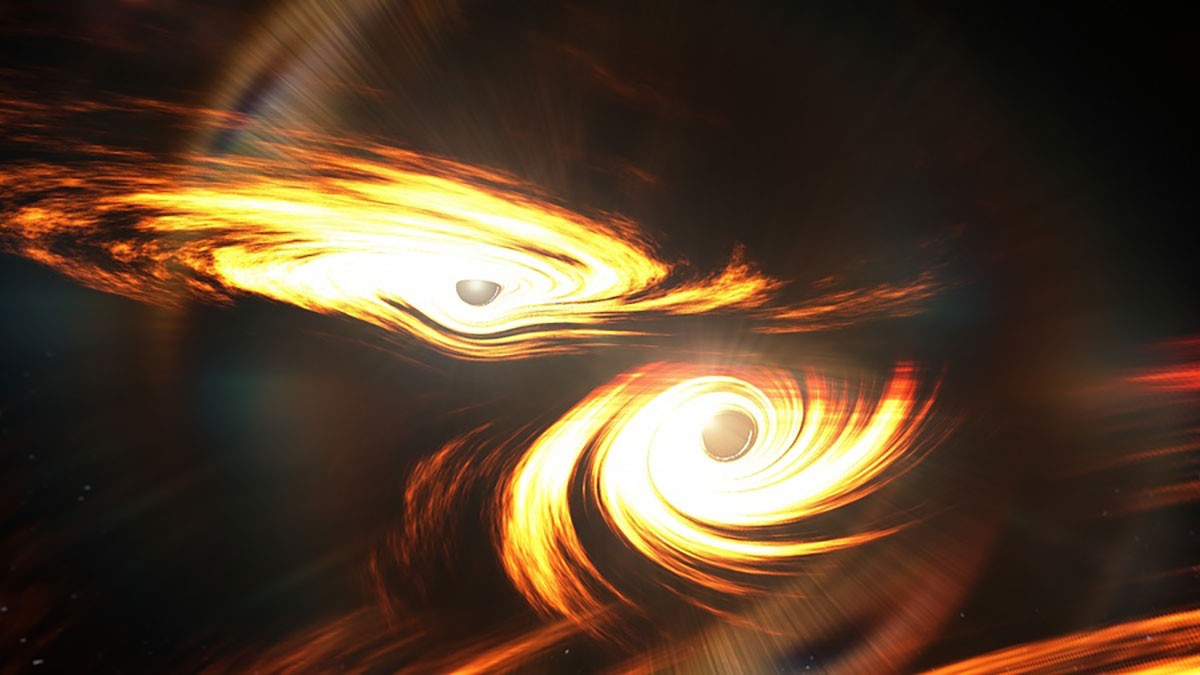
Two black holes in orbit don’t stay apart. Gravity pulls them tighter. They spiral in. Then they collide. It is an energetic event. It warps spacetime. It sends gravitational waves rippling across billions of light-years.
Earth-based detectors pick up those ripples. We hear the crash. The signal lets us estimate the size of the leftover black hole. The remnant.
Usually, getting an accurate prediction requires running complex simulations. Solving differential equations until your head spins. The Penn State team asked a different question. Can we skip the supercomputer? Can we use basic thermodynamic principles to predict the outcome?
Monica Rincon-Ramirez, the study’s first author, puts it this way:
“The final black hole after a merger is ringing like the struck bell, and it radiates more gravitational waves until it settles… The question we asked is: Can we predict what that final state is using arguments from thermodynamics?”
It’s about the how. How does nature decide what stays after the dust settles?
Entropy, disorder, and the final state
Thermodynamics usually deals with gases. Engines. Cooking. Lots of particles jiggling around. It describes energy, heat, and entropy on a large scale. We don’t track every molecule. We look at the big picture.
General relativity does it differently. It treats gravity as curved spacetime. Deterministic. One input, one output. No randomness. Black holes were once thought to be outside thermodynamics entirely. That changed in the 1970s when Stephen Hawking showed they radiate energy. They have entropy.
The Penn State researchers extended this. They looked at binary black hole systems. Mergers. Specifically, they looked at angular momentum. It measures rotational motion. The mergers lose energy and angular momentum to gravitational waves.
So, what is left?
Vaishak Prasad, a co-author, explains entropy clearly:
“Entropy is essentially a measure of disorder… A messy room has high entropy… A perfectly tidy room has low entropy… Nature tends to drift toward high entropy states because there are more of them.”
The researchers hypothesize that the merger does the same thing. The system drifts toward the state with the highest possible entropy. The most probable arrangement. Once you account for the lost energy and spin.
It’s a “maximum entropy conjecture.”
Matching simulations without the code
The idea isn’t new in theory. It mirrors how we predict the final state of mixing hot and cold gases. You don’t track every collision. You maximize entropy. You get the answer.
The team wondered if the same logic applies to black holes.
They tested it. They mapped the mass and angular momentum of merging black holes to a sequence of possible rotating remnants. Then they found the peak entropy point in that sequence. Finally, they compared it to results from numerical relativity simulations. Those simulations are the gold standard. Expensive. Time-consuming. Accurate.
The match was striking.
“Remarkably, we observe that entropy of this sequence reaches a maximum at points strikingly close to mass and angular momentum of actual final remnant… agreement within a few percent,” Rincon-Ramirez noted.
It’s not just an approximation. It’s within a few percent of the complex simulation. That is impressive for such a simple rule.
Eugenio Bianchi, a professor and co-author, highlights the contrast:
“When two hot gases are brought into contact… one does not need to track microscopic interaction… Maximizing entropy, while accounting other physical laws, predicts the outcome. Our new conjecture proposes same broad rule could determine what remains when two black holes combine.”
Why this matters for black hole physics
The final black hole forgets almost everything about the collision. It retains almost no memory of the chaotic merger. What remains is described by just two numbers. Mass and spin. The “no-hair theorem.”
But why those specific numbers? Why not another combination?
The thermodynamic approach offers an answer. The remnant settles into the state that maximizes entropy. It is the most natural, most probable outcome.
B.S. Sathyaprakash, who led the research, sees this as more than just a shortcut.
“This work explores surprising possibility at intersection of gravity, black hole physics, and thermodynamics… raises transformative question: Could entropy maximization be fundamental organizing principle governing black hole interactions?”
It goes beyond established laws of black hole mechanics. It suggests a deeper connection between gravity and thermodynamics. One that might apply to more than just mergers.
The U.S. National Science Foundation supported the research. The findings appeared in Physical Review Letters as an Editor’s Suggestion.
It’s a cleaner view of a messy universe. We don’t need to simulate every atom of spacetime. We just need to see where the disorder settles.
But does this mean all cosmic events follow simple thermodynamic paths? Or are black holes just unique enough to cheat the rule? We might never know for sure. The universe doesn’t always explain itself.