You think the best moon viewing happens when that orb is a perfect, glowing white disc in the sky?
Think again.
Wait for the shadows. Specifically, the long, jagged ones that carve into the surface during a half-lit phase. That is when the real drama happens.
Beginners assume the full moon wins. It is bright. It is obvious. But through a telescope? It is a glare fest. Flat. Glaring. Dead.
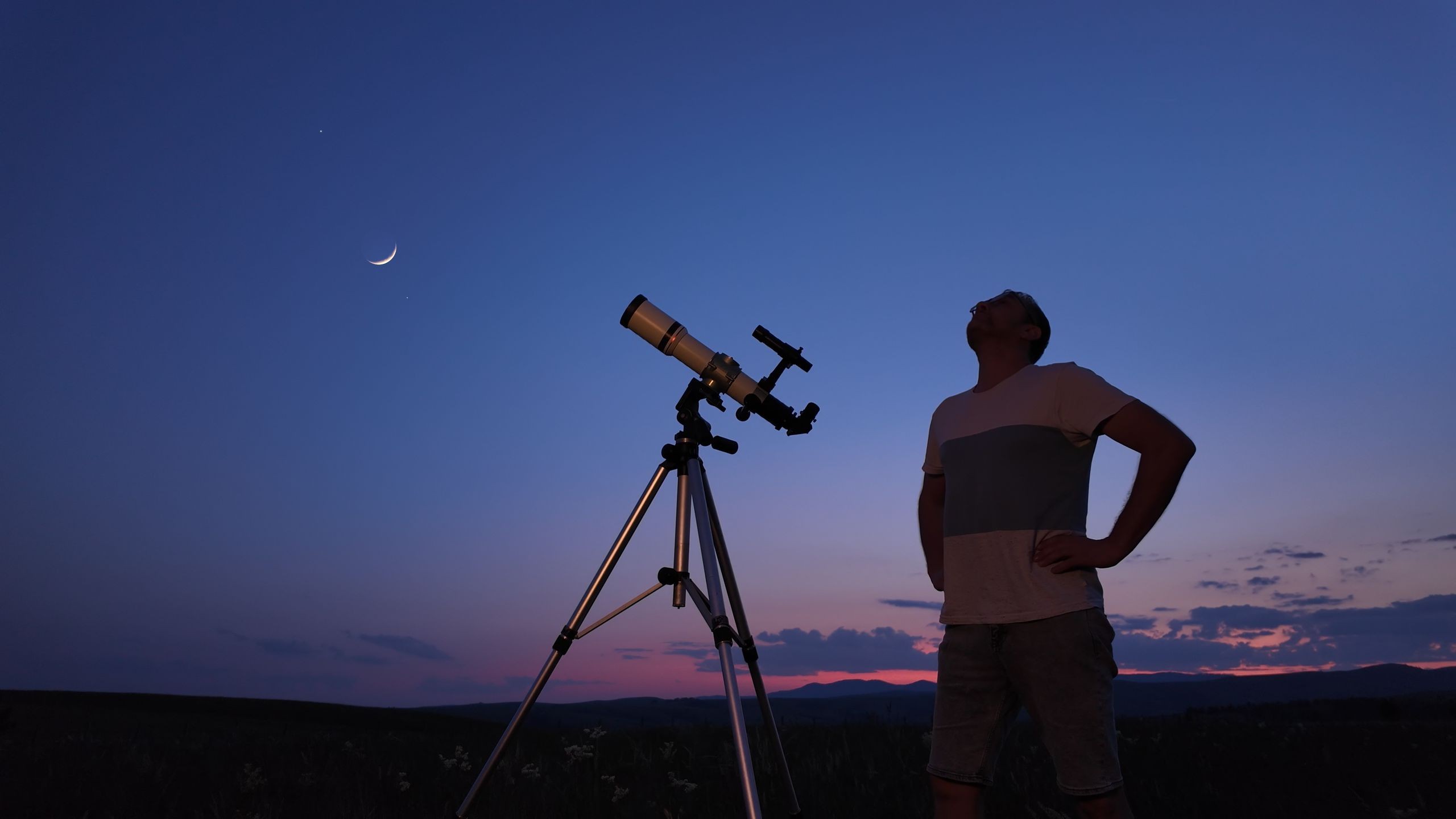
Leslie Peltier, who earned the nickname “the world’s greatest nonprofessional astronomar,” knew this instinctively. Even with a tiny two-inch spyglass in his early days, he chased the sunrise line across the lunar face.
“I followed the advancing sunlight all the way… I was still wholly unprepared for the wonders which I found… No photograph… is not cold and flat and dead compared to what meets the eye through a small scope.”
Photographs lie. They compress depth. A telescope at the right moment reveals three dimensions.
Chasing the terminator
So, when do you actually point your optics up?
Forget full. Aim for first or last quarter.
This is when the terminator sits near the features you want to see. The terminator is just a fancy word for the edge where sunlight meets shadow. It moves. As it rolls over craters and mountains, those shapes suddenly pop into high-relief definition.
Low power helps too. Twenty to forty times magnification keeps the whole dramatic scene in the frame. High power cuts the context. You lose the stage to focus on a prop.
On Monday, May 25 for example, look right of the terminator line. You will spot Copernicus. Nineteenth-century mapmaker Thomas Gwyn Elger called it the “Monarch of the Moon” because of its sheer presence. It sits there, 58 miles wide, with terraced walls and a central peak complex that looks carved from marble.
The geometry matters. When the first quarter arrives this Saturday, May 23, at 7:11 a.m. EDT, the sun hits from the side. Shadows lengthen. Topography emerges.
Is it bright? No. A common myth suggests a half-moon has half the brightness of a full one.
False.
It is only one-eleventh as bright. The surface scatters light inefficiently at low angles. Shadows devour the rest.
Why the glow is the enemy
Look at the full moon on May 31. It hits peak illumination around 4:45 a.m.
The sun stands directly overhead relative to the lunar center. Light floods into every crevice. There are no shadows to anchor the eye. Just a white wash. Glaring through even a decent eyepiece, it feels uncomfortable. Flat.
But wait until it’s a slim crescent. Look closely at the dark portion. See that faint ghostly outline? That is Earthshine. Sunlight bouncing off our oceans and clouds, reflecting back onto the Moon.
It is dim. It is eerie. It makes the Moon look like a sphere suspended in void, not a sticker pasted on a black sheet.
Most art ignores this. Artists draw crescents or full moons. Half-moons show up sometimes.
But who draws the gibbous?
Gibbous means humped, from the Latin gibbus. It describes that messy phase between half and full. It is actually the phase you see most often in real life, simply because it stays in the sky for most of the night. Try finding it on Tuesday, May 26 around 5:30 p.m local time. Look low in the east-southeast. You might find it hovering before sunset.
The crescent? Gone by late night. The gibbous? Still hanging on.
A Micro Blue Moon
We end the month with two titles for this final full moon on May 31: Blue Moon and Micro Moon.
Blue Moon means the second full moon in a single calendar month. It has nothing to do with color. Historically, blue referred to actual atmospheric dust or volcanic ash turning the moon blue. The name got stuck in a calendar misunderstanding back in 1946 via the Maine Farmers Almanac.
Micro Moon is physics. On June 1 at 1:00 a.m. EDT, this moon hits apogee. That is its farthest point from Earth in orbit.
At 252,004 miles away, it appears roughly 14 percent smaller than a “Supermoon” at perigee.
So, a blue, micro full moon.
It will be bright. It will be flat.
If you have a telescope, maybe keep the lens cap on until next week. Let the shadows return.