It shouldn’t exist. Or rather. We shouldn.
According to the standard model of the universe’s birth, matter and antimatter were created in equal parts. They should have annihilated each other instantly. A flash of light. Then nothing. But here we are. Breathing. Eating. Wondering why the scales didn’t tip evenly.
Physicists call this the matter-antimatter asymmetry. It is one of the biggest headaches in modern physics. Where did the extra matter come from? Why is there something instead of nothing?
New research points to a unlikely culprit. Black holes. Specifically. Tiny, ancient ones that exploded in the early cosmos.
The Primordial Suspects
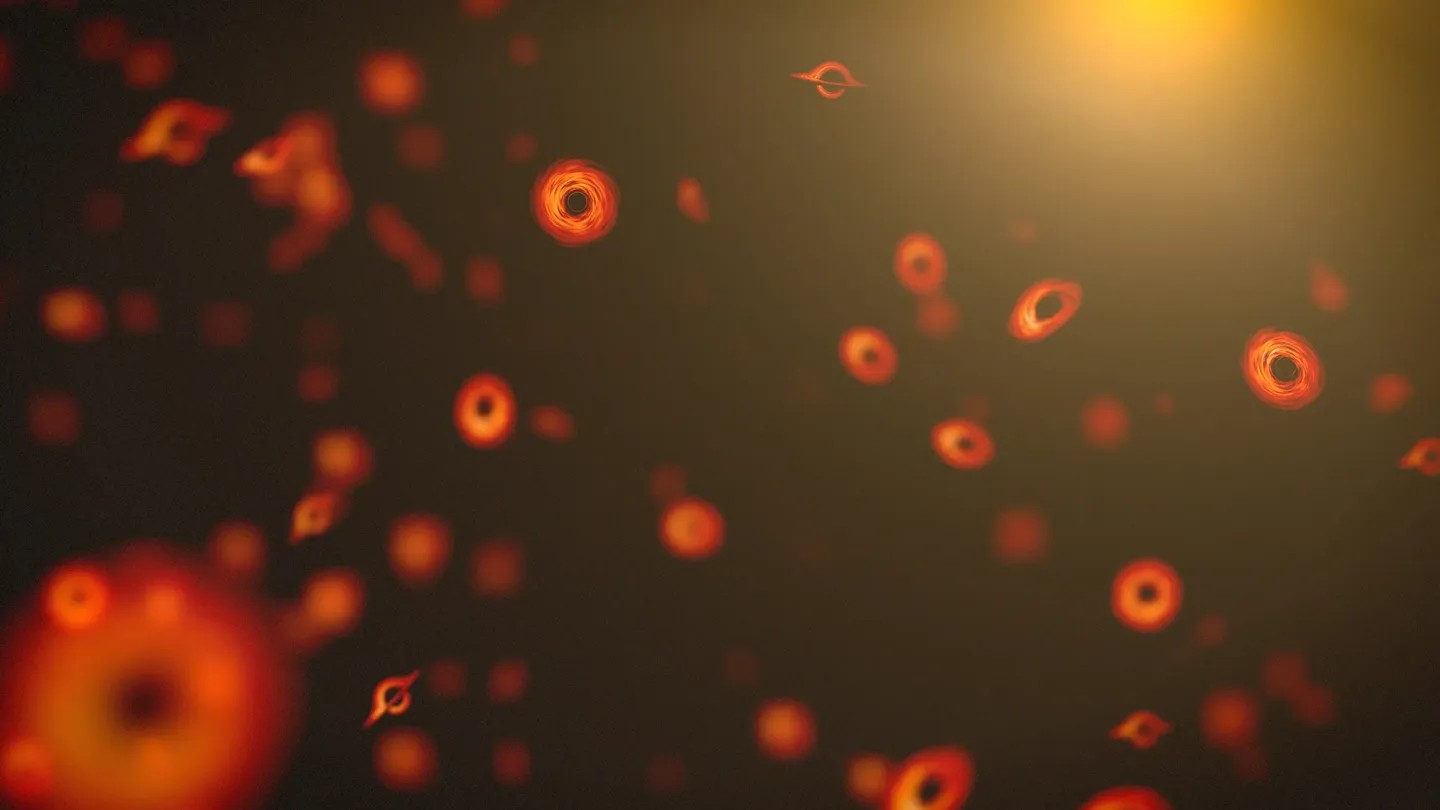
Not the giant monsters sitting at the center of galaxies. These were smaller. Born from density fluctuations in the Big Bang’s fiery aftermath. Primordial black holes. They formed fractions of a second after space-time began to expand.
Stephen Hawking had an idea decades ago. Black holes aren’t just cosmic vacuums. They leak. He called it Hawking radiation. Particles pop in and out near the event horizon. If one escapes, the black hole loses a tiny bit of mass. Eventually, it runs out of fuel. It explodes.
These early black holes didn’t last long. Many evaporated quickly. But right before they died? They spat out particles. Lots of them. Including antimatter. Or maybe. Mostly matter.
Here is the twist.
When a black hole explodes, it creates shock waves in the surrounding plasma. Shock waves cause sudden spikes in pressure and density. In this chaotic soup, physics gets weird. The explosions might have favored the production of matter over antimatter. Just a slight edge. One percent. Or even less. But in a universe that started with equal amounts, that slight edge is all it took to survive the annihilation event.
A Messy Solution
Usually, theories try to fix the asymmetry by tweaking the rules of particle physics. New forces. Heavy neutrinos. Elegant mathematical fixes.
This new approach is… messy. It relies on astrophysics. On gravity. On things exploding violently. It suggests that the reason you exist is because some tiny black hole blew up near the dawn of time and left an imbalance in its wake.
Does that sound less clean? Maybe. But is it effective? Potentially.
The theory solves another problem too. Dark matter. If some of these black holes survived. If they were heavy enough. They could be the dark matter we can’t see.
So we are leftovers?
There is a humility to the idea. We aren’t special. We are debris. Survivors of a chaotic cleanup job. The universe didn’t plan for us to be here. It just got lucky with gravity.
The evidence? We can’t go back and film the Big Bang. We have to look for the fingerprints. Gravitational waves. Gamma-ray bursts. Anomalies in the cosmic background. It will take time. Decades, maybe.
For now. It is a compelling guess. A wild card played on the table. Black holes weren’t just eating space. They were feeding matter into a world that would eventually host you. Me. This magazine article.
Who knew the answer was so destructive?