It’s not magic. It’s biology.
Ninety percent of us favor the right hand. In every culture. Across every corner of the globe. You’d think it would vary a bit. It doesn’t.
Thomas Püschel at the University of Oxford led a study to find out why. He worked with colleagues at the University of Reading. They wanted to crack the code on lateralization. Most primates don’t do this. Some monkeys have weak preferences. Maybe. Humans are stubborn about it. Ambidexterity is rare. Weirdly so.
Is it an evolutionary fluke? Probably not.
The team looked at data from 2,025 individual animals. Monkeys. Apes. Us. Forty-one species total.
They ran Bayesian models. These account for family trees. Evolution matters. They tested everything. Diet. Habitat. Body mass. Social groups. Tool use. Nothing explained the human outlier.
Until they added two variables.
Brain size. And arm-to-leg ratio. That ratio marks bipedalism. Walking upright.
Add those factors and the anomaly vanishes.
Suddenly humans fit the pattern. We stop looking weird.
The researchers projected back in time. What did our ancestors look like?
Early on it was soft. Ardipithecus. Australopithecus. Their grip was loose. Like modern apes. No strong side preference. Just mild.
Then came Homo. The shift happened hard.
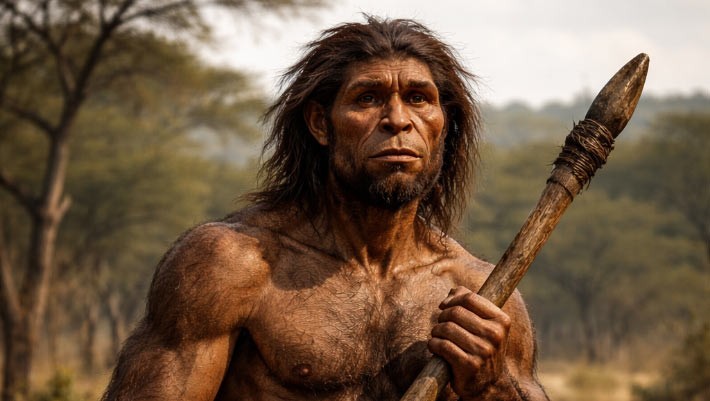
Homo ergaster. Homo erectus. Neanderthals. The right-hand bias hardened. By the time you reach Homo sapiens it is extreme. Almost universal.
Except for one guy.
Homo floresiensis. The “Hobbit” from Indonesia. Small brain. Short legs. Climbers and walkers mixed. His predicted handedness? Weak. Right again. It matches the model perfectly.
The story seems to be a two-step process. First you stand up. Hands are freed. Locomotion is over for the fingers. Fine motor skills need a home. One side takes the lead.
Then the brain grows. Reorganizes. The bias locks in. Becomes rigid.
This isn’t just guesswork. It’s the first study to put these major hypotheses into one framework.
“We can begin to understand which aspects… are ancient and shared and which are uniquely human,” Püschel noted.
Walking upright changed everything. The large brain cemented it. We are the sum of those choices. Or accidents.