What is the oldest weapon in the world right now?
We tend to associate violence with the noise of gunshots or the cold glint of missiles. But long before those existed, early humans were crafting tools designed for harm. Archaeological records stretch back hundreds of thousands of years, yet the title for “oldest” remains a tight race between a few contenders.
It depends on what you define as a weapon. Is a sharp stick enough? Or do you need a specialized object with clear intent?
How to identify the oldest weapons
Context matters. You can’t just dig up a sharp rock and declare it the world’s oldest killing machine. As Rolf Warming points out, experts look for proof. Did the tool cut meat? Were there wear patterns consistent with thrusting into flesh or hiding grasses? Residue, bone fragments, and specific craftsmanship tell the story that blunt objects alone cannot.
Most specialists settle on three key artifacts when answering “which is the oldest weapon?”
- The Clacton Spear
- The Schöningen Spears
- The Kathu Pan 1 points
Each one offers a different window into the evolutionary timeline of human aggression and cooperation.
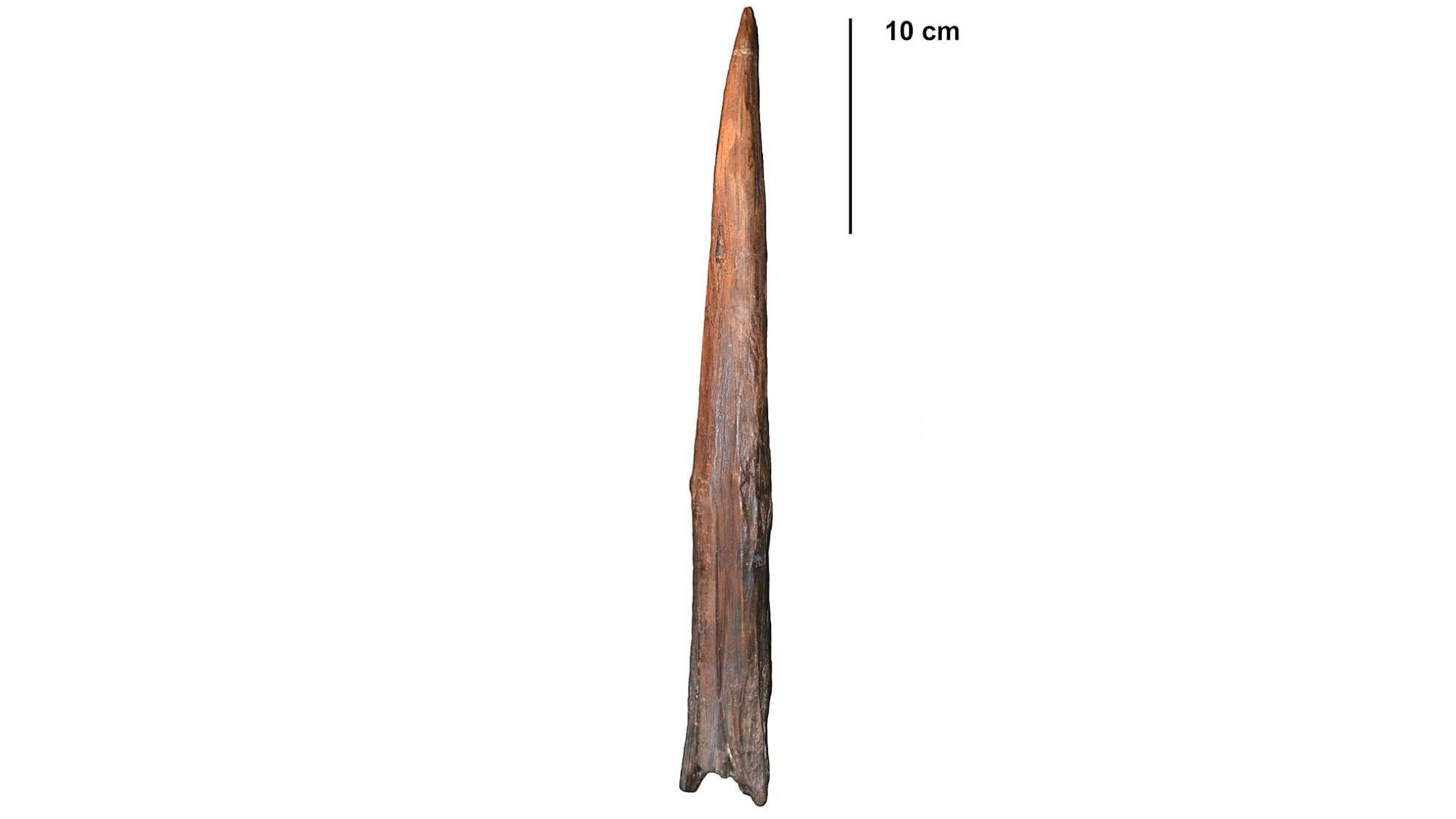
Oldest preserved wooden weapon: Clacton
Here’s a technical term you need: yew. The wood of the spear is made from a yew branch. It is dense, tough, and incredibly durable.
That durability helped it survive. Found in 1911 at Clacton-on-Sea, Essex, England, this 15-inch spike dates back over 400,00 years. It predates modern Homo sapiens by a comfortable margin.
Who made it? Probably Homo heidelbergensis or an early Neanderthal relative. Both groups existed before us and shared a common ancestor. They were big-brained, sturdy, and likely hunted together.
The spear isn’t complete. It broke. The handle is long gone. Whether the shaft snapped during a hunt or was snapped as some ancient ritual is a mystery. What we do know is the tip. It was deliberately shaped. The other end of the point wasn’t broken by accident—it looks worked. This was a thrusting weapon. A predator. A protector.
Clacton is generally considered the safest answer for the oldest known weapon due to the clarity of the context. — Rolf Warming
Today, you can see the fragment in London’s Natural History Museum. It sits behind glass, quiet and simple, yet older than anything else in human history that we can point to and say definitively: this was for killing.
The oldest completely preserved weapons
If you think Clacton is old, wait for these.
Buried in a sandy pit in Schöningen, Germany. Since 1992, workers there have uncovered a trove of wooden items. Between 20 and 23 artifacts in total. Spears. Throwing sticks. Some complete. Some shards. They’re mostly spruce and pine.
Why is this important? Organic matter usually rots away. It doesn’t just vanish. But here? No rain. No microbes. Just perfect conditions.
The Schöningen weapons are dated between 300,00 and 400,30 years. While older dating puts them firmly with H. heidelbergensis, some researchers suggest Neanderthals could be responsible given recent finds in similar contexts.
They’re sophisticated. That’s the key word. The tips are tapered. They are fire-hardened. Blackened. Sharpened until they gleamed.
Scientists estimate these hunters targeted large mammals. Horses, specifically. Butchery marks on horse bones found near the spear sites prove they ate their catch. But the size of these weapons suggests something more strategic. They weren’t just running at a horse. They were likely using throwing sticks for distance.
Imagine it. You have a heavy thrusting spear for when they get close. And you have a lighter throwing stick to knock the legs out from under a running beast. It’s a two-step kill chain. A hunting tactic that requires communication, planning, and shared language.
This isn’t just tool use. It’s advanced social cognition. You cannot coordinate a ambush hunt if everyone is thinking on their own timeline.
Oldest stone weapon points: Kathu Pan 1
Some argue we’re looking too hard at wood. Stone lasts longer. It stays.
Enter South Africa. The Kathu Pan site. Here, excavators found stone points that look eerily similar to arrowheads or spear tips you might use today. The base is shaped. There is wear on the edges consistent with hafting. Binding it to a shaft. Making it deadly from further away.
But these aren’t recent.
The points date to roughly 500,00. That beats both Neanderthals and the oldest H. sapiens fossils. This pushes the origin of projectile hunting technology further back in the deep past than previously thought.
Not everyone agrees. The skeptics point to the missing links. No wood was found attached to these stone tips. Could they just have been stone flakes used for butchery? A different shape for a different purpose? It’s a valid point. Without the handle, we are guessing at intent based on form alone.
But the wear patterns tell a story. And the context tells another. Many experts believe these H. heidelbergensis folks used these as ambush weapons. Wait. Watch. Strike.
Why this distinction matters
Why do we care so much about which spear came first?
Is it a competition? Sure. Humans love rankings. But it’s about us. It’s about where we come from.
These aren’t just cold artifacts. They represent imagination. Material knowledge. You have to know where the right wood grows. You have to know how fire changes its structure. You have to know how to sharpen rock. You have to share that knowledge.
Weapons are a mirror. They reflect our cooperative abilities just as sharply as they reflect our violent potential.
When you hold the Clacton spear in your mind’s eye, you aren’t holding a dead thing. You’re holding 400,0 years of human history. You are touching the lineage that led directly to you.
Final thoughts on ancient tools of war
So, which is it? Is it the spear in Essex? Or the points in Africa?
It’s messy. Archaeology rarely offers a clean, single-line answer wrapped in a bow. The oldest weapon is not a static object. It is an idea that evolved over millennia. Wood rots. Stone chips. Memory fades.
But the urge remains.
These things were shaped in dynamically sophisticated ways. They required deep material knowledge. — Ben Fitzhugh
Next time you pick up a rock, look at its weight. Look at its edge. Then put it down.
We have a quiz on the site about other weapons. Try it if you want to see how well you recognize these tools. Just remember. Every one of them started with an idea. A terrible, brilliant, human idea.