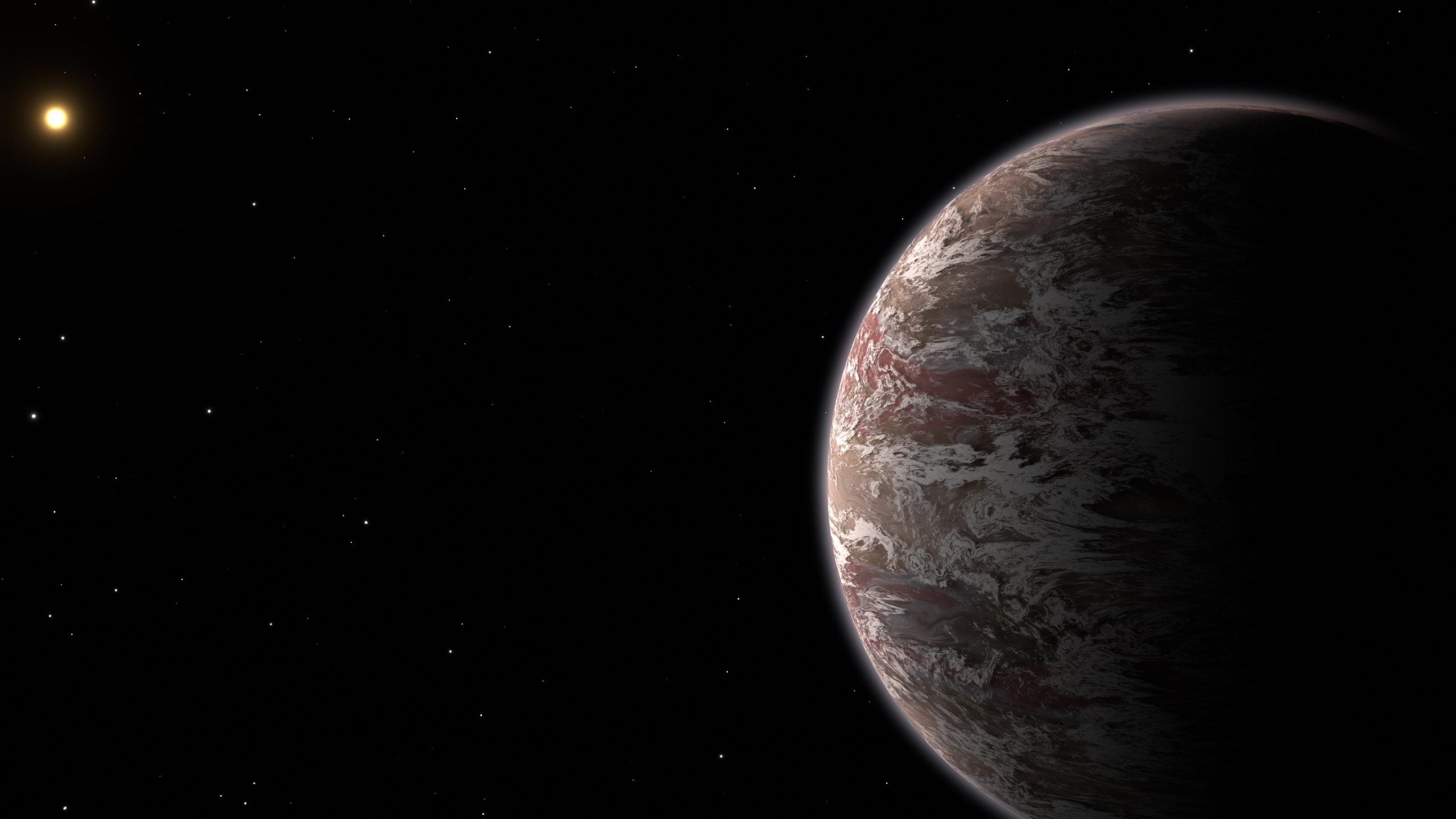
A recent study using the James Webb Space Telescope (JWST) has revealed a surprising feature in the atmosphere of a distant gas giant: thick clouds made of water ice. This discovery, centered on the exoplanet Epsilon Indi Ab, suggests that the atmospheres of “Jupiter-like” worlds are far more complex than current scientific models predict.
A “Super-Jupiter” with a Surprising Composition
Epsilon Indi Ab is a massive gas giant, roughly 7.6 times the mass of Jupiter, though it maintains a similar diameter to our solar system’s largest planet. Located in the constellation Indus, it orbits its host star at a distance about four times greater than Jupiter’s distance from the Sun.
Despite its massive size, the planet is relatively cold. With temperatures estimated between -70°C and +20°C (-100°F to 68°F), it is a “cold giant.” It remains warmer than Jupiter only because it is still shedding residual heat from its initial formation billions of years ago.
The Mystery of the Missing Ammonia
To understand the planet’s makeup, researchers led by Elisabeth Matthews at the Max Planck Institute for Astronomy (MPIA) used the JWST’s Mid-Infrared Instrument (MIRI). By using a coronagraph to block the blinding light of the host star, they were able to isolate and study the faint light reflecting off the planet itself.
The team focused on detecting ammonia, a gas that typically dominates the upper atmospheres of gas giants like Jupiter. However, the data revealed a discrepancy:
– The Expectation: High levels of detectable ammonia gas.
– The Reality: Significantly less ammonia than predicted.
The most plausible explanation for this “missing” ammonia is the presence of thick, uneven water-ice clouds —resembling Earth’s high-altitude cirrus clouds—which appear to be masking the chemical signatures beneath them.
Why This Discovery Matters: Challenging the Models
This finding highlights a critical gap in modern astrophysics. Currently, many computer models used to simulate exoplanet atmospheres omit cloud layers because they are mathematically difficult to simulate.
“What once seemed impossible to detect is now within reach,” says co-author James Mang. “This reveals new layers of complexity that our models are now beginning to capture.”
By proving that clouds play a major role in these distant worlds, the study forces astronomers to refine their simulations. If we cannot accurately model a Jupiter-like planet, we cannot hope to accurately model an Earth-like one.
The Road to Finding Life
While Epsilon Indi Ab is not a candidate for life, the techniques used to study it are foundational. The progression of exoplanet research follows a specific trajectory:
1. Discovery (1995–2022): Finding planets via indirect methods (mass and size).
2. Characterization (Current JWST Era): Analyzing atmospheric composition and structure.
3. Biosignature Detection (Future): Searching for signs of life on Earth-like planets.
The ability to directly image cold, distant planets is a vital stepping stone. As researchers refine these methods, they are building the toolkit necessary to eventually detect the subtle chemical signatures of life on much smaller, rocky worlds.
Conclusion
The discovery of water-ice clouds on Epsilon Indi Ab proves that even “standard” gas giants possess unexpected atmospheric complexities. This finding pushes scientists to improve their planetary models, paving the way for the eventual search for habitable, Earth-like worlds.