Has the answer to life’s origin been hiding inside your cells?
They’re there right now.
Tiny dots. Mysterious speckles floating around in the nucleus. You need a microscope to spot them, and even then they’re hard to track. Some sit still. Others drift as if caught in a silent, invisible current.
They look solid. They’re actually liquid.
We only realized these blobs existed in 2009. We’ve learned a lot since then. They do so many things for us. When they malfunction, it’s often catastrophic. Those sticky droplets in the brain might even be behind Alzheimer’s disease. They’re tiny, yes. But you’d be dead without them.
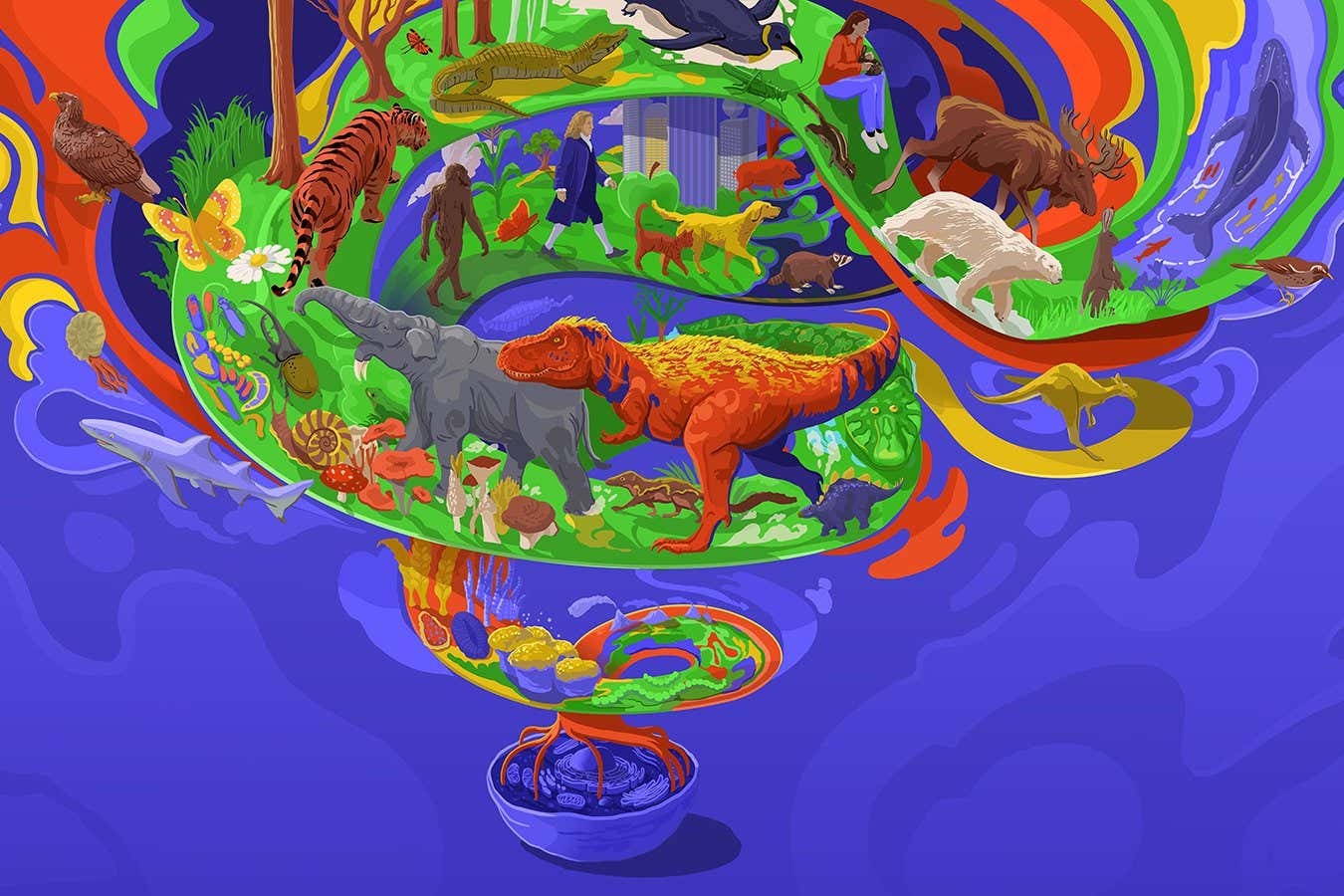
Some researchers think these blobs explain how life started on Earth at all. If that holds up, every time your cells divide, they’re running software from the first few billion years of planetary history.
Coacervate or condensate?
Depending on who you ask, the dots are coacervates (koh-AH-ser-vats) or condensates. Or biomolecular condensates. The names don’t match perfectly, but the gap between them is semantic. If it’s in a test tube, it’s a coacervate. Inside a living cell? It’s a condensate.
“Fundamentally, they are the same.” — Evan Spruijt, Radboud University
Back in the late 1800s and early 1900s, scientists loved things that weren’t quite solids or liquids. Gels. Liquid crystals. Coacervations fit the bill. They are liquid, sure. But they hold together with a stubbornness usually reserved for solids.
Hendrik Bungenberg de Jong and chemist Hugo Kruyt named them in 1929. They were looking at unmixing phenomena. Two liquids mixing, then splitting apart.
Oil and water are the obvious example. You stir them hard, they blend. Let them sit. They separate. First, tiny drops. Then, a heavy layer.
Coacervation is subtler. Long-chain molecules like proteins or fats in water clump into spheres. They stay round because they stay fluid. Unlike oil in water—which is 100 percent oil—these droplets trap water inside them.
The real trick is the lack of structure. Living cells have neat, double-layered lipid membranes. Precise. Orderly.
Coacervates have nothing like that. Biophysicist Dora Tang compares them to overcooked spaghetti. Strands tangling and sticking. There is a surface, sure—a place where the blob pushes back against the water. But there’s no skin. No true wall.
The old ghost theory
One hundred years ago, Alexander Oparin had an idea.
He was in the USSR. Working alongside biologist J. B. S. In his 1936 book The Origin of Life on Earth, Oparin looked back to a new, young planet. He pictured early oceans. Chemicalls mixed with mineral fragments. Chaos.
A gigantic, chaotic chemical factory.
As simpler compounds linked into complex ones—proteins, nucleic acids—the soup thickened. Some molecules separated from the mix. They formed droplets.
Oparin argued these coacervates were the ancestors of cells. Crude, unstable, but functional. First drafts of life.
Then biology moved on.
Nobody found these droplets in modern organisms. The logic seemed sound: if we don’t use them today, why assume ancient Earth used them to start things?
The molecular revolution of the 1950 changed everything else anyway. Researchers fixated on DNA. On RNA. The “RNA world” hypothesis suggested the first life forms were just genetic code floating around. No proteins needed. No blobs.
Membranes got their moment too. Vesicles—tiny lipid sacs—seemed like better candidates for the first cells. Coacervation became a historical footnote. A curiosity.
The comeback
That changed in 2009.
Anthony Hyman at the Max Plan Institute looked at P granules. Bits of stuff inside cells related to sexual reproduction. Everyone thought they were solid. Granules.
Hyman proved they behaved like liquid.
Two years later, other labs found more. Dozens of proteins formed liquid droplets inside cells. These condensates aren’t rare. They are everywhere.
Take the nucleolus in your nucleus. That dense cluster isn’t solid machinery. It is a dense packing of coacervates making ribosomes.
This matters because bad blobs cause real sickness.
Transplant hearts often fail because of them. When organs chill during transport, proteins form droplets. Those droplets trigger stress receptors. Cells die. Inflammation spikes. Last year, a study showed a simple drug blocking those coacervates kept hearts healthy longer.
Disease drivers
We used to think coacervates were passive. Wrong.
They influence cancer. They help turn on tumor-promoting genes. They determine if a cancer drug will work or fail.
And the Alzheimer’s connection? It keeps growing. Amyloid and tau proteins clump in brains, creating plaques linked to dementia symptoms. Studies now suggest amyloid proteins form coacervates first. The liquid state drives the hard, deadly clumps.
This explosion of health data revived an old question: could these blobs also be the answer to our beginning?
Do they really form on their own?
Which biological molecules can assemble like this?
Easy chemistry, ancient times
“We found it’s trivially easy.” — Claudia Bonfio, Cambridge
Making vesicles takes effort. Fiddly chemistry. Membranes are tricky.
Making coacervates? Simple.
The catch was scale. Long chains—proteins, big nucleic acids—form these blobs easily. But the early Earth? Probably short, fragmented, simple.
Or so we thought.
In 2021 Evan Spruijt built a miniature protein. Only four amino acids. Still formed coacervates easily.
Then he used a tiny peptide, oligoarginine. It teamed up with almost any small molecule to create a blob.
So even with the primitive soup available back then—simple, fragmented chains—the building blocks had a built-in mechanism for self-assembly. It happened fast. Probably as soon as molecules started connecting at all.
From blobs to bodies
Okay. We have an empty shell. Now what?
Back to Oparin. Back to 1920. The point of a compartment is concentration.
Outside, chemicals dilute into vast oceans. Inside? Dense. Crowded. Neighbors bump constantly. This forces reactions to happen that never would in the open soup. Different coacervates pull in different molecules. The environment shifts. Complexity grows. Life follows complexity.
It happens today in our bodies.
Iron compounds like ferricyanide —plausible in early oceans—can drive amino acids together. They stitch the building blocks into protein chains.
Enzyme speeds jump three times when they move from general water into coacervates. Last spring, researchers analyzed the data and declared them “active participants” not “passive boxes”
The chemistry works. The catch? We still don’t understand the rules.
Some molecules rush in. Some get ignored. Coacervates sometimes speed reactions up. Other times, the viscous interior slows molecules to a crawl. Dead ends happen. Boekhoven calls the physics chaotic. All over the map.
Simulating evolution
Researchers want to see more. Full systems. Genes. Metabolism. Not just random clumping.
Dora Tang packed some RNAs inside protein droplets. The RNA accumulated. She mixed RNAs with proteins and saw enzymes keep working. Functional genetic material, stored inside.
Claudia Bonfio tries the same trick. Can one molecule build a house and serve as a library inside that house?
Probably not yet. The system can store code, sure. It doesn’t necessarily replicate the code.
Can they divide though? That is the bigger challenge.
Real cells eat and split. Coacervates cannot.
Or could they? A theoretical paper in 2016 said they could, if given outside energy.
“I like to build.”
Job Boekhoven read that paper and started engineering. Four years later, his team proved the math was real. He fed them chemicals (EDC). They grew. Take away the food? They died. As they withered, they shattered. Like mother cells birthing daughters.
Spruijt saw growth from carbon fuel. Tang watched heated pores in rock force blobs to split and form internal layers. Even true membranes can push themselves inside.