It moves too fast to watch.
“If you don’t run from it and try to face it, it devours you.”
That’s Ecologio Cabrera, 86. He stood in a sports hall in Vilamanta, miles from his home west of Madrid, watching his life shrink to whatever he could carry. He and his neighbors used garden hoses. Firefighters arrived. They ordered everyone out. The water meant nothing.
The fires in southern Europe aren’t just bad. They are breaking systems.
What is happening in Madrid right now
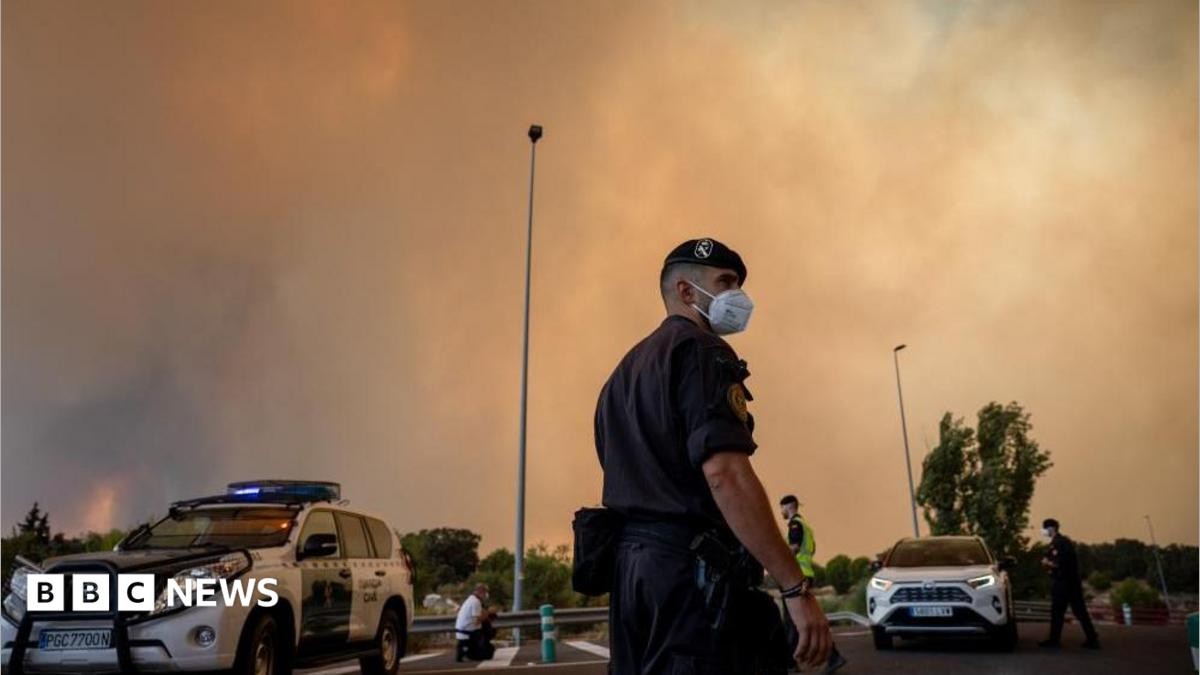
Three separate blazes west of Madrid merged. Now they are one massive front. It is “beyond capacity” for the firefighters on the ground, according to Carlos Novillo, Madrid’s emergency management chief. You cannot attack a fire that big in that terrain. You defend. You hold the line. Or you run.
Spanish officials have declared a national emergency.
- 25,000 people ordered to evacuate immediately.
- 40,000 people told to stay indoors.
- The fire is heading toward Robledo de Chavela and Fresnedilla de la Olivia, roughly 50 kilometers from the capital.
Madrid’s president, Isabel Díaz Ayuso, called it the “worst fire in the history of the regions.” She cited a perfect storm. High temps. Relentless wind. Multiple fronts merging. Prime Minister Pedro Sánchez visits the coordination center on Saturday. He urged citizens to be careful on Friday. People are living through something dramatic.
One suspect has been arrested. Another is under investigation. The Burgohondo fire may have started from negligence involving heavy machinery. The restrictions were in place. Someone ignored them. Or maybe they didn’t. We don’t know yet.
Why the evacuation numbers in France are so high
Switch to southwest France. The numbers are staggering.
Around 200,000 people have been evacuated in the Gironde and Landes. That is not a typo. It is a quarter of a million people fleeing for their lives.
The Gironde blaze burned through 19,000 hectares of forest. Eighty homes are gone. Entire towns near Bordeaux—Saint-Médard-en-Jalles, Saint-Aubin-de-Médoc, and two others—were evacuated pre-emptively. Fifty-eight thousand residents left on Saturday morning. As a precaution. Because the wind changes. And when the wind changes, the fire jumps.
Cap Ferret, that long thin peninsula, was emptied. Hundreds escaped by boat. The population there is usually 8,000. In summer? Eighty thousand. The infrastructure wasn’t built for this speed.
Interior Minister Laurent Nuñez called it an “XXL fire.” He said it is self-sustaining. It generates its own weather. It changed direction on Friday evening, moving east toward Bordeaux. Fifty firefighters have been injured. They are reorganizing. Trying to stop it from swallowing the city.
President Emmanuel Macron has mobilized the military. The scale requires boots on the ground. Lots of them.
Why these fires are harder to stop
Have you ever wondered why modern wildfires burn differently than the ones in older documentaries?
It isn’t just the heat. It’s the moisture—or lack thereof.
Europe is warming at twice the global average since the 1900s. The vegetation is bone dry. It acts like kindling. A spark is still needed. Lightning. A discarded cigarette. Heavy machinery sparks. But once it catches? It runs.
The European Environment Agency says climate change has increased forest fire risk. Especially in the south.
Look at Italy. Sicily lost a firefighter this week. The fires there are fierce too.
The EU sent aircraft and helicopters. They help. They drop retardant. But the ground reality is harsher. Drought allows fires to spread at night. They don’t cool down. They don’t sleep. Marc Vermeulen, the fire chief, said conditions were worse than 2022. He’s seen bad years. This is different.
What this means for the future
We are burning more land this year than the 20-year annual average. Just look at the charts from the European Forest Fire Information System. The trend is clear. The lines go up.
“Climate change has increased forest fire risk across Europe.”
It is not a prediction anymore. It is the baseline.
Human error starts many fires. But extreme weather amplifies them. It makes containment nearly impossible. The tools we used ten years ago are inadequate now. We need different strategies. Faster evacuations. Stronger buildings. Maybe fewer people in high-risk zones?
Nobody has the answer. The smoke clears eventually. The scars remain.