Imagine playing 20 Questions. You’re trying to guess the subject. Animal? Vegetable? Or mineral?
It’s a classic setup. But for Perinereis cultrifera, a predatory bristle worm that’s been swimming the oceans for eons, the answer breaks the game. These aren’t just animal parts. They’re not minerals either. They’re something else entirely.
And that distinction matters.
Scientists are now calling these jaws “bio-metals.” It’s not just a poetic nickname. It’s a proposed new category in material science. A study from TU Wien and the University of Vienna suggests we need a new word for what happens when biological structural proteins merge with metal ions to create something tougher than steel, yet flexible as sinew.
How Bio-Metals Differ From Standard Alloys
Here is the thing about terminology: “Metallike biomaterial” sounds clunky. It lacks punch. It implies a similarity but misses the substance. The researchers want to draw a line in the sand. Bio-metals aren’t just materials that look like metal. They behave like them, down to the atomic scale, but with a twist that ordinary alloys can’t replicate.
The definition hinges on hardness, strain response, and the internal dance of proteins and ions.
Previous studies hinted at this. They used phrases like “biomaterials with metallike properties.” Weak. Vague. This new research, published in Biophysics Reviews, aims to sharpen the focus. It asks: what specifically makes these jaws act like metals?
The answer lies in the tip.
The Hardness of Jaw Tips and the Nix-Gao Effect
To understand the strength, you have to measure it. Not with a hammer. With nanoindentation.
This technique pushes a microscopic probe into the material. It’s like testing the dent resistance of a car hood, but at the nanoscale. The team combined this with chemical analysis. They wanted to see exactly where the ions were hiding.
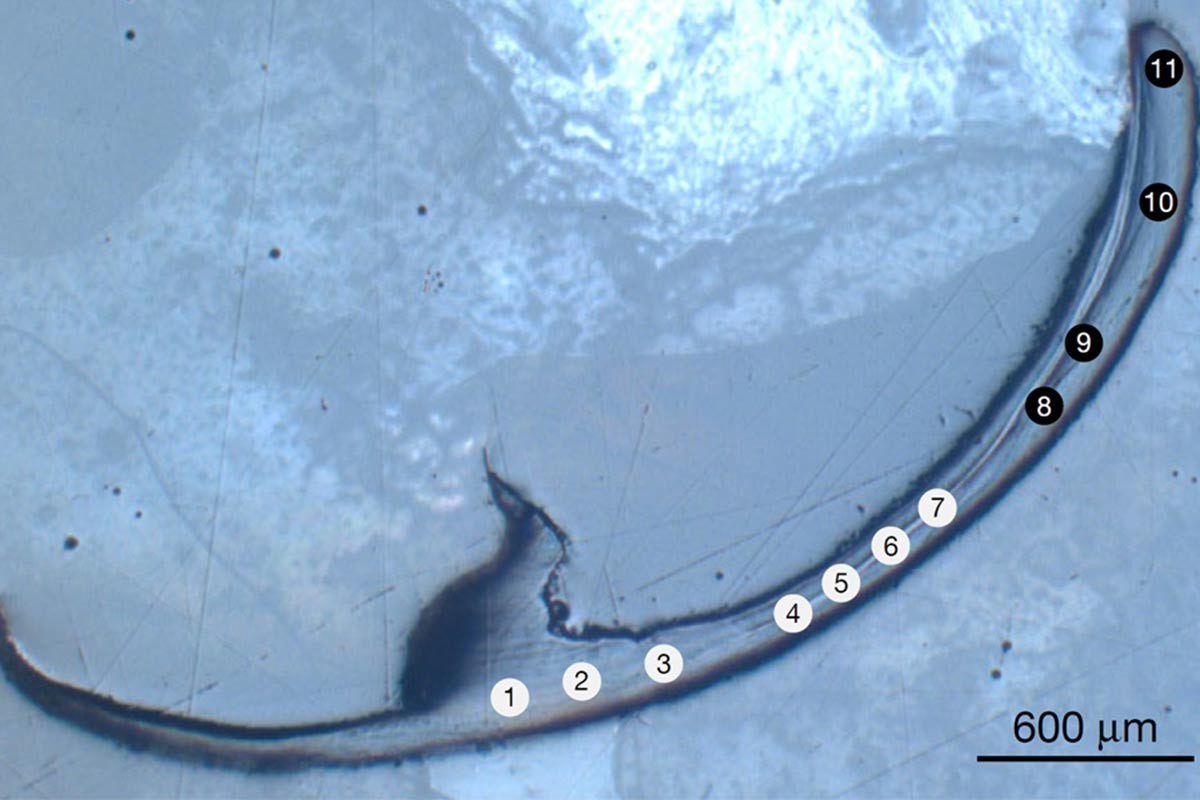
The results were predictable yet fascinating. Metal ions concentrate at the tips of the jaws. The center? Less so. This gradient makes the tips exceptionally hard. Perfect for biting. Perfect for crushing.
But here is where it gets weird.
The researchers tested the jaws at varying depths of indentation. They triggered something known as the Nix-Gao nanoindentation size effect.
You might not have heard of it. Neither did most of the general public until today. It’s a phenomenon usually seen in pure metals like copper or silver. At smaller scales, materials get harder to dent. Why? Because strain changes more sharply across tiny areas. It creates interlocking disruptions in the atomic structure. The smaller the space, the tougher the fight against deformation.
The worm’s jaws do this too. They share this mechanical trait with engineered metals.
What Makes a Bio-Metal Distinct from Copper?
Wait. If they behave like copper and silver, why invent a new term?
Because they don’t act exactly like them. There’s a difference. A critical one.
Standard crystalline metals are rigid in their elasticity. Bend copper. It bends. Release it. It snaps back. Or it stays bent if you’ve exceeded its yield point. It doesn’t care about the size of the bend, in terms of its elastic modulus.
Bristle worm jaws? They care.
“Bristle worm jaws also showed size-dependent elasticity — this is a distinguishing feature of bio-metals when compared to standard crystalline metals like Copper or Silver,” said author Christian Hellmich of TU Wien.
Let that sink in. The ability of the jaw to bend and recover changes depending on the scale you are examining. A tiny bit of the tip behaves differently than a slightly larger chunk of it. Ordinary metals don’t do this. They are uniform in their elastic response across scales (within limits). These bio-metals adapt.
The researchers used mathematical models to map this out. They tried to explain how atomic-level processes create these elastic quirks. They are just scratching the surface. Literally. The pun is intended.
Can We Engineer Our Own Bio-Metals?
So what’s the point? Why study an ancient worm?
Nature is a master engineer. It solved these problems millions of years before we invented alloys. The goal now is reverse engineering. Not just copying. Understanding.
The team plans to look at more species. Expand the database. Refine the theory. They want to know if genetic changes can tweak the material design space. Can you edit a gene to make a jaw softer? Harder? More flexible?
“If we can explore the link between genetic interventions and material design, we open up new possibilities for synthetic materials,” Hellmich suggests. The excitement isn’t just academic. It’s practical. It’s about beauty. Elegance. Refinement.
We often think of metals as industrial. Cold. Refined in furnaces. But here is a material born of biology. Hardened by ions. Shaped by evolution.
It challenges our definitions. It forces us to ask: when does an organism become a factory? And when does a biological trait become an engineering blueprint?
The answers are still forming. Like a jaw hardening at the tip.