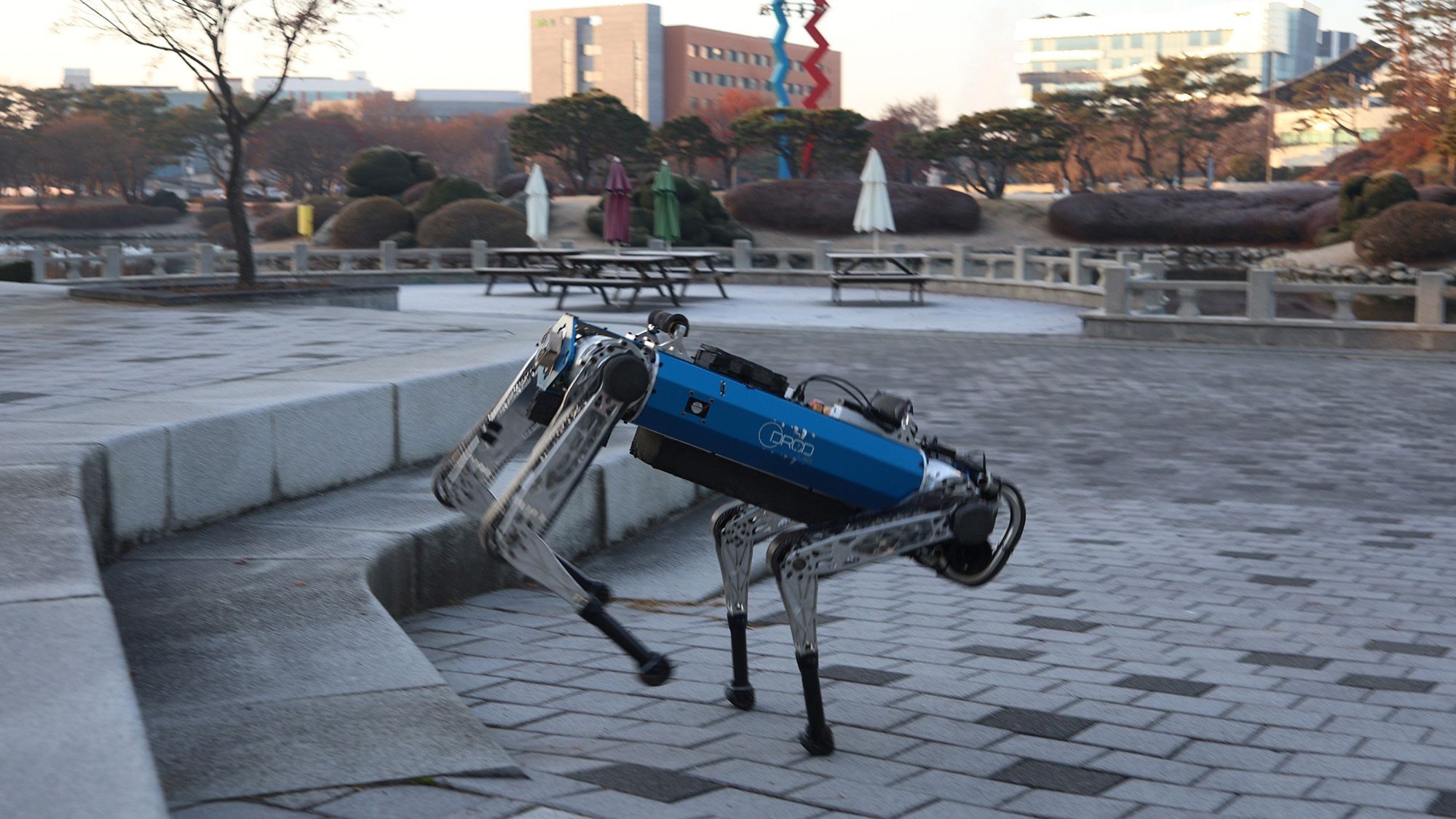
Look at the robot dog go.
It trots. Then it bounds. No human telling it what to do. It just switches.
That is the KAIST HOUND. It weighs about 45 kilograms (100 pounds) and it moves with a fluidity that used to be impossible for machines of this type. It uses cameras and lidar to look at the ground ahead. Then it picks a gait. A steady trot for the flat parts. A fast, bounding run for the gaps. It does all this in real time, adjusting its legs without asking for permission.
The researchers proved this outside. They took the bot through a university campus, about 0.7 miles of pavement. Then they sent it into the woods. A 0.2-mile trail covered in roots, logs, and slippery leaves. It handled it all. The details appeared in Science Robotics on July 15.
Why it’s hard
Animals change their walk all the time. You know how a dog slows down to trot over rough dirt, then leaps over a stick when the path clears? It feels natural.
Doing it in a robot is not natural at all. It’s tricky.
Usually, a trot and a bound are coded by totally separate systems. Switching between them creates lag. Lag means stumbling. Stumbling means the robot breaks or fails. The gap between two coding styles is where robots die.
The team needed a bridge.
The brain behind the brawn
They built something called APT-RL.
It stands for action pretrained transformer-based reinforcement learning. The name is a mouthful. The concept is simpler.
First, the AI studied a bunch of actions. A transformer model looked at the patterns across all of them. Then reinforcement learning kicked in. Trial and error. Rewards for good moves, penalties for bad ones.
But where did the data come from?
They didn’t build a real robot yet. They started in 2D. A simple computer model. They used trajectory optimization to figure out what physically works for the legs. They generated 180,0 million sequences. Short bursts of trotting and bounding. They calculated the joint forces needed. It took eight minutes to create that dataset. Fifteen hours worth of movement data. Ready in the time it takes to boil water.
Next, the AI had to learn when to use what.
The simulation threw obstacles at it. Stairs. Stepping stones. Hurdles. Gaps. Rough ground. The bot had to figure out how to select the right skill and modify it on the fly.
And here is the kicker. The simulation added depth cameras and lidar scanners. It had to “see” like the real bot would.
“The system selects appropriate gaits and adjusts movements in real time based on visual input.”
In one indoor test, the thing cleared an obstacle that was two feet high. It hit 15 kilometers an hour (about 9 mph) while doing it. It even jumped down three stairs.
Notice how it chose its moves. Lower speeds? It trotted. Uneven ground? It stayed low and careful. High speeds? Big steps? It bound.
It made the right call every time. A version of the software restricted to only trotting failed often. So did the version forced to only bound. The hybrid? Consistent.
Is this just a trick?
No. The robot learned behaviors it was never explicitly taught. Like jumping over a log. The original training data was flat. The log wasn’t in the plan. But the AI figured it out because the training wasn’t just copying—it was understanding terrain in three dimensions.
It corrects itself.
It adapts.
This is the kind of thing that changes what these machines can actually do outside a lab. No more flat floors required.
Will you see one delivering packages next? Maybe.
Or maybe it stays on campus for a while.