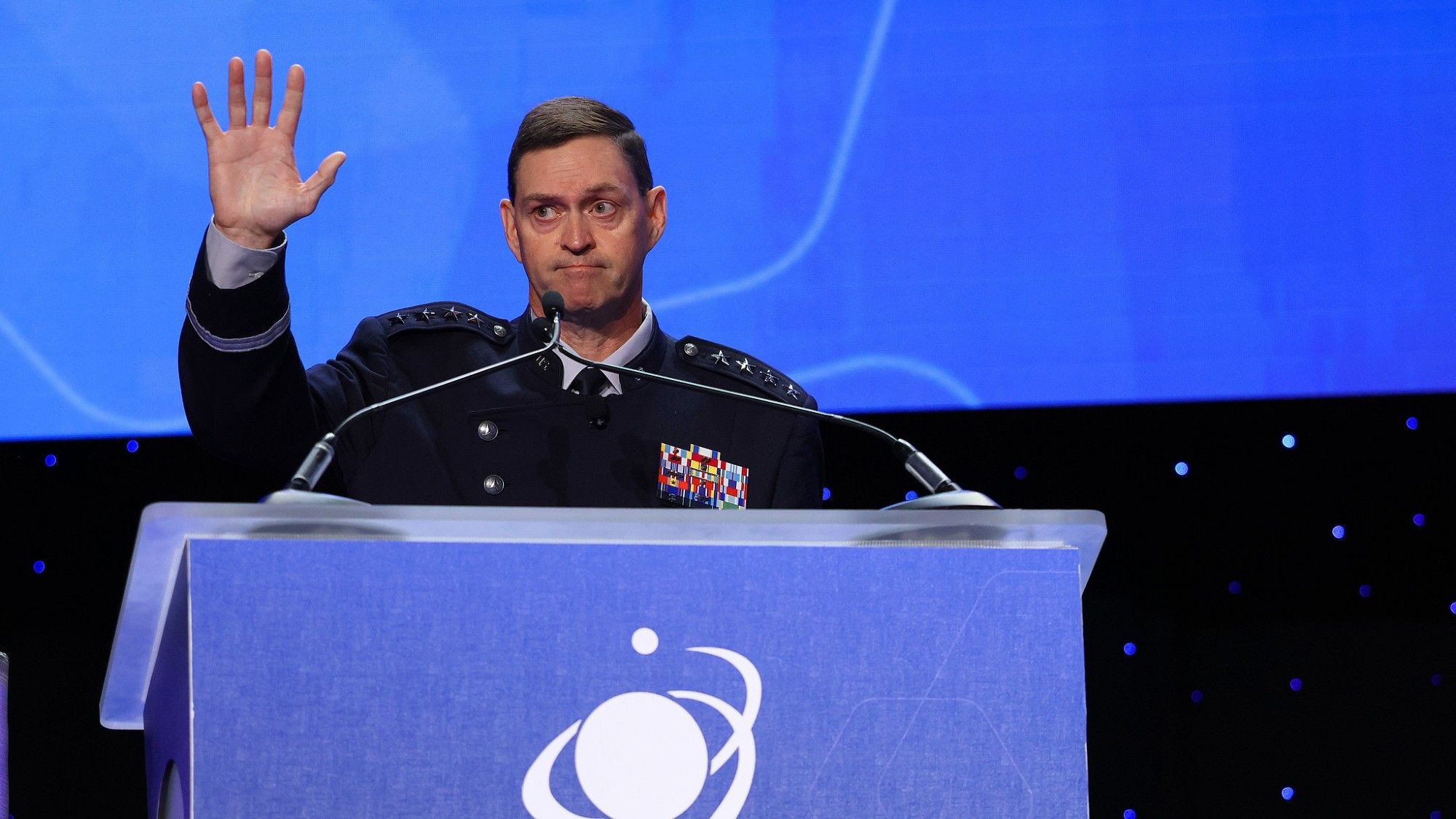
Gen. Chance Saltzman didn’t sugarcoat things. His final public remarks as the U.S. Space Force Chief of Space Operations landed like a stone in a quiet pond.
At the 2026 Global Air Space Chiefs Conference, he dropped a hard truth on military leaders from around the world: if war spills into space, everyone is in the kill box.
“No military or nation in the world will be sparing,” he said.
It sounds dramatic. It’s not. It’s orbital mechanics.
You can dodge bullets on the ground. You can run from tanks. You can even hide from aircraft. But orbit? It doesn’t care about your politics. It doesn’t care if you’re neutral. The physics of low Earth orbit force all satellites and space capabilities into the same chaotic traffic jam.
“If a conflict extends into space… we will not be able to steer clear,” Saltzman warned.
The math is brutal. There isn’t enough room in orbit for unlimited expansion. We’ve packed key orbital inclinations with thousands of active satellites. Add debris from a single explosion, and the dominoes start falling.
Remember 2022? When Russia tested an anti-satellite missile and shattered one of their own satellites? That wasn’t just a test. It left a permanent scar in space. A debris field that persists today.
The International Space Station has had to maneuver away from it. Multiple times.
One destroyed satellite could trigger a cascade effect. Kessler Syndrome. The debris from one impact hits another, which hits another. Suddenly, parts of Earth’s orbit become unusable for generations. We’re talking about blinding ourselves from the sky.
But Saltzman wasn’t just shouting warnings for no reason.
He’s been pushing a counter-narrative for years: cooperation is our only shield.
“We will share the consequences,” he said in that July 15 speech. “Therefore, we should share the responsibility.”
Think about it. If war makes space uninhabitable for all of us, deterrence only works if everyone believes in the cost. A fractured approach invites disaster. A unified front? That’s stability.
He called defending space “the ultimate team sport” back in 2025 during the launch of the International Partnership Strategy. The domain is simply too vast, too fast, and too tangled for the U.S. to police alone. Or for any single nation to dominate.
That’s why the Space Force had to change.
When Saltzman took over as the second CSO in 2022, the branch was still finding its footing. Fast forward to today, and he’s declaring it “combat-credible.”
This isn’t just talk.
Earlier this year, at the Space Symposium in Colorado Springs, Saltzman highlighted real-world operations. Not theory. Not tabletop exercises.
“Guardians who deliver them,” he noted. Real effects. Real operations. The shift from planning to executing is complete.
Now, as he prepares to retire in August 20226, the baton passes to someone with deep operational experience.
Lt. Gen. Douglas A. Schiass is the pick.
Nominated by President Donald Trump, Schiess takes the role of Chief of Space Operations. He’s known his way around the machinery since November 20225, when he stepped in as Deputy Chief of Space Operations for Operations.
The transition happens against a backdrop of growing tension.
Space is no longer a sanctuary. It’s a domain. A contested one.
Saltzman’s parting shot wasn’t a plea for peace. It was a reality check.
Orbital mechanics doesn’t negotiate. It doesn’t take sides. If the lights go out up there, the darkness hits Earth just as hard as the war.
Who will keep the sky safe? That’s the question left hanging.
One thing is clear: the old ways of separating battlefield from home front are dead. The war zone has no borders.
And it’s only getting more crowded.