


Mars didn’t just get visited. It got used.
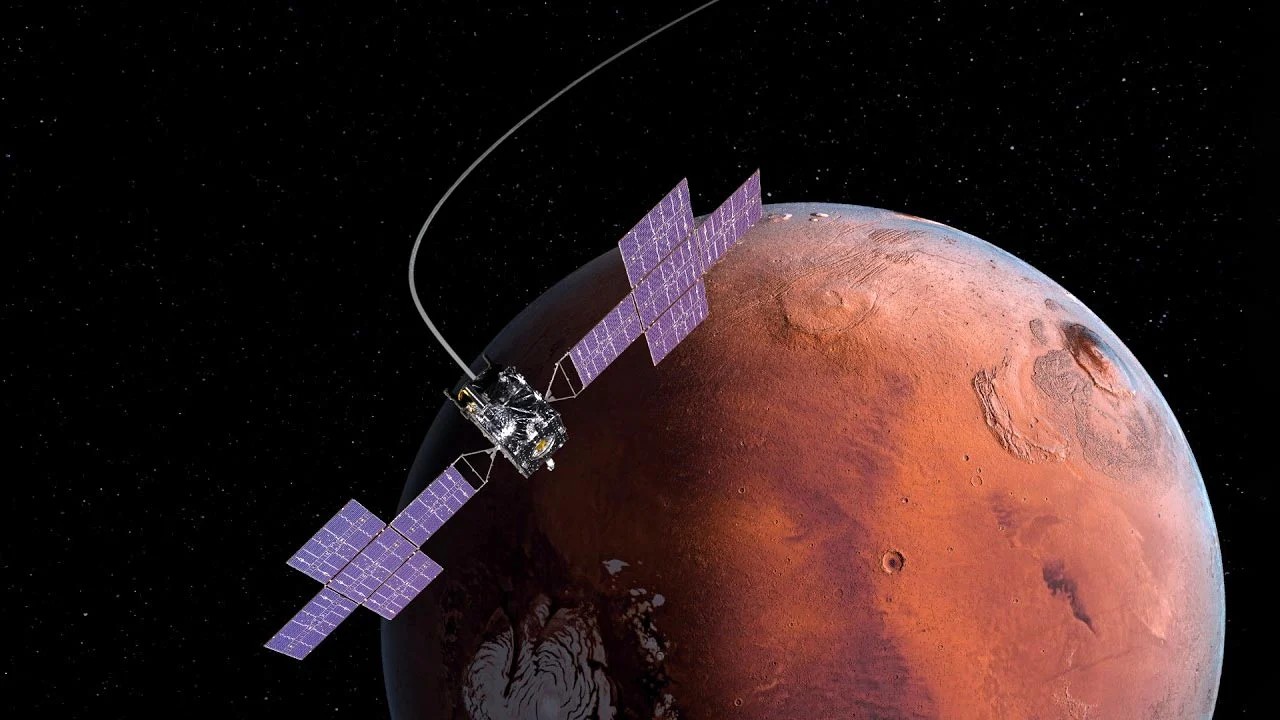
NASA’s Psyche spacecraft swung by the Red Planet on May 15. The pass was close—roughly 2,800 miles above the surface. That proximity wasn’t for sightseeing. It was a physics problem waiting to be solved. The team let Mars’ gravity grab hold, pulling the craft into a faster trajectory. No fuel burned. Just momentum. A gravitational slingshot sending the probe deeper into the solar system.
Why go there? To find out what hides inside Earth.
“Although we were confident… monitoring the DSN’s Doppler signial… was still exciting,” Don Han noted. “Mars gave the spacecraft a 1.000-mile-per-hour boost.”
Han leads navigation at JPL. The numbers check out. The orbital plane shifted by about one degree. Now Psyche heads straight for its target in the asteroid belt, between Mars and Jupiter. Arrival? Summer 2029.
Weird Angles on a Familiar Neighbor
While speeding up, Psyche turned its cameras on. Calibration duties required looking at everything. Cameras, magnetometers, spectrometers—they all fired up.
The result was strange.
Approaching from a steep angle, Mars appeared as a razor-thin crescent. Not a round disc. A sliver of light. Sunlight scattered through the dusty atmosphere, pushing the illuminated edge farther out than expected.
As the spacecraft crossed from night into day during the closest approach, it snapped thousands of photos rapidly. A blur of data.
“This dataset provides unique… opportunities for us to cal… the cameras,” said Jim Bell from Arizona State.
Bell runs the imager. He also helps with the Mastcam-Z on the Perseverance rover. Cooperation ran both ways. Mars Reconnaissance Orbiter? Curiosity? Even ESA’s ExoMars orbiter? They all pitched in with atmospheric data. It helps tune the instruments before Psyche reaches the metal asteroid.
Why trust the calibration on Mars?
Because you test the gear where you know what the subject looks like.
Before the Iron World
The magnetometers might have caught a glimpse of Mars’ bow shock—that invisible barrier where solar wind meets planetary magnetism. The gamma-ray and neutron spectromers gathered data quickly, comparing it against decades of existing observations. Old data versus new eyes.
Now the coast is clear for propulsion restart.
Solar electric thrusters will hum back to life. The long slog toward the asteroid continues. Psyche (the asteroid, not the ship) is wide—173 miles across. It’s suspected to be an exposed core. A planetesimal’s guts laid bare, left over from when planets formed billions of years ago.
Once in orbit, the craft will drop through multiple altitudes. Mapping. Measuring. Looking for secrets.
If this rock really is the core of a dead world, we can see planetary insides without drilling to the center of the Earth. A rare window into the dark.
“We can thank the Red Planet… for giving our spacecraft a… slingshot,” Lindy Elkins-Tanton said. Principal Investigator at Berkeley. “Onward.”
The Heavy Lifting
This mission didn’t just happen. It’s the 14th pick of NASA’s Discovery Program. Marshall Space Flight Center manages the portfolio. Kennedy Space Center handled the launch.
JPL runs the daily operations and engineering. They built the brain. Intuitive Machines provided the body—the chassis housing that powerful solar propulsion.
Arizona State University handles the camera ops, working with Malin Space Science System. Design. Build. Test.
All roads lead to the asteroid belt now. The flyby is done. The fuel is saved. The target is locked.
Will we recognize what we’re looking for? We won’t know for another five years.