Another ancient circle. Or at least. What might be one.
It lies beneath Machrie Moor on Arran. Covered in peat. Hidden for thousands of years. Until now.
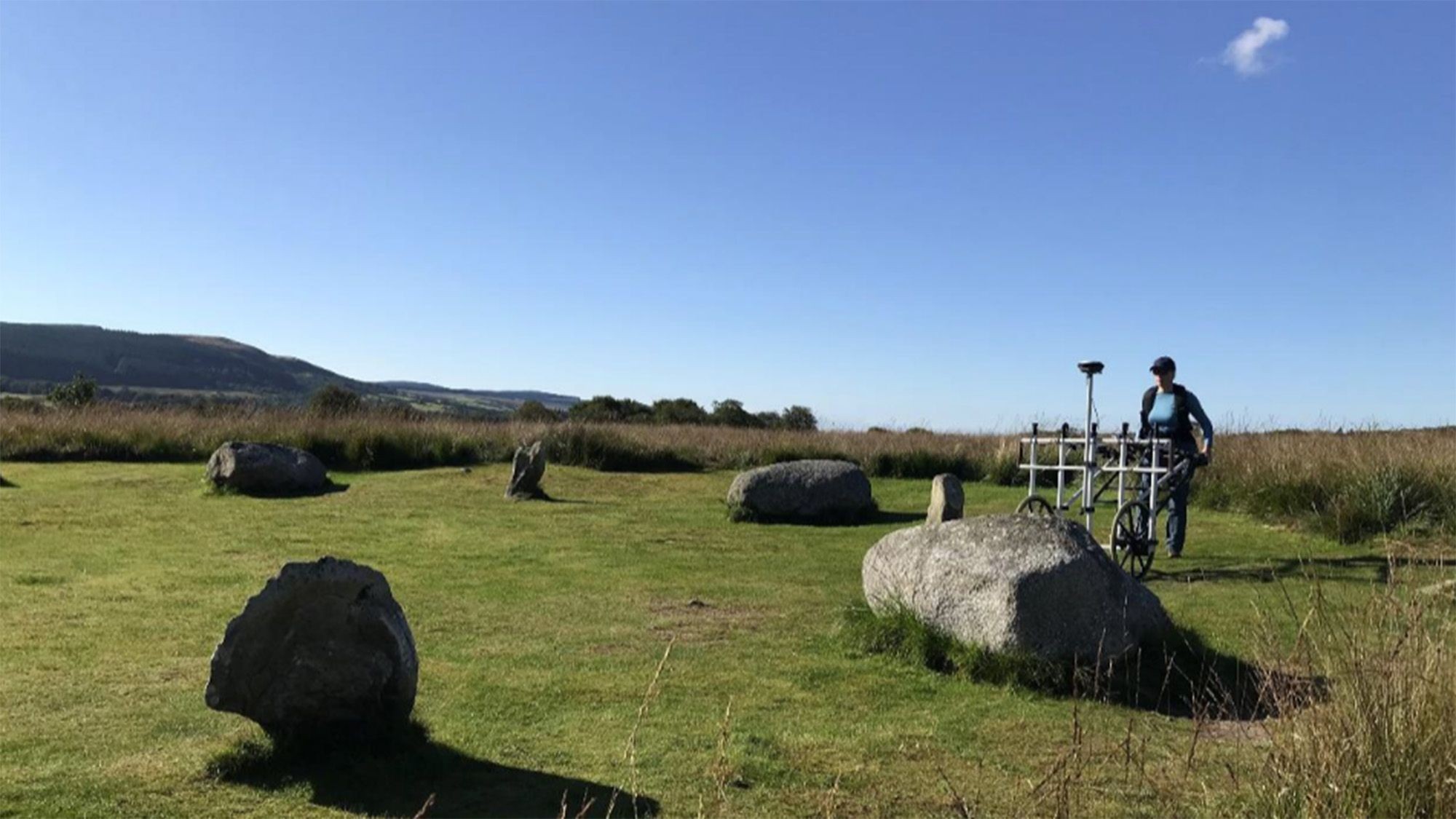
Archaeologists from Historic Environment Scotland weren’t looking for it. Specifically. They wanted to test if modern survey gear could see through boggy ground. A test. Nothing more. Then they saw something else entirely. A circle. Buried.
Seeing without digging
Geophysical scanners do the heavy lifting. Wheeled over the ground. Sensing magnetic shifts underground. No spades. No dirt flies. Just data.
Nick Hannon. Senior heritage recording manager there. He said it surprised everyone.
“The discovery of a new circle completely surprised our expectations”
Fair point. They already knew the land held secrets. Arran is famous for it. Standing stones. Burials. Ceremonial spots dating from 3500 to 1500 B.C.. Six circles found since the 80s alone. This? That’s number seven. Maybe eight. Hard to say. Not yet dug up.
Counting stones that aren’t there
Here’s the odd part. The scan shows 12 pits. Circular anomalies. Roughly 92 feet across. Spaced out like chairs in a waiting room. Two gaps are too wide though. Empty. Rotted away maybe?
If those gaps held posts once… 14 spots. Not just 12.
Timber. Or stone. Probably timber originally. Then stone later. Around 2000 B.C.. Other circles nearby proved that pattern. Wood rots. Stone stays. Humans cremated or buried inside too. Functions shifted. Life changes. Monuments change.
Which material did this ring start with? Unknown. The scan only shows holes.
There is no indication that any anomaly contains stone yet.
So. A ring of nothing. For now.
Looking up at the sky
Orientation matters. All these circles line up. Toward Machrie Glen. Specifically. The notch at its head. Where the sun rises midsummer.
Astronomy? Likely. Ceremonies tied to the light? Very possible.
It reminds people of Stonehenge. Naturally. Stonehenge gets all the fame. But it’s not special. Just one of hundreds across Europe. Neolithic and Bronze Age folks loved circles. Hundreds of them. Machrie Moor keeps some better than most.
Even known sites told new stories. Circle 2? Previously thought to have 7 or 8 stones. Now? Likely 14. We keep undercounting the past.
Who built it? We don’t know. Only that they looked at the sky. And left marks. Some marks stay. Some vanish into peat. Waiting.