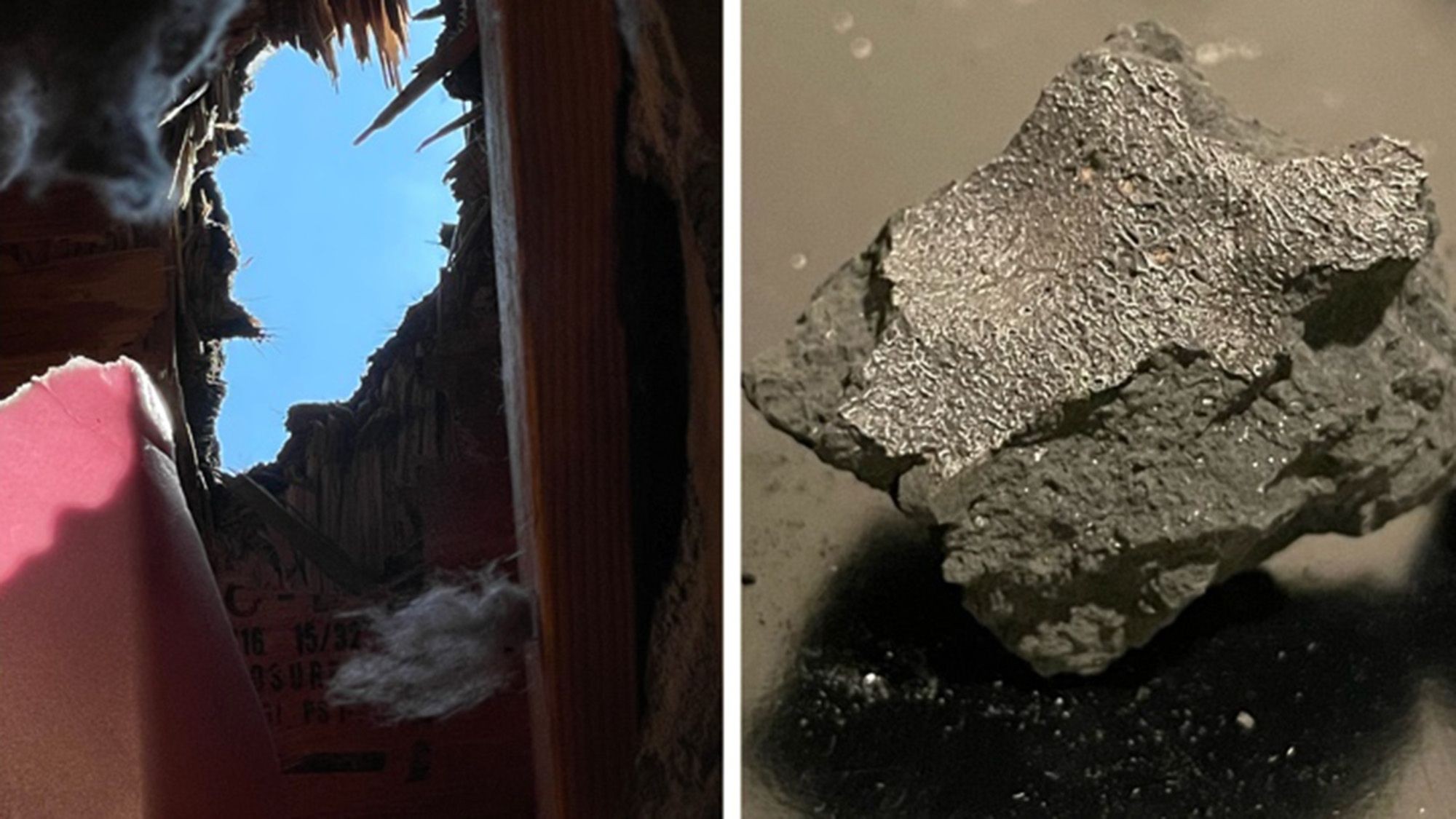
The roof didn’t just break. It shattered.
On July 16, a loud crash echoed through the Hillsborough master bedroom, leaving behind black dust, sulfur fumes, and holes in the ceiling. The homeowner didn’t panic. He acted. Gloves on. Foil out. Glass jars ready. This instinct saved history.
Two years later, we finally know why his reaction mattered.
That rock wasn’t just space junk. It carried amino acids. Carbon compounds. The actual building blocks of life, sourced from a primitive planet that never quite formed.
“A forensic study of the fragments revealed they contained preserved bits… from a small primitive asteroid where it experience concentrated salty fluids,” said lead researcher Peter Jenniskens.
Jenniskens works with SETI and NASA Ames. He wasn’t alone in marveling at this find. The team praised the Hillborough resident immediately. Without his careful collection method, the sample would be contaminated. Useless for high-end analysis. Instead, we got a time capsule from the early solar system.
What is the Hillsborough meteorite and why is it significant?
Most meteors are common stones. This one is different. It’s a carbonaceous chondrite. Specifically, Hillsborough is the second of its type ever observed in a fall where people watched it drop from the sky.
First of all, rarity strikes. But the chemistry is what really stands out. The rock is soaked in ancient brines. Salt water from billions of years ago. Scientists haven’t seen this process preserved before in protoplanet worlds. It suggests concentrated salty fluids circulated near the surface of this asteroid body. That environment is key. It creates prebiotic molecules. The kind of soup life starts swimming in.
We usually think of water on Mars or Europa. This proves it happened here, on rocky bodies that orbit our sun but aren’t quite planets.
How did scientists trace the meteorite’s path to New Jersey?
You might ask how anyone knows where a rock comes from if it explodes in mid-air. They look up.
At least 60 people across the Northeast saw it. New York. New Jersey. Others felt a shock wave. The rock tore through the atmosphere at 32,00 mph.
Then it broke.
Witness reports stopped when the meteor hit an altitude of 22 miles. Why? Because the sky cleared for a second before fragments drifted down. Newark Liberty International Airport didn’t have eyes looking up, but their radar did. Doppler systems caught pebbles raining from above.
The American Meteor Society had better luck.
Mike Hankey, their operations manager and a co-author on the Science Advances paper, pulled footage. Cameras in Northford, CT. Douglassville, PA. Even a Ring-style doorbell camera in Wayne, NJ. By stitching those angles together, they drew a line straight back to the asteroid belt. Low in it.
It answers the “where” question directly. Not the Oort cloud. Not a comet from the edge of the system. The neighborhood asteroid belt.
Which details confirm this came from an ancient protoplanet?
It’s about the salts. The textures. The organic residues.
When Jenniskens and his team looked closely, they found things usually washed away. Prebiotic molecules that suggest chemical processing. Amino acids aren’t just floating there. They are arranged. Created in an environment with water and minerals.
The homeowner found black fragments. Scientists found proof that a small world once had geology. Or at least geochemistry active enough to create brines.
Was life possible there?
We can’t say yes yet. But the ingredients are present. Carbon. Amino acids. Salty residues. It mirrors the conditions we imagine on early Earth. Only this sample never got hit by volcanoes. Tectonic plates shifting. It stayed cold. Dark. Preserved until it hit a roof in New Jersey.
We tend to romanticize meteorites as alien invaders. They are actually messengers. Quiet ones, usually. This one arrived with a bang, a hole in a bedroom, and a scent like rotten eggs.
But now, we have the data.
The Hillsborough meteorite changes how we view these protoplanets. They aren’t just inert piles of dust. They were chemically active. Wet. And possibly ready for whatever came next in the cosmic sequence.
Whether life followed elsewhere remains the billion-dollar question. For now, we just have the bricks.
The path traced back to low in the Asteroid Belt.
The rocks are safe in glass jars now. Away from sulfur and dust. Scientists get to work. We wait to see if those prebiotic sparks ever become a flame.