


For decades, astronomers have debated the exact distance and energy of the Vela Junior supernova remnant – a glowing cloud of debris from a star that exploded thousands of years ago. Now, a groundbreaking discovery links the remnant directly to a newly forming star, Ve 7-27, providing definitive answers and a unique insight into stellar evolution.
The Decades-Long Puzzle Solved
The Vela Junior supernova (also known as RX J0852.0-4622 or G266.2-1.2) has long puzzled scientists because its distance and true size remained unclear. Traditional methods struggled to yield precise measurements. This has now changed with the identification of Ve 7-27, a star actively being born within the nebula.
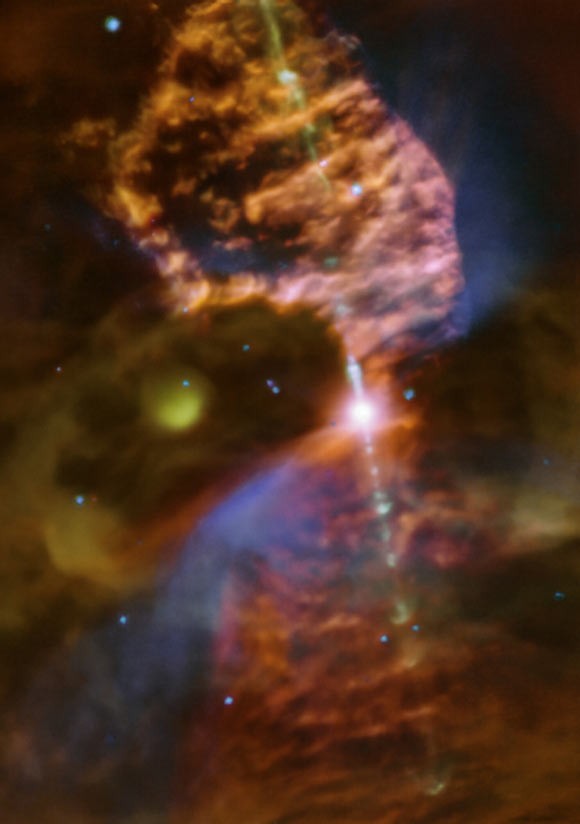
Using the Multi Unit Spectroscopic Explorer (MUSE) on the European Southern Observatory’s Very Large Telescope, astronomers captured the first detailed image of Ve 7-27 and its connection to the supernova remnant.
The Smoking Gun: Chemical Fingerprints Align
The key breakthrough came from analyzing the gas flowing out of Ve 7-27. Researchers, led by Dr. Samar Safi-Harb of the University of Manitoba, found that this gas shared an unmistakable chemical signature with the material ejected during the Vela Junior explosion.
“This is the first-ever proof linking a newborn star to the remains of a supernova,” Dr. Safi-Harb stated.
This alignment confirms a direct physical link between the star and the remnant, allowing astronomers to finally determine that Vela Junior is approximately 4,500 light-years away.
Implications for Understanding Supernovae and Star Formation
The new findings reveal that Vela Junior is larger, more energetic, and expanding faster than previously estimated. It ranks among the most powerful supernova remnants in our galaxy. This suggests that the original star was massive and its explosion significantly more violent than earlier models predicted.
Dr. Safi-Harb explains that stars have layers like onions, and supernovae scatter these layers into space. The discovery shows that these scattered layers are now visible in the outflow of a nearby baby star, illustrating how cosmic events recycle materials for new star formation.
The research has broader implications for understanding how galaxies are enriched with elements and how extreme cosmic events continue to shape the Universe. The elements formed in the exploding star will eventually find their way into new stars—and even onto Earth.
Ultimately, this study solves a long-standing astronomical puzzle while offering vital insight into how stars evolve and how galaxies develop.