


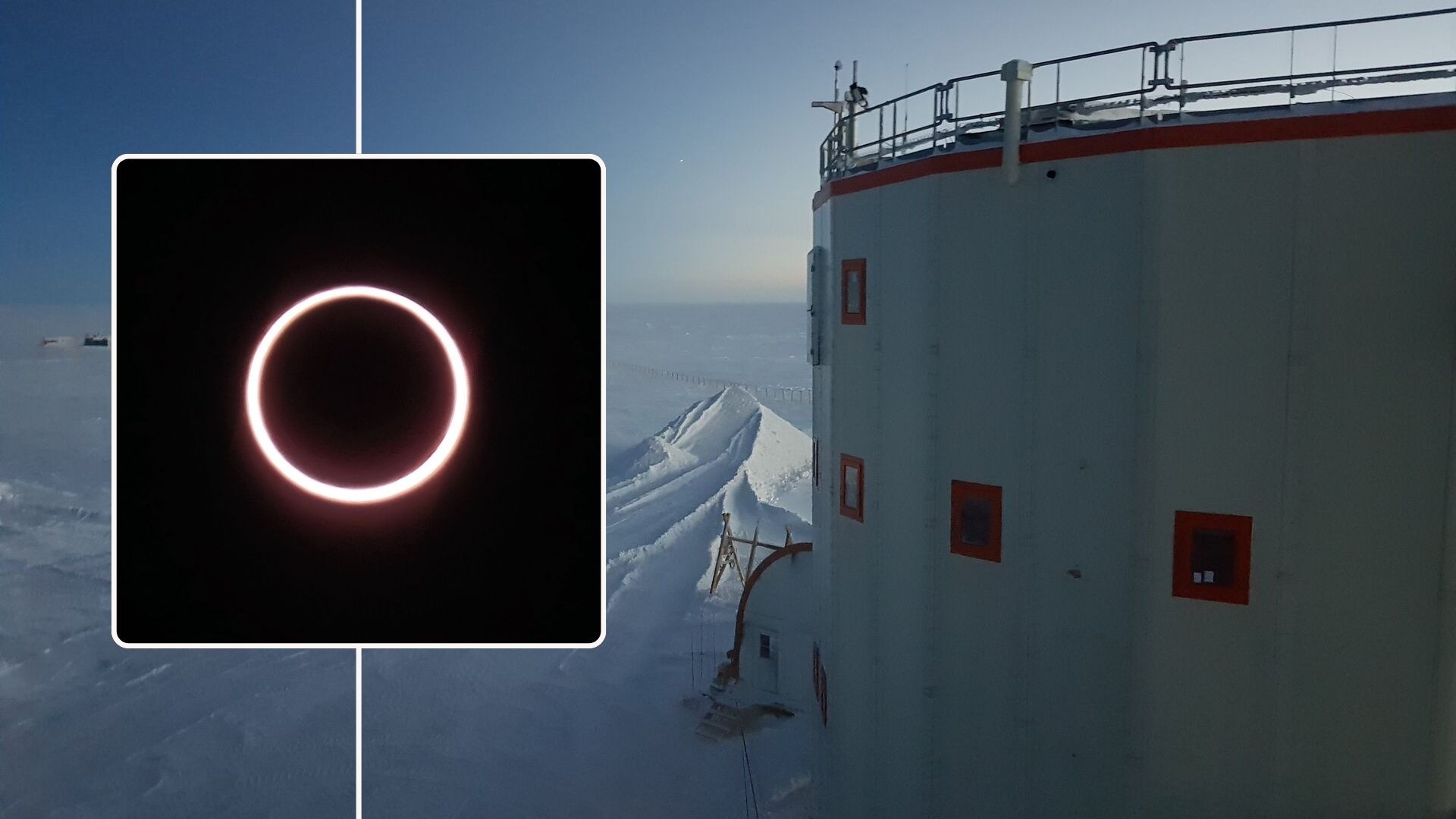
While astronauts aboard the Orion spacecraft recently experienced a total solar eclipse from the vantage point of space, a much more intimate astronomical event occurred on the ground this past February. At the Concordia Research Station, a tiny crew of just 12 people became the only humans on Earth to witness a rare “ring-of-fire” eclipse in its full glory.
An Unprecedented View
On February 17, 2026, an annular solar eclipse swept across the Antarctic continent. Unlike a total eclipse, where the moon completely obscures the sun, an annular eclipse occurs when the moon is too far from Earth to cover the sun entirely. This leaves a brilliant, glowing ring of sunlight visible around the dark silhouette of the moon—a phenomenon famously known as the “ring of fire.”
The path of this ring was highly specific, crossing only two inhabited locations in Antarctica: the Russian Mirny Station and the French-Italian Concordia Research Station. However, weather conditions played a decisive role in who actually saw the event. While thick clouds obscured the view at Mirny, the skies over Concordia remained clear.
Improvised Science in Extreme Conditions
The Concordia Research Station is one of the most isolated environments on the planet. Located 750 miles inland at an altitude of 10,600 feet, it sits in a polar desert where winter temperatures can plummet to -58°F (-50°C).
Andrea Traverso, a researcher overseeing various scientific monitoring systems at the station, found himself in the unique position of being one of the few people capable of documenting the event. Interestingly, the team had not planned for the eclipse. Without specialized solar filters or eclipse glasses on hand, Traverso had to rely on scientific improvisation to protect his equipment and his eyes.
To capture the shot, Traverso:
– Utilized old sheets of mylar film left over from previous solar studies.
– Constructed a makeshift filter using cardboard and glue.
– Positioned himself at a station window perfectly aligned with the sun’s path.
By opening the window to eliminate glass reflections and using his improvised lens filter, Traverso successfully captured a striking image of the ring of fire—an image later shared by the European Space Agency (ESA).
The Rarity of the Moment
The true scale of the event only became clear to Traverso after the eclipse had passed. Upon contacting other Antarctic research outposts, he discovered that nearly everyone else had been “clouded out.”
“I became aware of the uniqueness of my observation,” Traverso noted, realizing that he and his 11 companions were the sole witnesses to the spectacle on Earth.
This event highlights the intersection of extreme geography and astronomical rarity. In the vast, desolate stretches of the Antarctic interior, the combination of clear skies and specific orbital alignment can turn a remote research outpost into the most exclusive viewing gallery in the world.
Conclusion: Through scientific improvisation and sheer luck, a small team in Antarctica captured a once-in-a-lifetime visual phenomenon that remained hidden from the rest of the world due to cloud cover.