



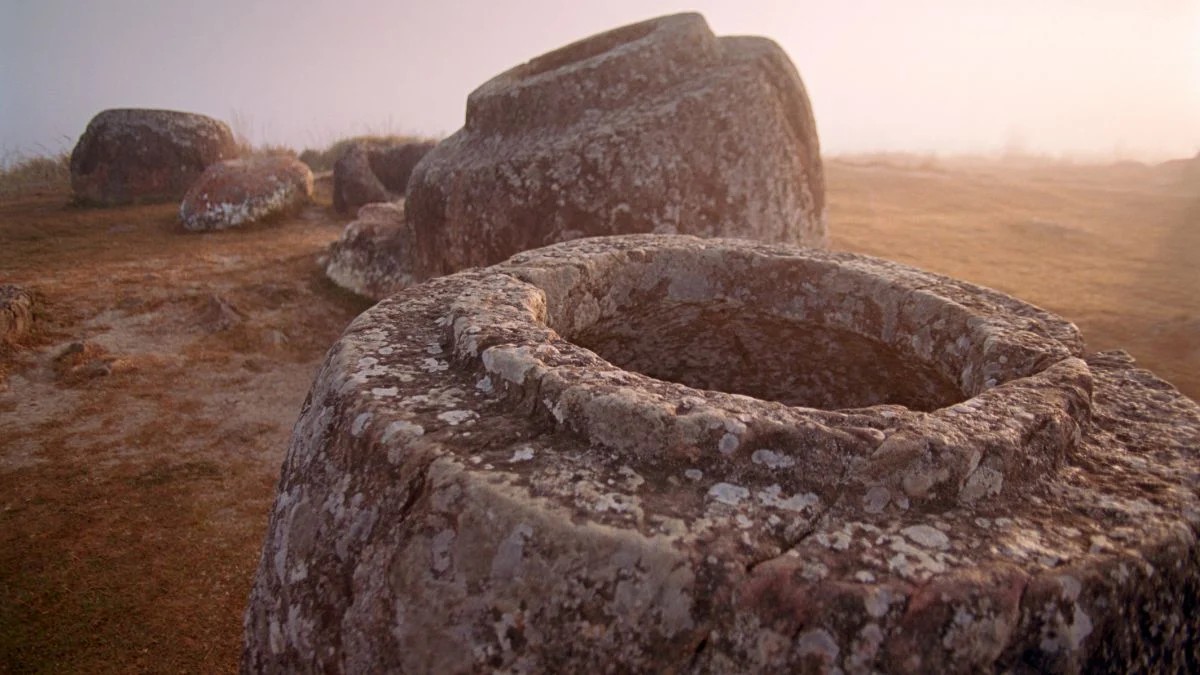
In central Laos, the landscape holds a quiet, heavy secret. The Xiangkhoang Plateau is dotted with thousands of giant stone jars. Most stand open to the sky, empty, their original intent obscured by centuries of silence. For decades, scientists couldn’t get close. Not because of distance. But because the ground itself was a minefield. 80 million unexploded cluster bombs. Left over from the US bombing campaigns of the 1960 Laotian Civil War.
Danger kept the mysteries locked up. Now, one jar has opened. And inside was not empty.
“The number of individuals also suggests the jars owned by family groups served as places for ancestral rites.”
— Nicholas Skopal
Archaeologists excavated a massive jar and found a grim surprise. A densely packed jumble of human bones. Approximately 37 people. But it wasn’t a mass grave in the traditional sense. The remains weren’t deposited all at once. They accumulated over 270 years, between 890 CE and 1160 CE # The Secondary Dead
The site was dangerous. The team worked over three field seasons from 2022 2024. They dug “Jar 1” at Site 75. It was in terrible shape. Conglomerate stone. Partially swallowed by earth. Only the crumbling sides stuck out.
At first, just fragments. A hint of what was below. Then the full picture emerged. Dense bone layers at the bottom.
But here is the twist. This was likely not where these people first died. Nor where they stayed forever.
Skopal, an archaeologist from James Cook University, calls it secondary interment. Bodies decomposed elsewhere first. Then the bones moved into the jar. Perhaps they rested there temporarily before being moved again, to a third site. That explains why so many jars stand empty today.
Why build thousands of containers for transient bones? Who knows exactly. The practices probably varied wildly across Laos. We shouldn’t assume a single rule applied to all of them.
Trade Goods and Glass Beads
Bones are not the only story. The jar held objects too. Twenty glass beads. Five stone slabs. Shards of pottery. A small bell. An iron knife.
Some pottery shards fit together, forming a round pot. The bell and knife match items found in other graves. Important goods, placed for the dead. But the glass beads are the real surprise.
Their chemical composition reveals their origin. South India. Mesopotamia.
Wait, Mesopotamia? In Laos?
This points to trade networks that were far wider and older than we realized. Connections spanning thousands of miles. Reaching deep into Southeast Asia.
Who lived there? Who made these jars? These questions remain open. The team is now analyzing the bones to check for DNA. To find familial ties. To see if the site truly represents generations of a single family group.
“Continued investigation of these landscapes fundamentally transform our understanding the cultural social dynamics region.”
The preservation is rare. An exceptional window into how people handled death. Many more jars probably exist. Buried under earth or waiting behind minefields. They await discovery. What will they tell us? Who will make the connection between the local ritual and the distant desert?