New observations from the James Webb Space Telescope (JWST) have revealed a surprising dynamic in the life cycle of galaxies: massive star clusters break free from their birth clouds much faster than previously thought. This rapid emergence not only reshapes the surrounding galactic environment but also imposes strict limits on how planets form within these stellar nurseries.
By combining JWST’s infrared vision with Hubble’s visible-light data, astronomers have captured a detailed timeline of star formation across nearly 9,000 young clusters in four nearby galaxies. The findings challenge existing simulations and suggest that the feedback loop between newborn stars and their environment is more aggressive and swift than models predicted.
Peering Through Cosmic Dust
The study focused on four specific galaxies: Messier 51, Messier 83, NGC 628, and NGC 4449. To understand the full lifecycle of star clusters, researchers employed a dual-telescope strategy:
- James Webb Space Telescope (JWST): Used its infrared capabilities to penetrate thick clouds of dust and gas, revealing clusters in their earliest, hidden stages.
- Hubble Space Telescope: Traced older, fully exposed clusters in visible light.
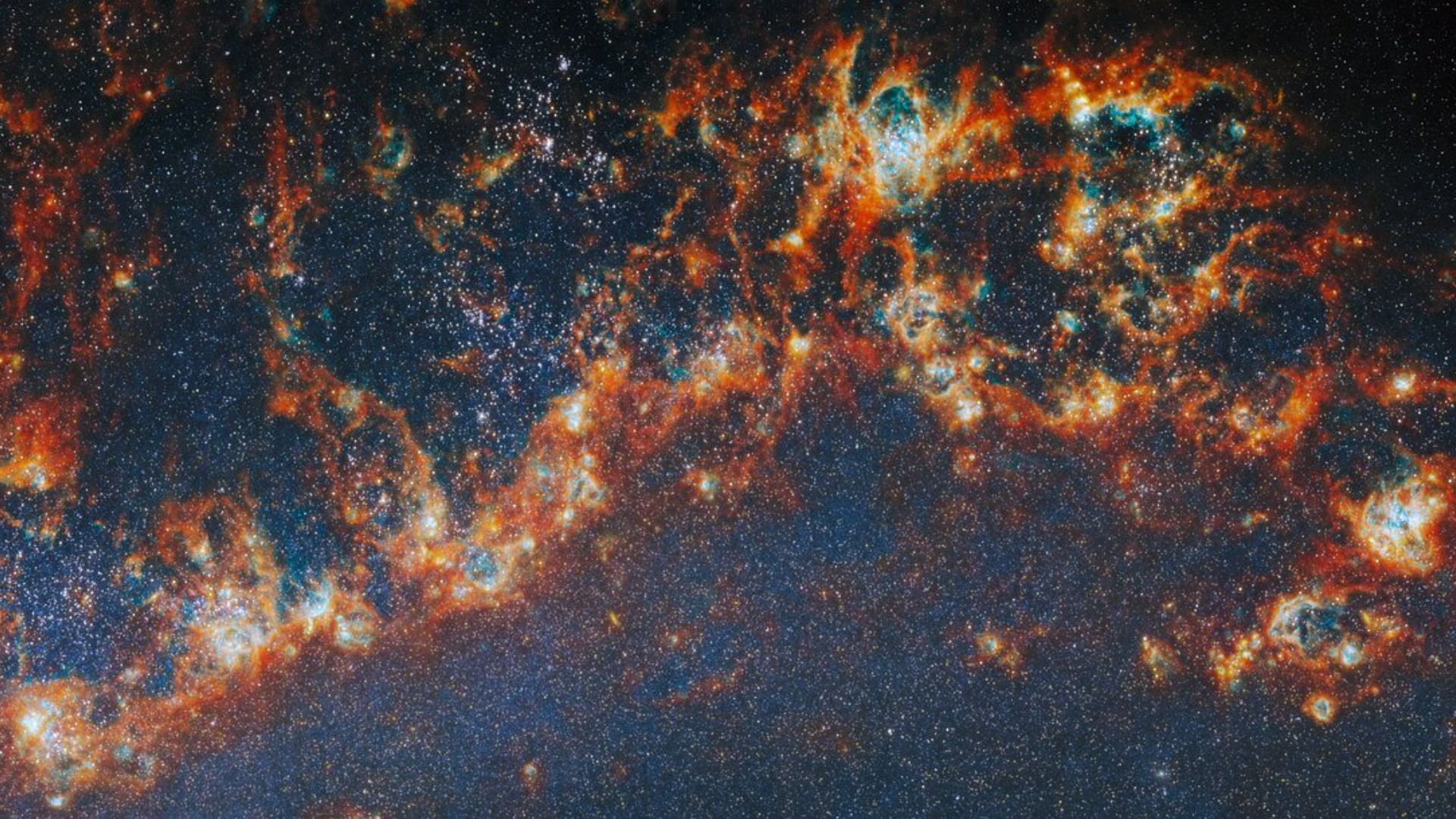
This combination allowed scientists to observe the transition from dusty, obscured nurseries to bright, open stellar groups. The resulting images display glowing cavities carved by stellar winds, dark rivers of dust, and brilliant knots of newborn stars—a vivid portrait of galaxies in constant motion.
“This work brings together researchers simulating star formation and those working with observations, as well as groups researching planet formation,” said Alex Pedrini, lead author of the study from Stockholm University and the Oskar Klein Centre. “Using Webb, we can look into the cradles of star clusters and connect planet formation to the cycle of star formation and stellar feedback.”
The Speed of Emergence
A key finding of the research is the speed at which massive clusters clear their surroundings. Simulations that account for stellar dynamics show that the universe’s largest star clusters disperse their natal gas clouds in approximately five million years. In contrast, smaller clusters take up to eight million years to emerge.
While a three-million-year difference may seem negligible on a cosmic scale, it is significant for galactic evolution. Angela Adamo, co-author of the study and Principal Investigator of the FEAST (Feedback in Emerging Extragalactic Star Clusters) program, noted that previous simulations struggled to reproduce how clusters form and emerge.
“These results give us important new constraints on that process,” Adamo explained. The data suggests that massive clusters exert influence on their environment much sooner than theoretical models had assumed.
Stellar Feedback and Planetary Limits
Once freed from their birth material, these giant clusters unleash intense ultraviolet radiation and powerful stellar winds. This process, known as stellar feedback, heats and disperses nearby gas. Since cold gas is the essential raw material for creating new stars, this feedback mechanism effectively regulates future star formation within the galaxy.
However, the implications extend beyond star formation to the creation of planets. Young planetary systems developing inside these clusters are exposed to harsh ultraviolet radiation earlier than expected. This radiation can erode the disks of gas and dust surrounding newborn stars—disks that serve as the building blocks for planets.
Consequently, planets forming in these dense, massive clusters may face a “shrinking window” for growth. The early dispersal of their protoplanetary disks could limit the maximum size of planets that can form, potentially resulting in smaller worlds or fewer gas giants compared to stars born in isolation.
Conclusion
The rapid emergence of massive star clusters acts as a powerful regulator for galactic evolution, halting star formation and constraining planetary growth through intense stellar feedback. By revealing that these clusters clear their surroundings faster than previously modeled, this research provides critical new constraints for understanding how galaxies structure themselves and how the environments of newborn stars dictate the potential for life-bearing planets.