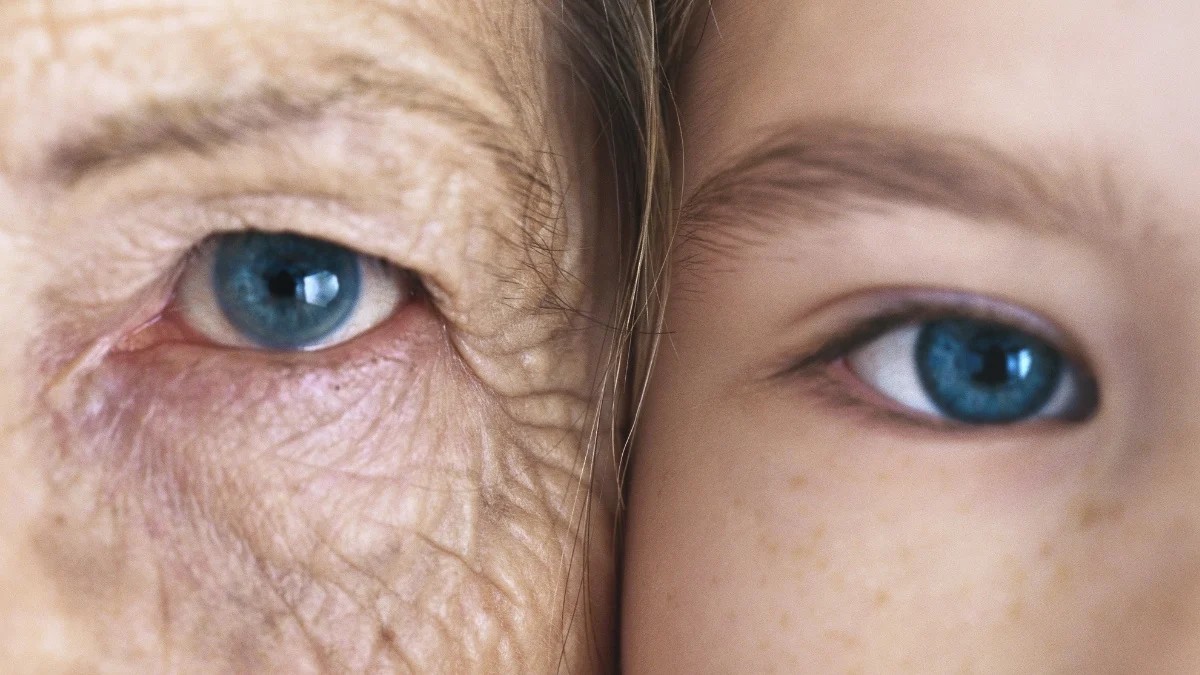
Aging feels linear.
It doesn’t have to be.
Wake up. Look in the mirror. Feel that weird shift in your energy, your skin, your mood? You might be imagining things. Or you might be experiencing a molecular cliff drop.
Research published in Nature Aging in August 2024 suggests the latter is far more likely. According to Stanford University geneticist Michael Snyder and his team, we don’t just slowly decay over time. We experience two abrupt lurches into older selves. One hits at 44. The other lands around age 60.
“We’re not just changing gradually… there are some really dramatic changes,” Snyder noted. “And that’s true no matter what kind of molecule you look at.”
The Data Behind the Drop
Snyder didn’t pull these ages out of thin air.
He looked at 108 adults who donated biological samples every few months for years. The data load was massive. We’re talking about 135,231 biological features tracked across RNA, proteins, lipids gut, skin nasal and oral microbiome taxa. Participants submitted an average of 49 samples each over roughly 1,800 days. That generated 246.3 billion data points.
The pattern emerged from that noise.
In many health contexts such as Alzheimer’s risk or heart disease, danger doesn’t creep up slowly. It spikes after a certain point. So the researchers mapped the molecular shifts to see what was driving that acceleration.
What they found was staggering. 81 percent of the molecules they studied changed during one of the two identified time windows. The changes weren’t gradual slopes. They were step-wise jumps.
Different Ages Different Triggers
The mid-40s hit and the early-60s shift involve slightly different bodily systems.
Between ages 43 and 46, the body reels in metabolic shifts. Molecules tied to processing caffeine and alcohol spike or dip. Lipid metabolism goes sideways. The signs point to stress in skin, muscle, and the heart.
Then there’s the second peak between ages 60 and 61. Here the body shifts its focus to carbohydrates. Immune regulation takes a turn. Kidney function markers change. Skin and muscle issues remain but now the cardiovascular and metabolic landscape looks distinctly different from the decade before.
So what causes it?
For women hitting midlife, the obvious answer is menopause or perimenopause. It makes sense. Hormones drop, metabolism changes. But Snyder’s team checked.
The changes happen in men too. Men who undergo none of the ovarian transitions showed the same molecular chaos at the same average age. So yes. Hormones might play a part in women’s 40s but they aren’t the main engine driving these universal human shifts. Something deeper is pulling the lever. Xiaotao Shen. a lead author now at Nanyang Technlogical University, puts it plainly: those hidden factors are likely more significant and deserve serious investigation.
Is 201 Too Few People?
The sample size was tiny by epidemiological standards. Just over one hundred people between the ages 25 and 36 were tested. It was a proof of concept not a census.
Previous work in flies rats and zebrafish hints that aging in nature isn’t always a straight line. This human study mirrors that biology. But until larger groups are monitored in this granular fashion over long periods the “peaks” remain strong suspects not absolute law.
Which leads to an uncomfortable question.
If your body fundamentally reconfigures itself twice between middle age and old age are our medical treatments designed for the wrong model?
Most care protocols assume gradual decline.
This says otherwise.