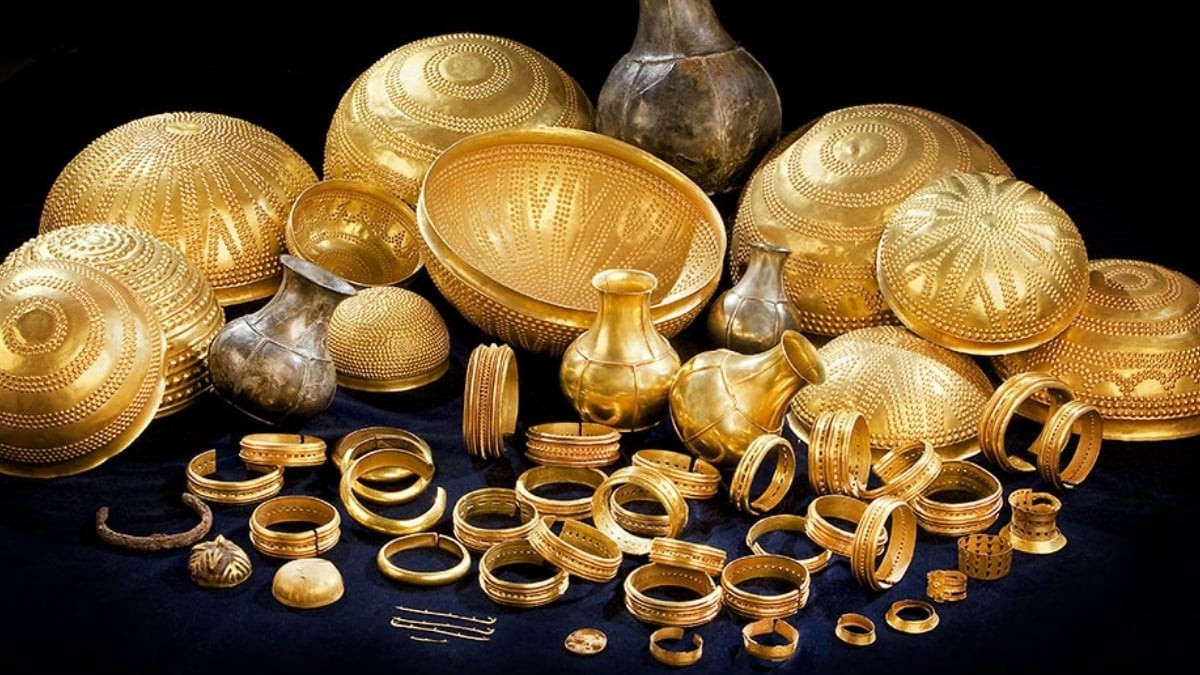
Gold shines. It draws the eye. It screams value. But buried within a legendary cache from Spain, two dull, corroded pieces might be worth far more.
A bracelet. A hollow sphere. They look like junk compared to the rest of the Treasure of Villena. Rusty. Pitted. Unassuming.
They aren’t made from earthly ore.
Researchers, led by Salvador Rovira-Llorens—the now-retired head of conservation Spain’s National Archaeological Museum—found these items were forged from iron that fell from the sky. Meteoritic iron.
This changes the script on Bronze Age Iberia. We assumed their metallurgy was simpler. More primitive. This discovery suggests otherwise. They were playing with high-end materials more than three thousand years ago.
A Dating Puzzle
The Treasure of Villena is old news, essentially. Found in 1963 near Alicante. Sixty-six gold objects. Glittering. Heavy. It stands as one of Europe’s prime examples of Bronze Age craftsmanship.
Most of the dating is easy. Carbon-dating isn’t useful on pure gold, so historians rely on style, context, and associated materials. The consensus puts the stash between 1500 and BCE and 1200 BC.
Then there are the two oddballs.
They look ferrous. That’s archaeologist-speak for “they look like iron.” Here’s the rub. Iron smelting from Earth’s crust in this region didn’t start until 850 BC.
That’s centuries too late.
If these items were terrestrial iron, the whole treasure is a forgery of sorts, an anachronism mixed with older gold. The timeline breaks. The cache doesn’t make sense.
Stars Fall Down
Nature has a backdoor.
Meteorites contain iron. Lots of it. And ancient cultures knew this. Pharaoh Tutankhamun had a dagger made from a fallen star. Other Bronze Age elites traded in these sky-fallen weapons. They were rare. Precious. Magical, almost.
So how do you prove it wasn’t ground iron?
Chemistry. Specifically, nickel.
Meteoritic iron carries a high nickel content. Earthly iron does not. At least, not in significant, traceable amounts like this.
The team at the Municipal Archaeological Museum in Villena gave researchers permission to take micro-samples. They didn’t just guess. They used mass spectrometry. It’s delicate work. One slip, one wrong cut, and you damage heritage.
The corrosion was bad. Thick. It muddies the data. Corrosion changes elemental makeup, adding noise to the signal.
Yet. The results held up.
The nickel levels were consistent with meteorite iron. Not Earth iron.
Solving the Anachronism
This clears up the mess.
The hemisphere—likely a part of a scepter handle—and the torc-like bracelet date to roughly 1400-1200 BCE. Same as the gold. Same era. No time travel required.
“The available data suggest that the cap and braceelet… would currently be the first two pieces atrributable to meteoritic iron in the Ibrian Peninsul.”
The researchers wrote that. It fits the Late Bronze timeline. Before the widespread adoption of smelting local iron ore. It implies a network of trade or knowledge reaching far beyond the local horizon.
Was this local skill? Or imported status symbols?
We don’t know. The objects are still degraded. The corrosion fights back.
The paper, published in Trabajos de Prehistoria in 2024, calls for better tools. Non-invasive imaging. Techniques that don’t require slicing the history open. If those come through, we might see the crystal structure—the Widmanstätten patterns that fingerprint meteoritic metal—without risking another gram of dust.
For now, the answer hangs in the air, mostly likely.
These people looked up. They saw rocks fall. And they built their history out of the sky.