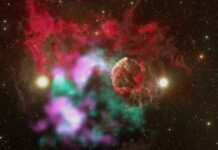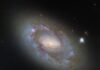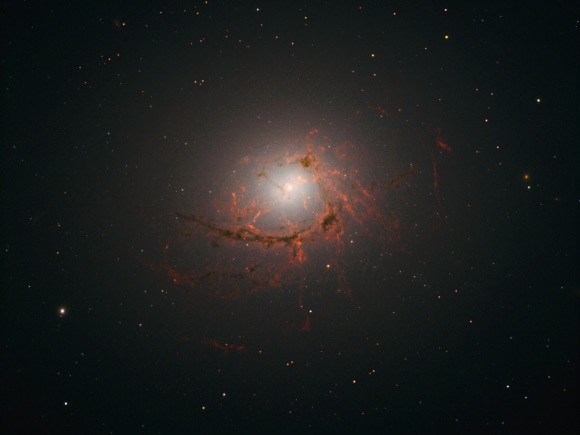
Webb didn’t just look at NGC 4697. It watched the food arrive.
The James Webb Space Telescope caught new images of this giant elliptical galaxy showing something strange. Gas filaments. Thin streams. They are funneling material straight into a spinning disk surrounding a supermassive black hole that is 800 light years across. For decades we have asked how these monsters keep getting bigger. We had the answer. It solves the puzzle of cosmic appetite.
Most big galaxies have these beasts in the middle. They are heavy. Millions of times heavier than our sun. Billions.
When they eat they light up. Like engines. They shoot jets of energy that can change the shape of an entire galaxy. They slow down star birth. Astronomers call them active galactic nuclei or AGN.
But here is the rub. If those jets heat the gas nearby it should cook the food. No cold gas means no fuel. So how do they stay active? Why don’t they starve themselves?
The theory was simple. The gas cools down again. It clumps. It forms long streamers. Filaments. It falls back into the center. A cycle. Self-regulating.
“We are all working together to solve…” says Megan Donahue from Michigan State. She notes the data from Webb is vast. Hard to digest. But necessary.
She and her team turned Webb toward NGC 4696. It sits in the constellation Centaurus. Roughly 116 million light years away. It is huge. Almost 30 thousand light years wide. The biggest galaxy in the Centaurus Cluster. A swarm of galaxies all packed tight.
They used nearly eight hours. NIRSpec instrument. They mapped the motion of the gas deep inside. Sharp enough to see details of 30 light years. A tiny slice.
What they found was an S-shaped swirl.
It is a spinning disk. Gas wrapped around the hole. Moving fast. Up to 600 kilometers per second. And critically. The disk is not alone.
It is connected.
One of the big infalling filaments touches the disk. Directly. The observations showed the gas flowing along that filament. Pouring into the disk. Feeding the black hole.
It explains the full cycle now.
The black hole fires jets. Energy pumps into the surrounding gas. The gas cools eventually. Becomes unstable. Collapses into those long thin filaments. Some are wide but stretch thousands of light years long.
Magnetic forces matter too.
They slow the gas as it falls. Steer it inward. The gas piles up in that disk. The disk feeds the hole. The hole fires jets again.
Repeat.
Did it match the models?
Researchers ran simulations. State-of-the-art stuff. The simulated gas behaved almost exactly like Webb saw it. It supports the theory. Strong support.
“It’s amazing to see,” Dr. Mark Voit said. He believes magnetic fields help feed these giants. They channel cool gas. The images prove it.
The results go into Astrophysical Journal Letters.
Julie Hlavacek Larrondo et al published it in 2026 on arXiv. The cycle holds up. For now. The gas keeps flowing. The hole keeps eating. 🌌