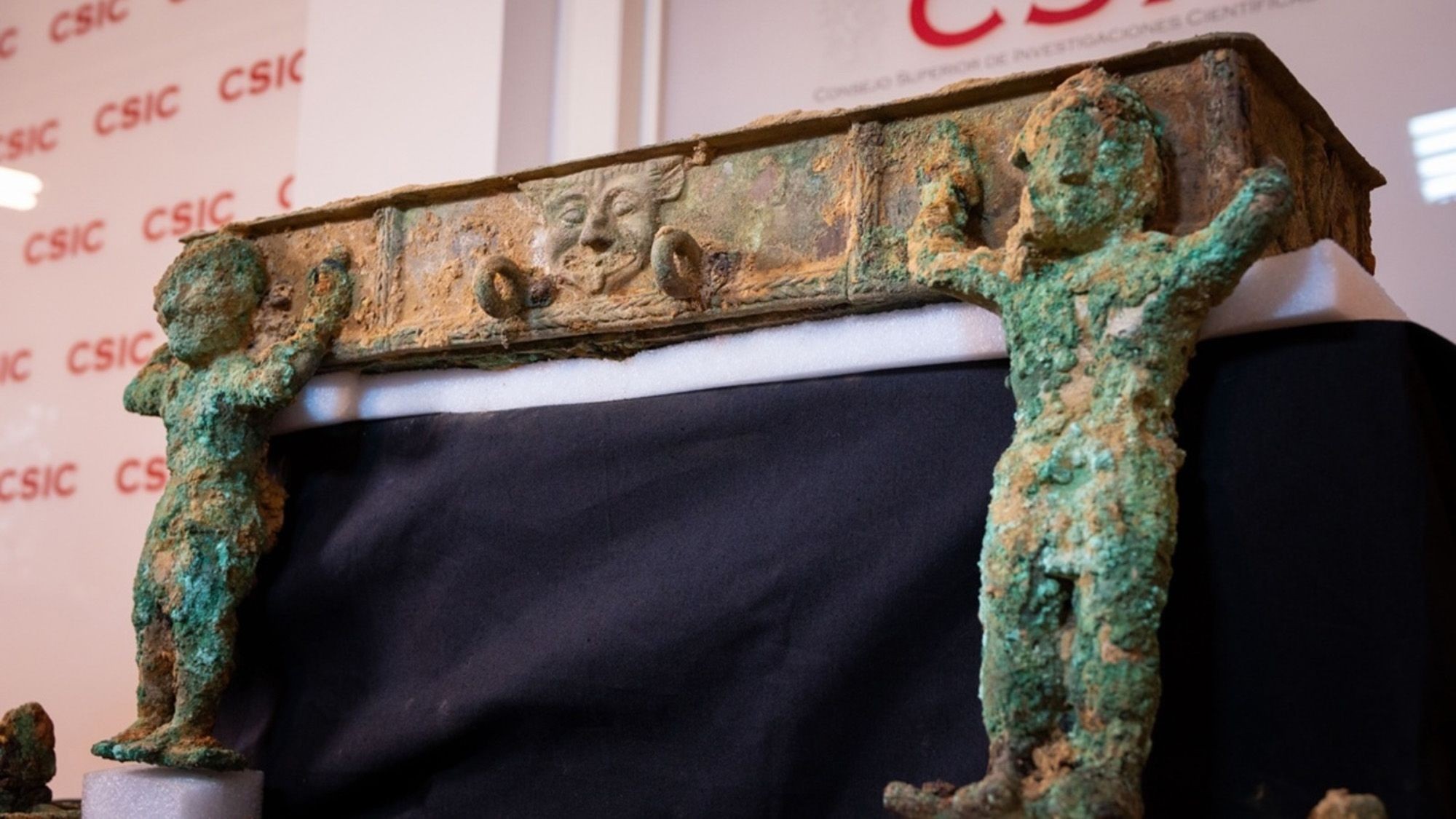
Archaeologists found it. A bronze chariot. Roughly 24 inches long. Sitting in the dirt near Badajoz, Spain. It is unlike anything previously recorded on the Iberian Peninsula.
This wasn’t a vehicle for war. It was for the gods. A table-like structure meant to hold burning incense. An offering. But look closer at the craftsmanship.
There is a face sticking out its tongue on the side. It is strange. A fusion. Part gorgon, that ancient symbol linked to Medusa. Part Achelous, the Greek river god who could shapeshift into a bull. Guiomar Pulido González of the Mérida Institute called it an unusual mashup. Never seen before. Not in the archaeological record, at least.
The Art of Protection
The legs of the chariot are not metal posts. They look like people. Two figures holding up the heavy bronze top. They are wearing skirts. That is odd. Etruscan bronzes—made by that pre-Roman Italian group between 900 and 100 B.C.—usually depict naked figures.
Yet the style screams Etruscan origin.
“All the figurative parts point to protective divinities,” Pulido said.
Griffins guard the short ends. Lion bodies. Eagle heads. Symbols of safeguarding. What are they protecting? The incense? The viewer? Or something more abstract? No one is sure. But the iconography suggests someone cared deeply about warding off evil. Or maybe just emphasizing status.
Burnt and Buried
The story gets weirder when you look at the context.
The chariot was broken in half. Intentionally. It had no battle damage. It was placed inside a pile of rubble at Casas del Turuñaelo. This site belongs to an enigmatic people in the Middle Guadiana River valley. These folks influenced or mixed with the Tartessian civilization. They vanished around 400 B.C.
Gone. No trace left behind.
Fourteen sites like this one exist. All show the same pattern. Buildings burned down. Filled with soil. Fragmented objects dumped in. Was it an attack? Unlikely. Pulido thinks the destruction was too precise. Too careful.
Maybe it was ritual. A planned closure. A symbolic farewell.
Who were they? The elite clearly had wealth. Imported Greek pottery exists. Etruscan objects too. This broken chariot likely traveled those same Mediterranean trade routes. Arriving in Spain perhaps as early as the sixth century before the city itself went dark.
The Disappearance
So we have these imported treasures. And a people who just… left. Or died. Or dissolved.
The chariot sits at the edge of our knowledge. A beautiful, tongue-out face staring across 2,400 years. We have the artifact. We have the fire. But we lack the voices that explained it.
Which feels fair, in a way. Some secrets stay buried. 🏺