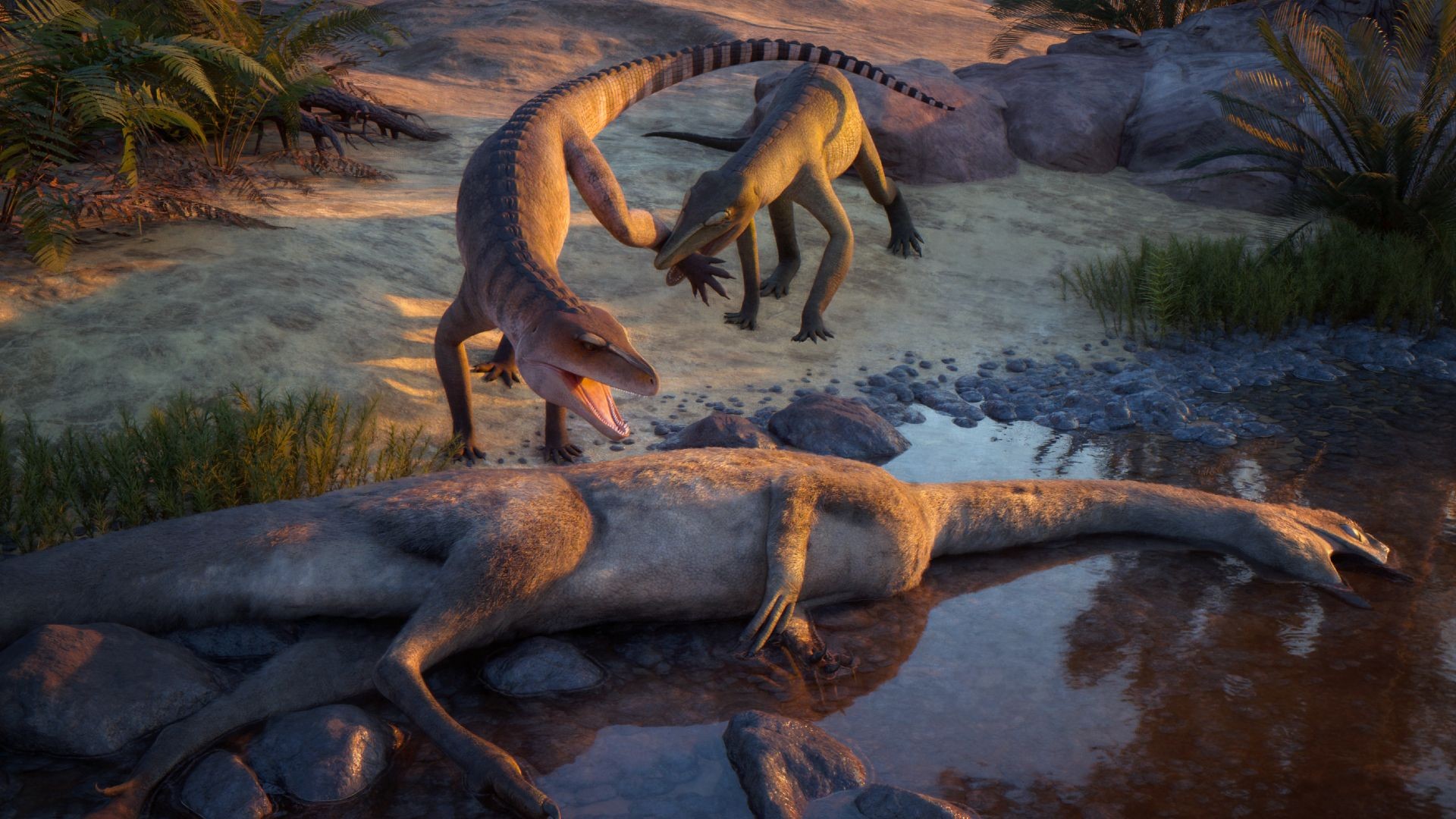
For nearly eight decades, a fossil remained tucked away in the basement of the Yale Peabody Museum, misidentified and largely overlooked. Now, researchers have finally unlocked its secrets, revealing a prehistoric predator that challenges our understanding of how early crocodile relatives lived and hunted.
A Forgotten Discovery
The specimen was originally unearthed in 1948 at the famous Ghost Ranch site in New Mexico—a location renowned for its rich fossil record. For 75 years, it was tentatively cataloged as Hesperosuchus agilis, a known early relative of modern crocodiles.
However, a new study published in Proceedings of the Royal Society B: Biological Sciences reveals that this was a mistake. The fossil actually belongs to an entirely new genus and species: Eosphorosuchus lacrimosa .
Not Your Typical Crocodile
While modern crocodiles are synonymous with water-dwelling ambush predators, E. lacrimosa tells a different story. Based on its physical characteristics, researchers believe this creature was a terrestrial hunter.
The fossil—which includes a skull, leg bones, a vertebra, and scales—suggests an animal roughly the size of a large dog. Key anatomical features include:
– A short, reinforced snout: Unlike the long snouts of many aquatic crocodilians, this skull was built for durability.
– A powerful bite: The presence of a large, triangular postorbital bone and specific jaw structures suggests massive muscle attachments designed for heavy chomping.
– Land-based lifestyle: Rather than lurking in rivers, this predator likely stalked its prey on land, functioning much like a modern fox or jackal.
Ecological Coexistence: A Biological Snapshot
One of the most significant findings of this study is not just the discovery of a new species, but the context of its existence. The researchers compared the new fossil to a specimen of H. agilis found only about five meters away. Both animals lived during the Late Triassic and appear to have died in the same event, possibly a sudden flood.
This discovery provides rare, “strong evidence” of niche partitioning —a process where different species live in the same area without competing for the same resources.
“This is the first really strong evidence we have of coexistence between two functionally different-looking crocodylomorphs,” says study co-author and Yale paleontologist Miranda Margulis-Ohnuma.
By evolving different skull shapes, these two species could share the same habitat:
1. H. agilis likely hunted different types of prey using a different method.
2. E. lacrimosa used its powerful bite to tackle larger, less agile targets.
Why This Matters for Paleontology
The evolutionary history of “crocodylomorphs” (the group including crocodiles, alligators, and their extinct relatives) is notoriously difficult to map. The fossil record for this period is “data deficient,” meaning scientists have very few specimens to work with.
The identification of E. lacrimosa proves that even in the early stages of their evolution, these animals were already diversifying into specialized roles. It shifts the narrative from seeing early croc relatives as a single, struggling lineage to seeing them as a dynamic and diverse group that was rapidly adapting to different environments.
Conclusion
The identification of Eosphorosuchus lacrimosa transforms a forgotten museum relic into a vital piece of the evolutionary puzzle, proving that early crocodile relatives were already masters of diverse ecological roles on land and in water.