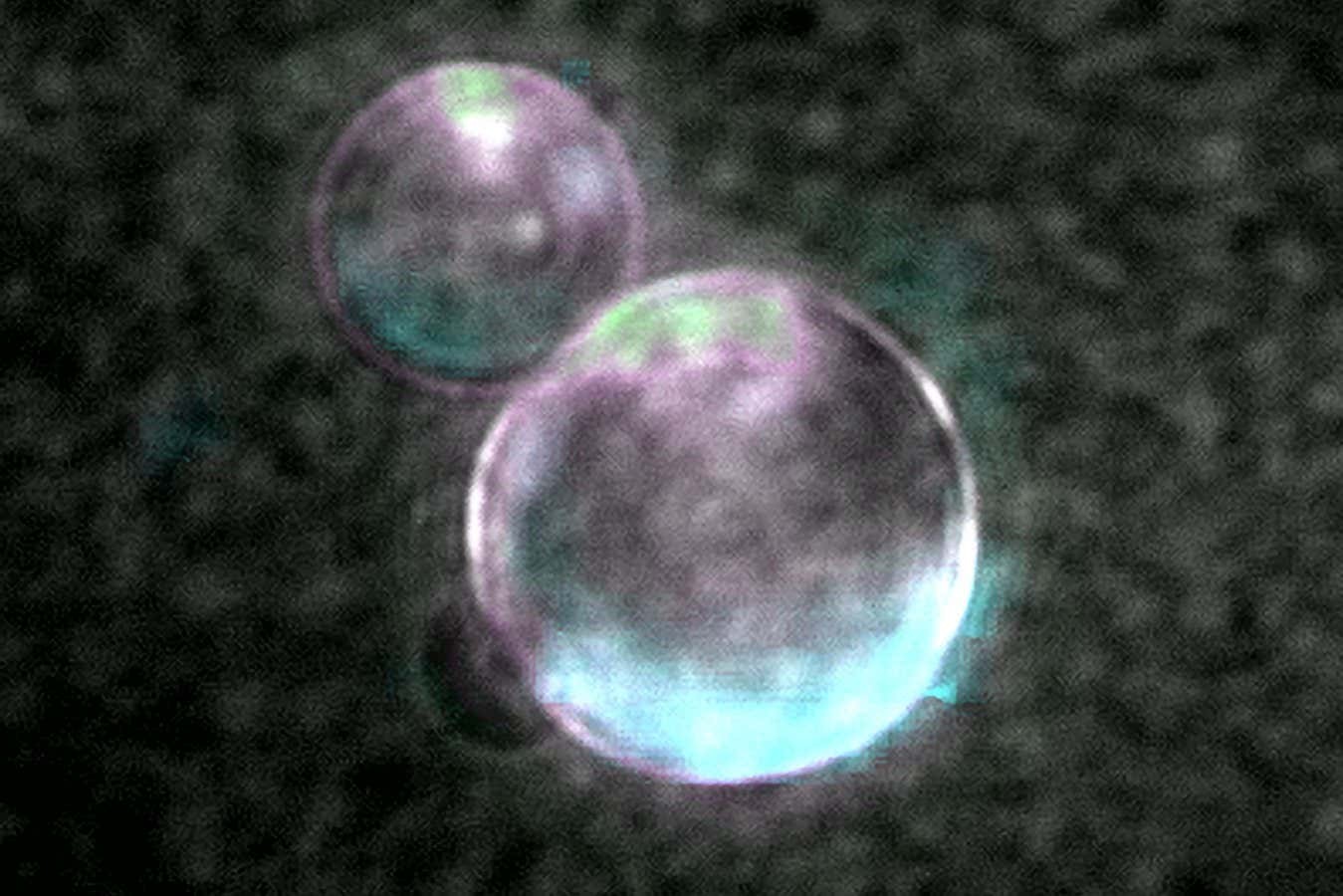
Arguably the greatest feat in bioengineering history? Maybe.
It’s called the “SpudCell.”
Creators call it a major advance in synthetic biology and some of the hype sticks.
It’s a cell. Kind of.
It has 36 genes allowing it to copy DNA.
It replicates.
It fails after about five divisions though.
Still better than what any other team has managed so far.
Kate Adamala at the University of University of Minnesota built this thing.
She and her team just made the project open source.
Why?
Because they want others to develop it further.
To make it divide indefinitely.
That is the goal.
What is the SpudCell
Think minimal life form.
Fully understood functions.
Previous attempts stripped genes down from existing bacteria.
Back in 2016 a bacterium went from 901 genes down to 473.
Adamala did it in reverse.
She started with 36 genes only.
Most from E. coli bacteria.
Some from phage viruses that eat bacteria.
One from jellyfish fluorescent protein just so the cells would show up under a microscope.
So it’s alive?
No.
It mimics living cells.
It replicates genes and divides.
Badly.
It needs massive outside help just to function at a rudimentary level.
Researchers even showed it could evolve.
If they introduced a beneficial mutation the cells performed better.
But that mutation had to be put in manually.
Not spontaneously.
Never natural.
“I think I would be satisfied calling it living if it’s replicating independently and if it can do Darwinian evolution.” — Adamala
Right now it does neither on its own.
A synthetic cell?
That depends on your definition.
Yes it was assembled in a lab.
No it wasn’t made from scratch.
It uses parts of existing organisms.
It is an extreme stripped-down version of E. coli with additives from viruses bacteria and jellyfish.
How did they build it
The team engineered the 36 genes onto seven circular DNA pieces.
They copied them.
They poured everything into a solution with DNA building blocks proteins and fatty molecules that form bubble-like structures.
Some bubbles grabbed all seven DNA parts.
Voila.
Sort of.
How it stays “alive”
The cell can’t make its own stuff.
So two genes code for proteins forming pores in the membrane.
Small molecules drift in through these holes.
Large molecules come wrapped in small bubbles that fuse directly with the cell.
The SpudCell is basically a parasite of its own design.
Supplied with all the raw materials.
No production line inside.
The messy division process
Here’s how they make new ones.
They added huge proteins to the solution.
These proteins bind to pores sticking out of the membrane.
They crowd each other out.
This pushes against the membrane making it bend.
Part of the SpudCell buds off.
A separate bubble forms.
The daughter cells inherit random DNA chunks though.
Usually they lack full sets of genes.
Why split the DNA
You might think putting all genes on one large DNA circle would solve the inheritance problem.
It would.
But working with such big DNA pieces is technically hellish right now.
Adamala admits that eventually the genome will move to a single piece.
For now they have to live with the fragmentation.
The five-generation cliff
Why do these things stop dividing after five rounds?
Unknown exactly.
Suspect? Ribosomes.
The SpudCell can’t make ribosomes itself.
They must be fed them from the solution.
Eventually ribosomes break down.
Supply runs out.
Cell dies.
Adamala says getting the cells to make their own ribosomes should fix this.
She thinks it will happen very soon.
Then indefinite division might happen too.
Why bother?
Climate.
Society.
Oil dependence.
“We want to make petrochemicals with biology,” says Adamala.
Plastics pesticides medicines most derived from oil gas.
Often toxic to normal biological systems.
Standard bacteria die if they produce them.
Synthetic cells can be built to tolerate toxins.
Replace the refinery with the lab.
Is it dangerous
Not even close.
Imagine Frankenstein’s monster bedridden.
Spoon-fed by scientists.
It cannot survive outside the specific solution in a beaker.
No running amok here.
Wild bacteria remain the actual threat.
The SpudCell just stays put and waits to be fed.