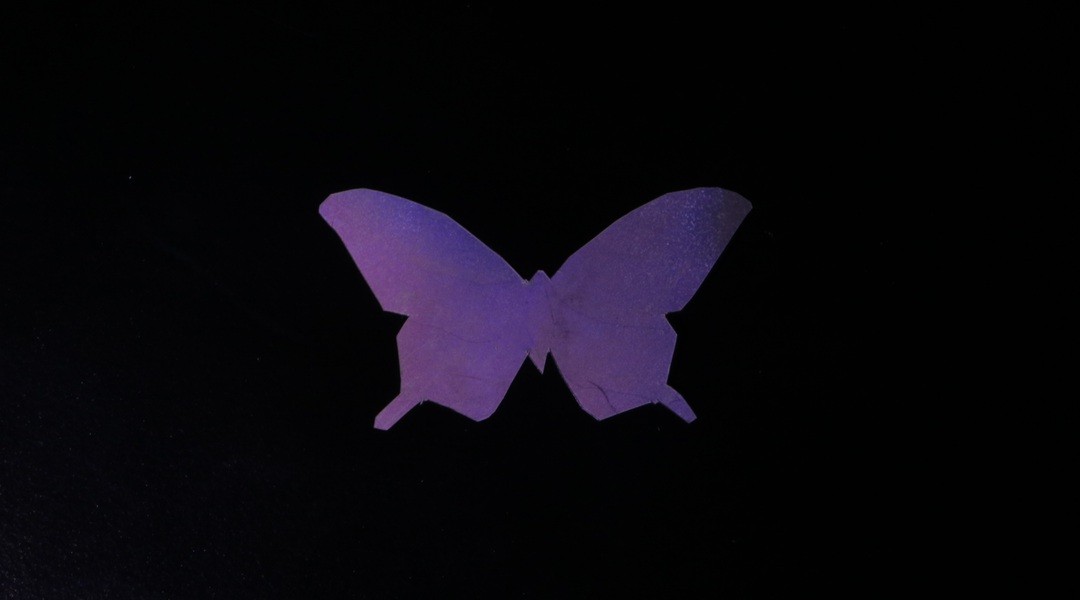
Soft robots are getting weirder. Or better, depending on your angle. They move. They breathe. Some even blush.
Most photonic actuators are messy like that. They change shape and color at the same time, tangled together by design. Not this one.
Researchers at the Chinese University of Hong Kong (Shenzhen) pulled a neat trick. They separated the color from the motion. Two different things happening in one body, but controlled independently. It sounds minor, maybe academic. But for people trying to build skins that actually work in the real world, it’s a huge unlock.
Yuhua Jin, an assistant教授 there, calls it a system that decides whether to be visible based on how you look at it. Literally.
“Our system can switch between colorless and vivid… depending on how the material is illumined.”
It’s made of polyvinyl alcohol. PVA. Stuff you might find in glue sticks. This stuff bends when you get your fingers moist on it. Touch the bottom, it flips up. Touch the top, it sinks. Simple. Humidity drives it. No motors. No wires. Just wet hands making a plastic wing shudder.
But the magic is in the paint. Or lack thereof.
Two faces, one trick
The structure is “Janus.” Named after the two-headed god. One side is boring. Smooth, flat, translucent. Invisible. The other side is full of micro-domes. Tiny glassy bumps.
When light hits those domes, it doesn’t just bounce off. It goes inside. Bounces around. Interferes with itself. That’s where the color comes from. Not pigments. Not dye. Pure geometry playing tricks on photons.
Peacocks do this. Beetles do this. Now a piece of humidity-sensitive plastic does this.
Here’s the kicker: the smooth side drinks water faster than the bumpy side. So when it gets humid, the smooth side swells. The bumpy side stays put. The whole sheet curves.
Because the color comes from light bending inside those domes—and not from the swelling itself—the color stays put even when the material bends. Or shifts. You can watch the shape change while the color stays constant, or change the lighting angle and watch the hue spin from purple to green without moving a muscle.
Doesn’t it make more sense? To control them separately. To decide now is the time to show color, not necessarily move. Or move, but stay quiet optically.
Why this actually matters
Current photonic gadgets rely on packing nanoparticles tightly together. Expensive. Brittle. Hard to make at scale. This PVA sheet is cheap. Easy to print. And it responds to invisible environmental shifts by throwing up a visual flag you can actually see.
“We think this kind of material… converts invisible environmental changes into signals people can directly see.”
Imagine a wearable sensor that doesn’t need a battery or an app to tell you how hard you’re breathing. Just a patch that changes hue and curves slightly. Wearable tech usually requires complex electronics, heavy boards, power sources. This? It’s just chemistry. Physics. Humidity.
Or think about soft robotic grippers working in damp, confined spaces. Current sensors might short out or get muddy. This just flexes. Glows pink if things get weirdly humid. Green if the light shifts. A passive report card from a closed system.
What next?
Jin and Cui want more. Multi-stimuli responses. Add electric fields to the mix. Maybe light, too. Right now, it’s just humidity. They’re also working on tougher polymers. The current stuff works, but real-world use demands durability. Long-term stability. A material that lasts past the first week.
They aren’t there yet. The 2026 publication in Advanced Optical Materials shows it’s early days. The prototype works. The science holds. But integrating this into a functional system—that’s the next hill.
Until then, we have a butterfly made of glue-stick plastic that watches us watching it. Changing colors for the sheer drama of it.
Wait, will it hold up? Maybe. Probably not yet. But someone will fix it. They always do.