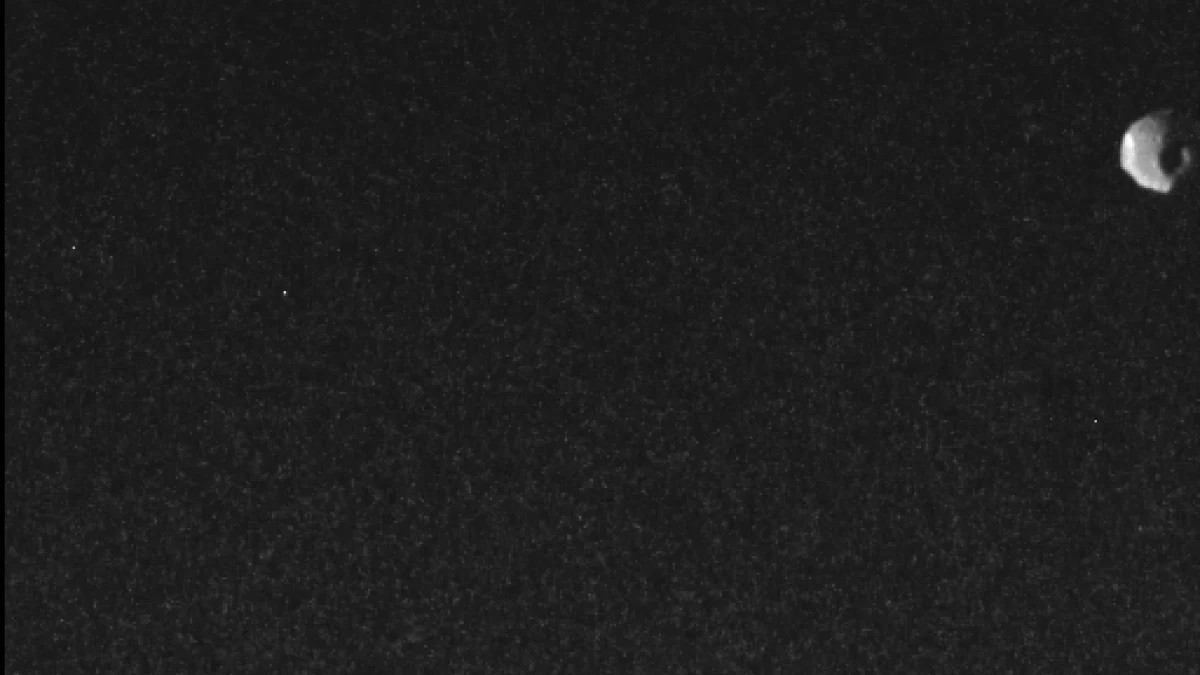
During a recent close flyby, NASA’s Juno spacecraft captured a striking, high-resolution image of Thebe, one of Jupiter’s inner moons. Taken on May 1, the photograph reveals the moon’s rugged, cratered surface in unprecedented detail, offering scientists a fresh look at a celestial body that plays a critical role in the formation of Jupiter’s faint ring system.
This sighting is notable not just for its clarity, but for the instrument used to capture it. While Juno’s famous JunoCam often provides the mission’s most colorful imagery, this portrait was snapped by the Stellar Reference Unit (SRU) —a navigation tool primarily designed to track star fields. Its high sensitivity in low-light conditions allowed it to produce a science-grade image when Juno passed within just 3,100 miles of Thebe.
A Moon of Contrast and Speed
Thebe is a small, irregularly shaped world, roughly 60 miles wide and predominantly reddish in hue. Despite its modest size, it is a dynamic object. Orbiting Jupiter at a distance of 138,000 miles, Thebe completes a lap around the gas giant every 16 hours —a rapid pace that gives it a sense of perpetual motion.
The moon’s surface is dominated by Zethus crater, a massive depression on its far side that spans nearly half the moon’s diameter. This feature highlights the violent history of the Jovian system, where frequent impacts have shaped the surfaces of these small satellites.
The Architect of Jupiter’s Gossamer Rings
Thebe’s significance extends beyond its own geology. It resides at the outer edge of Jupiter’s “gossamer” rings, a pair of faint, diffuse rings that are much harder to see than the main ring system.
Scientists believe Thebe is a primary source of material for these rings. As meteors and space debris collide with Thebe and its neighbor, Amalthea, they spray dust and rock into space. This debris slowly spreads out, forming the ethereal rings that encircle the planet. Capturing Thebe in such detail helps researchers understand the mechanisms behind this continuous process of destruction and creation.
A New Tool for an Old Mission
The image underscores the versatility of Juno’s hardware. Launched in 2011, Juno has orbited Jupiter for nearly a decade, transitioning from studying the planet’s atmosphere and interior to mapping its broader system.
While the mission’s primary phase revealed that Jupiter’s weather layer extends deep into the planet, the extended mission has focused on the moons and rings. The SRU’s contribution here is a reminder that even secondary instruments can yield primary scientific value. In addition to navigation data, the SRU has previously helped detect “shallow lightning” in Jupiter’s atmosphere, proving its worth as a multi-purpose sensor.
Looking Ahead
Juno’s mission continues until the spacecraft’s fuel runs out or its systems fail. As its orbit gradually decays, Juno will eventually plunge into Jupiter’s atmosphere. NASA confirms that this controlled end-of-life trajectory poses no risk of contaminating any of Jupiter’s moons, some of which, like Europa and Ganymede, are considered potential candidates for harboring life.
Key Takeaway: This rare image of Thebe not only showcases the capabilities of Juno’s navigation instruments but also provides crucial data on how Jupiter’s faint rings are sustained by the debris from its inner moons.