The Look
Head tilted back. Eyes staring up.
She looks at something we can’t see anymore. Or maybe we still can’t look up properly ourselves.
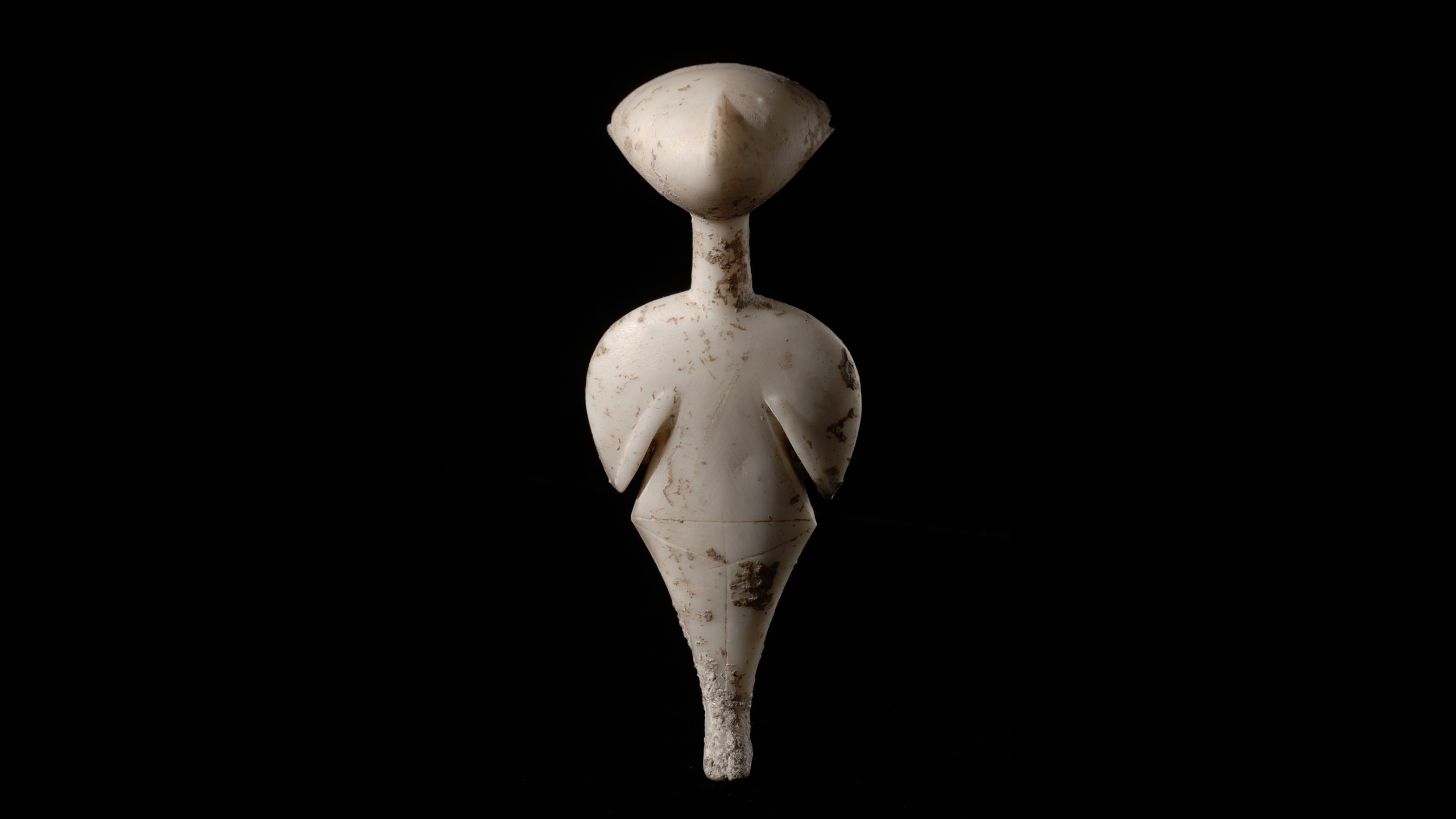
The Cleveland Museum of Art calls her The Stargazer. Carved from milky-white marble. She’s small—barely 7 inches tall, weighing about a pound. But she’s heavy with mystery.
Only thirty of these survive. Roughly thirty. Every single one dates back to around 3000 B.C.E. They were made in western Anatolia—modern-day Turkey—by a culture that left no books. No manuals. No “how to read this art” pamphlet.
Silence. Absolute historical silence.
Rockefeller’s Find
Here is a twist. This specific lady used to sit in the private collection of Nelson Rockefeller. You know the name. Wealthy. Industrialist. Vice President of the U.S.
He held her. Then she moved. Now she’s at the Cleveland Museum of Art. She’s one of the lucky ones.
Why?
Because most Stargazers were found broken at the neck. Deliberately smashed before being buried in the dirt millennia ago.
This one? She’s intact. Rare does not even cover it.
She lacks a mouth. Why carve a face and leave the most communicative part out?
She has no hands or feet really—just a body. Lines incised below the waist suggest a pubic triangle. Large oval head. Dot eyes. Abstract but undeniably human. You can’t make her stand on her own, which implies she was meant to be held. Close. Intimate.
“She may be associated with fertility and abundance.”
Art historian Amanda Mikolic wrote that. It fits the trend. Other female figurines from the Mediterranean era—like the Cycladic ones—also focus on women, cycles of life, reproduction. Simple shapes. Powerful symbols.
Or maybe that’s just what we want to hear.
Why Keep Her?
If you smash the figurine before burying it, why preserve this one? Or rather, why do we preserve this one now?
Former curator Arielle Kozloff thinks it’s simple. It was important.
“She must have been an important devotional objects to some long-lost culture.”
Think about that. A devotional object. Someone prayed to this stone. Or prayed with it. Looking at the stars?
Early 20th-century cubists loved this stuff. They looked at these ancient, abstract forms and saw genius. Picasso, Braque—they were hunting for truth in geometry and primitive lines. These stargazers gave them permission.
Mikolic says this gives the statue “timelessness.” A chance for us to think about our place in the cosmos.
Is it fertility? Is it religion? Is it just art?
We don’t have a written word to tell us. The creators left. The records stayed in the soil or got destroyed. All we have is marble. White and cool. Looking up.
We fill the gap with guesses.
Fertility. Abundance. Timelessness.
Maybe.
But she just keeps looking.