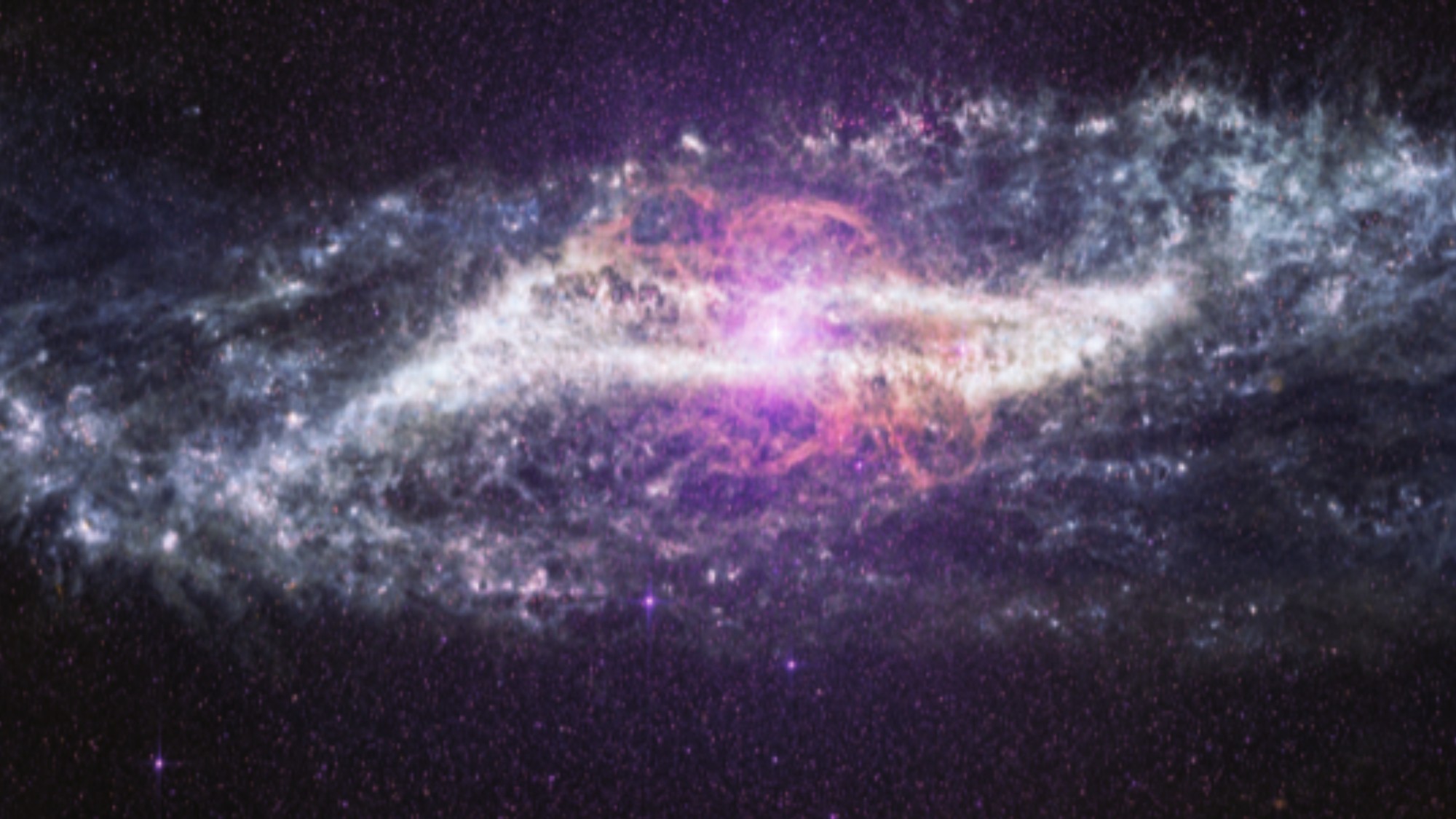
It has been four years since James Webb showed us what we could never see before. July 2026. NASA dropped this image to mark the birthday of the telescope itself, the most powerful eye ever turned at the dark. The subject is Centaurus A. Weirdly shaped. Striking.
The galaxy is 11 million light-years distant. That sounds far but in cosmic terms? It’s next door.
What makes Centaurus A look so twisted? A crash. Two galaxies collided roughly 2 billion years ago. They smashed together and mixed everything up. Gas. Dust. Stars. All the raw fuel for new stars. Also food. A supermassive black hole sits in the middle of this mess and it is eating well. The black hole chugs on all that matter and powers an active galactic nucleus. Violent stuff. High-speed jets of plasma blast outward.
Closer than the ancient galaxies JWST usually hunts, right? Doesn’t make Centaurus A any less useful. If anything the opposite is true.
“No single telescope tells the whole story.”
That’s Shawn Domagal-Goldman speaking, director of Astrophysics at NASA HQ. He’s right. We stack discoveries. New observatories stand on old ones. Webb just gives us the highest resolution yet. Open the window. See wavelengths that were previously invisible.
Discoveries build over time, and newobservatories expand on the foundations laid earlier.
Hubble saw dust. Webb saw through it.
The trick here is infrared light.
Visible light? Hubble’s best friend. It fails at Centaurus A because thick dust chokes the galaxy’s core. You can’t see through dust in visible light. But infrared? It slips through the sheets. It ignores the blockage.
Spitzer did look at Centaurus A before it was retired. It had infrared eyes sure. But they were fuzzy compared to Webb. Spitzer could see the big picture, the large structures. It couldn’t pick out individual stars or the fine grain. It missed the texture.
JWST doesn’t. Its NIRCam and MIRI instruments are hunting down details no one imagined before. And yet… questions remain.
Look at the MIRI image. There are stellar nurseries. New stars are being born. They spew gas and dust around them, glowing hot. But alongside all that beauty is this odd S-shaped feature. It’s curious. Nobody knows how it formed. Did the central black hole twist space enough to carve that out? Or was it debris from the original crash? We don’t know yet.
We do know what the black hole is doing. Webb caught it in action. Fast-moving ionized gas gets shoved outward. The black hole is shunting matter out of its domain. The data also picked up warm molecular hydrogen spinning in a warped disk near the center.
This is the duality of galactic cores.
On one hand, the black hole triggers intense star formation by squeezing gas and dust until they condense and ignite. On the other, it acts like a vacuum cleaner. It purges the material. It stunts birth. It literally kills star formation by starving the region of fuel. It can build a galaxy and destroy it. All at once.
Scientists are now piecing together the history of Centaurus A with a clarity that didn’t exist four years ago. The goal isn’t just to understand one weird galaxy. It’s to build a template. Apply these rules elsewhere. Figure out how universes evolve over time.
Webb is four years old now.
We are only beginning to see what is actually out there.