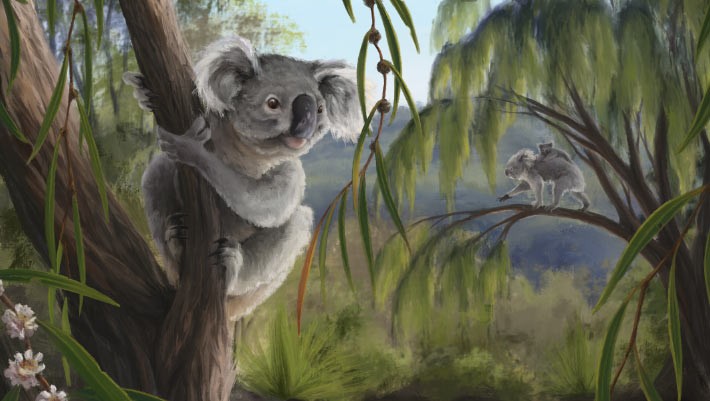
For more than a century, fossilized bones collected from caves in Western Australia were tucked away in museum drawers, assumed to belong to the same species as the modern koalas found on the east coast. A new study has overturned this long-held assumption, identifying these remains as a distinct, extinct species: Phascolarctos sulcomaxilliaris.
This discovery does more than add a name to a list; it reshapes our understanding of Australia’s natural history. It reveals that koalas once thrived in a vastly different environment in Western Australia and highlights how rapidly shifting climates can drive unique species to extinction.
The Discovery in the Dust
The story begins not in the field, but in the archives. Dr. Kenny Travouillon, a researcher at the Western Australian Museum and Curtin University, led a team that re-examined 98 fossil bones from the museum’s collection. These specimens, sourced from cave deposits in Yanchep, Margaret River, and the Roe Plain near Madura, had been known since 1910 but were previously classified as Phascolarctos cinereus —the modern koala—due to superficial similarities in their teeth.
By comparing these ancient bones with modern koala skeletons from eastern Australia, the researchers identified clear, quantifiable differences in skull structure, teeth, and post-cranial bones. These distinctions were significant enough to confirm the presence of a new species, which they named Phascolarctos sulcomaxilliaris.
“Due to the similarity of the dentition with Phascolarctos cinereus, they were traditionally assumed to be the same species,” Dr. Travouillon explained. “The results showed clear and quantifiable differences… confirming the presence of a new species.”
A Koala Built Differently
Phascolarctos sulcomaxilliaris was not just a smaller or larger version of the modern koala; it was structurally distinct in ways that suggest a different lifestyle.
The most striking feature was found in the cheekbones. The fossils revealed deep grooves that housed large facial muscles. Researchers believe this anatomy supported unusually large, mobile lips. This adaptation may have served two purposes:
* Feeding efficiency: Manipulating tough eucalyptus leaves with greater precision.
* Enhanced smell: Flaring nostrils to detect food sources from greater distances.
Furthermore, the skeleton suggests that P. sulcomaxilliaris was less agile than its modern counterparts. It likely spent less time climbing and moving between trees, indicating a different ecological niche within the forest canopy.
Why Did They Disappear?
The extinction of Phascolarctos sulcomaxilliaris offers a cautionary tale about climate change and habitat loss. Radiometric dating places the species’ disappearance around 28,000 years ago, at the end of the Pleistocene epoch.
This timeline coincides with a major climatic shift. During this period, severe drought and cold reshaped Western Australia’s landscape. Eucalyptus forests—the koalas’ primary food source and home—contracted dramatically, covering only about 5% of their current extent.
With food and shelter drastically reduced, the unique western koala could not survive. In contrast, modern koalas (Phascolarctos cinereus ) persisted in the more stable forests of eastern Australia, though they now face their own threats from land clearing, disease, and habitat fragmentation.
Why This Matters Today
The identification of P. sulcomaxilliaris underscores the importance of re-evaluating existing scientific collections. Many museums hold “unknown” specimens that could rewrite history when viewed through the lens of modern analysis.
Moreover, this discovery highlights the fragility of specialized species. Just as climate shifts wiped out the western koala thousands of years ago, today’s modern koalas—listed as Vulnerable by the IUCN—are struggling against rapid environmental changes. Understanding the past helps contextualize the present: when habitats shrink, even iconic species can vanish quickly.
The findings were published in the journal Royal Society Open Science, reminding us that sometimes, the biggest discoveries are waiting in the dark corners of our own archives.