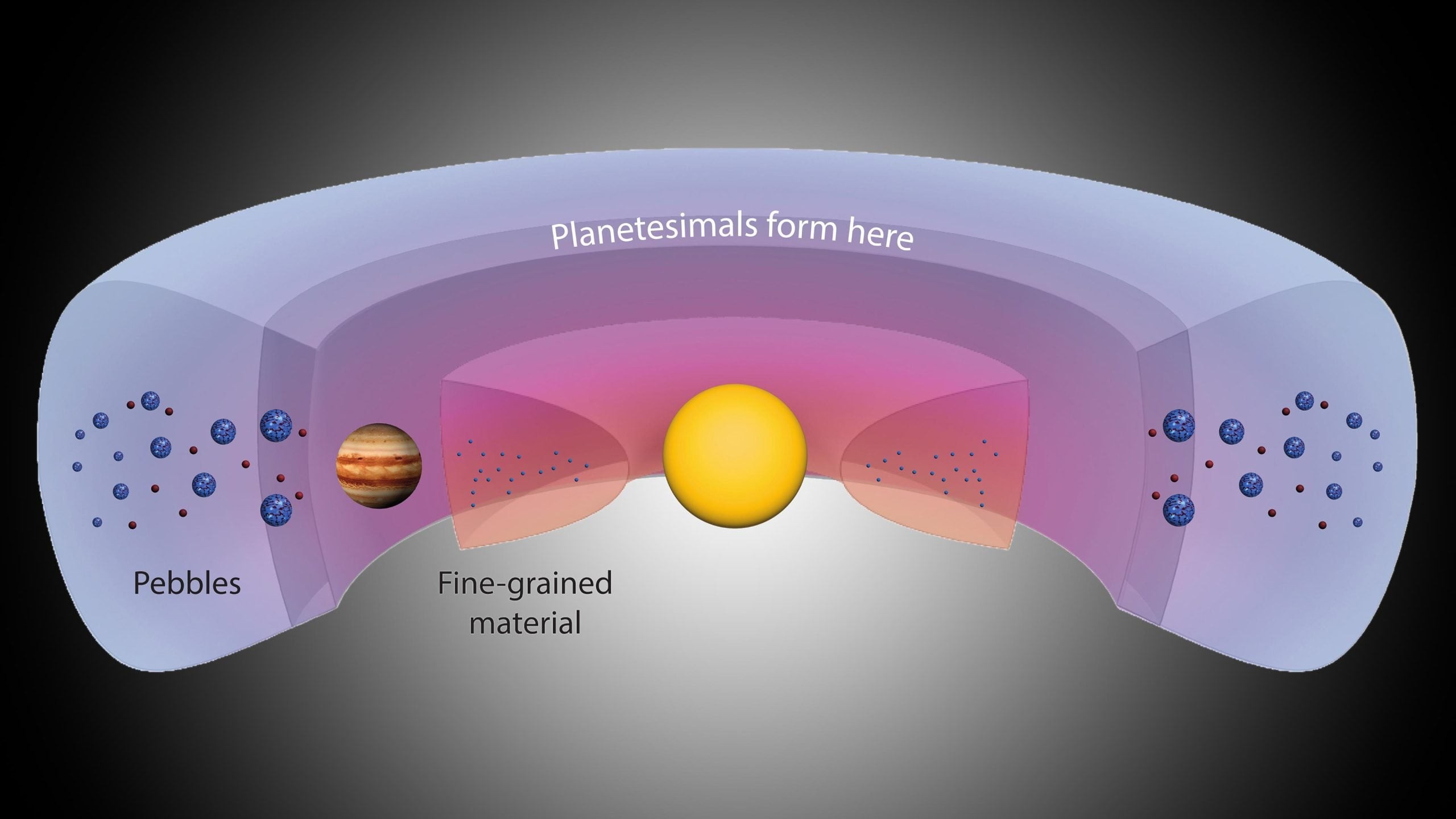
We’ve always known planet formation was a mess. Not an orderly line of construction sites, but a chaotic brawl in a swirling disk of gas and dust.
Now scientists at the Max Planck Institute have pinpointed the exact arena.
It’s a ring-shaped region just outside Jupiter’s orbit. A dust trap.
Over the past two million years of our Solar System’s youth, this place churned out planetesimals. The ancestors of planets, mostly, or perhaps asteroids.
Jupiter as the Gatekeeper
Think of the early Sun. Hot, young, surrounded by raw material.
Then Jupiter showed up. It grew fast. Hungry.
As Jupiter swept up everything nearby, it cleared a lane. A gap.
But physics is weird. Clearing that lane created a wall of pressure right behind it. Outside the gap.
Dust drifting through the system hit that wall and stopped. Piled up. Became thick.
These weren’t just loose grains. They formed pebbles. And then bigger clumps.
We knew pebbles could turn into rocks. What we didn’t know is whether one spot could make different kinds of rocks over time.
It seems it can.
“Different types of planetesimals apparently formed… only at different times.”
— Joanna Drążkowska
The simulations match the real thing.
Specifically the meteorites that crash onto Earth. These are fragments of those ancient rocks, frozen in time. They’ve barely changed since the Solar System started.
The team looked at carbonaceous chondrites. Carbon-rich stones.
Laboratory data says they formed beyond Jupiter. Right there.
They split them into groups. Six types. Some are weak. Crumble if you look at them wrong. Others are tough.
The simulation recreated both.
How It Works
Two million years isn’t long in cosmic time, but it’s plenty for drama.
The region started with delicate dusty material. Then, stable clumps arrived. These sturdy bits formed in hotter areas near the sun and drifted outward.
Jupiter didn’t like the big stuff.
The planet acted like a barrier. It kept the stable particles trapped in that high-pressure zone longer than it kept the tiny dust.
As time passed, the mix changed.
For the first 500k years? The fragile dust dominated.
Then, as new planetesimals ate up some material and the balance shifted, the tougher stuff took over.
Two distinct generations.
One made of soft crumbs. One made of hardened clumps.
The computer models matched the lab results perfectly. Thorsten Kleine, head of the MPS, calls the meteorites a touchstone for these theories. Without them, the sims would be guesswork.
What does that mean for us?
Maybe all the early planets had similar beginnings. Same zip code, different street address.
Or maybe the universe just loves repetition.
We still have questions about even older rocks. Did they form there too?
The dust trap is a crowded neighborhood. 🪐