For over a century, paleontologists have puzzled over the Cambrian Explosion, the rapid burst of animal diversity roughly 500 million years ago. Traditionally, this event was viewed through the lens of anatomy: the sudden appearance of hard shells, jointed limbs, and complex body plans. But a new hypothesis suggests we have been looking at the wrong end of the evolutionary stick.
According to Professor Ariel Chipman of the Hebrew University of Jerusalem, the true driver of this biological revolution was not the shell or the limb, but the brain.
A Cascade, Not an Explosion
The period between the Late Ediacaran and Early Cambrian (approximately 550–520 million years ago) marks the most dramatic shift in animal life on Earth. The biosphere transformed from a quiet world of low-diversity, sessile organisms—mostly bottom-feeders and suspension feeders—into a dynamic, tiered ecosystem. This new world featured motile animals with diverse feeding modes and locomotion strategies, occupying complex ecological niches.
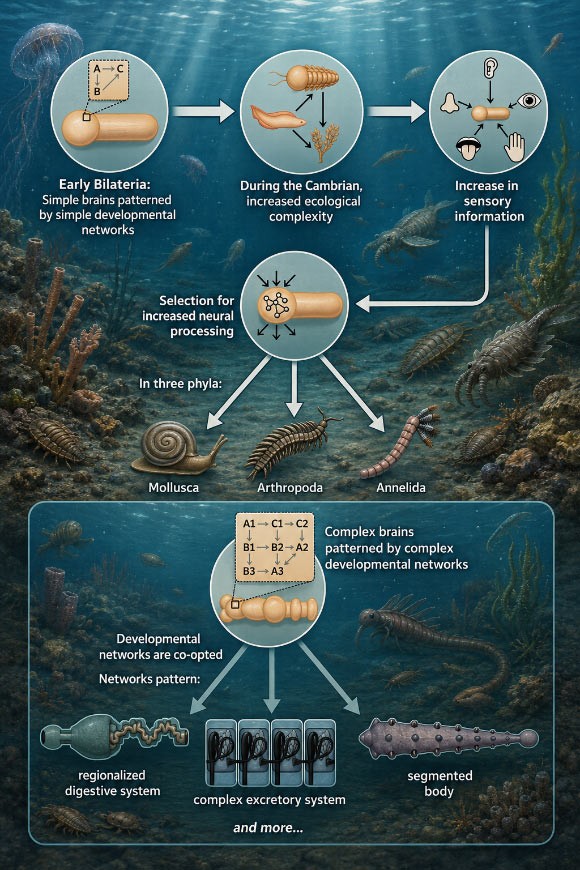
Professor Chipman argues that viewing this transition as a single “explosion” is misleading. Instead, it was a cascade of interconnected developments. As marine environments became more competitive and dynamic, with intensified interactions between predators and prey, organisms faced unprecedented pressure to sense, process, and respond to their surroundings.
“Rather than thinking about a single ‘explosion,’ we should think in terms of a series of linked stages. As environments became more complex, animals needed better ways to process information.”
The Brain-First Hypothesis
At the core of this new framework is the Brain-First Hypothesis. This model challenges the traditional view that complex nervous systems were merely a byproduct of advanced body structures. Instead, it proposes that the expansion and regionalization of the brain occurred early and played a pivotal role in enabling subsequent anatomical innovations.
The logic is straightforward: to navigate a complex, competitive environment, an organism needs more than just a strong shell; it needs sophisticated neural processing. The ecological shift favored the development of complex neural systems capable of handling increased sensory data.
Genetic Co-option: One Toolkit, Many Uses
Crucially, the researchers propose that the genetic mechanisms underlying brain development did not remain confined to the nervous system. Through a process known as co-option, these same genetic toolkits were reused to pattern and build other organ systems.
This reuse of existing developmental pathways helped drive the emergence of more complex body plans, including:
* Specialized digestive systems
* Advanced sensory organs
* Segmented structures
By repurposing the genetic instructions for brain development, early animals could rapidly evolve new anatomical features. This increase in overall biological complexity allowed certain groups to adapt to a wider range of ecological niches, significantly contributing to their evolutionary success.
Who Benefited Most?
The effects of this neural-driven evolution were not uniform across all life forms. The hypothesis suggests that the impact was particularly pronounced in lineages that today exhibit both high structural complexity and exceptional species diversity, such as:
* Arthropods
* Mollusks
* Annelids
* Chordates
Complexity Is Not Always King
It is important to note that increased biological complexity is not inherently advantageous. Many organisms have thrived for millions of years with relatively simple body plans. Evolutionary success depends entirely on the specific demands of an organism’s environment.
By shifting the focus from a single dramatic event to a sequence of gradual, ecologically driven changes, this research offers a nuanced understanding of the origins of animal diversity. Future work in genetics and developmental biology will be essential to test this hypothesis and further clarify the role of the brain in shaping the trajectory of life on Earth.
Professor Chipman’s findings were published in April 2026 in the journal BioEssays.
In summary, the Cambrian Explosion was likely less about the sudden invention of hard parts and more about the rise of cognitive capacity. The brain didn’t just follow the body’s evolution; it led the way, unlocking the genetic potential for the diverse animal life we see today.