Current rovers creep along. Five hundred to a thousand feet per hour. Roughly the length of three football fields. They do it in short bursts then sit idle. It is agonizingly slow.
NASA knows the hardware can move faster. The bottleneck is not the wheels. It is the brain. Specifically, the fact that the brain lives 200 million miles back in Pasadena.
Meet ERNEST. Exploration Rover for Navigating Extreme Scaled Terrain.
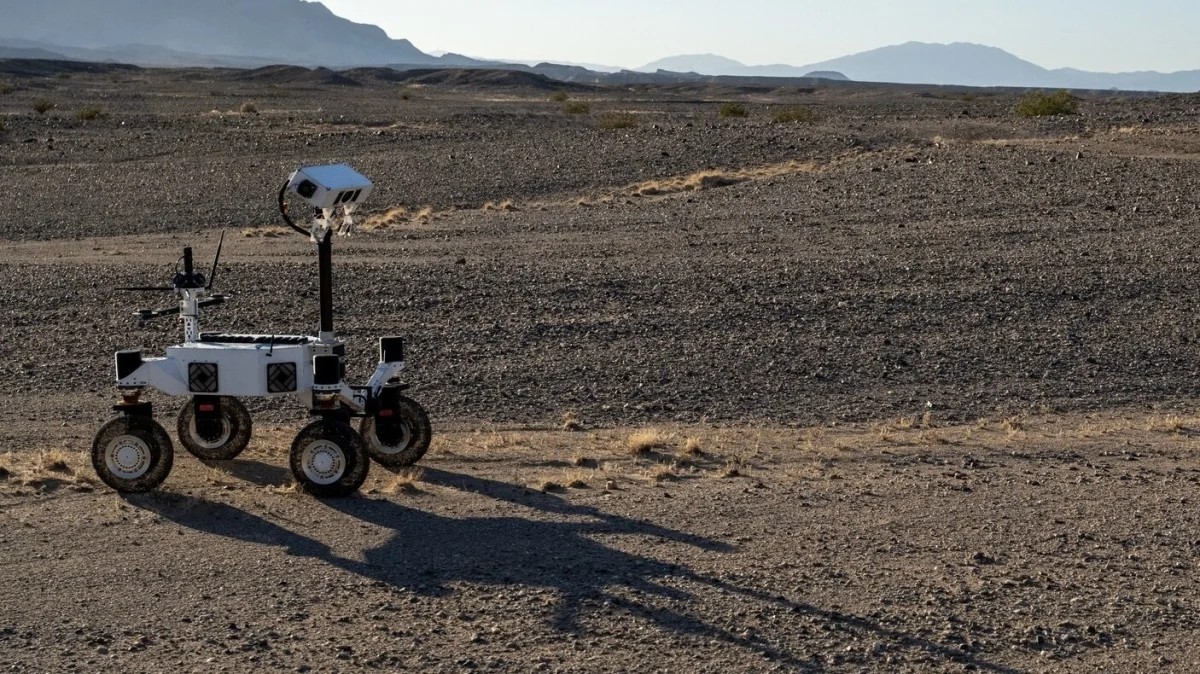
It is a mini-prototype. About four feet long. It looks like Wall-E had a baby with a rock crusher. Four mesh wheels. No treads. Those wheels tilt and lift like it is standing on its tiptoes.
In a recent test ERNEST rolled toward a pile of bouldbers that would have stopped Perseverance. Curiosity would have stalled. ERNEST just climbed over. No joystick input. No call to Mission Control. It sized up the rocks shifted its weight and drove on.
You may ask why this matters.
Think about Perseverance on Mars right now. It stops. Waits for instructions. Drives a few inches. Waits again. That is micromanagement. The light lag from Earth to Mars means commands take minutes one-way. By the time engineers see the photo of the obstacle they already spotted and drove past the window to react has closed.
Integrating artificial intelligence and autonomy software isthe future of extraterriall roversbecause it fundamentallyovercomes thecommunicationdelays. — Ashish Goel, JPL Research Technologist
Goel puts it bluntly. Perseverance drives significantly more distance than Curiosity did. Why? Not better wheels. Better autonomy.
The goal is Endurance.
That is a concept study. Not a funded mission yet but NASA is looking at it. Endurance is a lunar rover. It needs to cover 1,200 to miles on the moon over four years.
To do that it needs to travel two point five to four miles per earth day. That is what Perseverance does in a year. Endurance needs to keep moving when Earth goes silent.
Three problems make this hard.
- Bandwidth. Sending images eats radio resources. You cannot ask for permission for every left turn if you are crossing a continent-sized crater field.
- Schedules. Mission control doesn’t send daily text messages to these things. Up links happen every few weeks. Daily hand-holding is not on the calendar.
- The environment. Lunar night lasts fourteen earth days. Temperatures swing wildly. Light changes drastically.
Current rovers hibernate or power down during the long lunar night. Endurance cannot. It has to survive the cold. Manage its own heat. Check its own health. And wake up ready to drive.
Thefrequencyof anomalies has to besufficientlylowto maximizemeans-distance betweeninterruptions. — 2025IEEEAerospaceConference Paper
If the rover has to call home for every flat tire or stuck wheel the math doesn’t work. The distance between interruptions becomes the primary metric for success.
ERNEST is the practice run.
Engineers built smaller half-scale models first. They tossed them into sandboxes with artificial moondust. Tried eleven different suspension designs. Finally settled on one that squats. Leans. Walks. Spreads its weight when the ground feels soft.
Then came the AI.
Reinforcement learning. A type of artificial intelligence that learns by trial and error much like a toddler learning to walk but without the tantrums. JPL’s simulation lab created a digital twin of ERNEST. Fed it real-world data from hardware tests. Then let it drive. Virtually. For thousands of hours.
Digital practice pays off. The “brain” got uploaded into the real chassis. Then the real rover hit the Mars Yard. An obstacle course in a building in California. Sand ripples. Rubble. Steps. Steep slopes.
ERNEST chose when to lift a wheel. When to crab-walk sideways. When to detour around a tricky patch.
But wheels are only part of it. Eyes matter more.
Light on the moon is brutal. Sunlight blasts one side of a rock face while the other side sits in pitch black. There is no atmosphere to scatter the light like on Earth. No blue sky. No diffuse shadow. Cameras see glare and darkness in the same frame. Depth perception goes out the window.
Future rovers need sharper eyes. Better cameras. Headlights. Laser 3D mapping. The onboard AI needs clean data to make steering decisions. If it cannot see the crater rim it cannot decide not to fall in.
We are building machines that can think independently. Because waiting is not an option. Not when the frontier is 200 million miles of dead space.