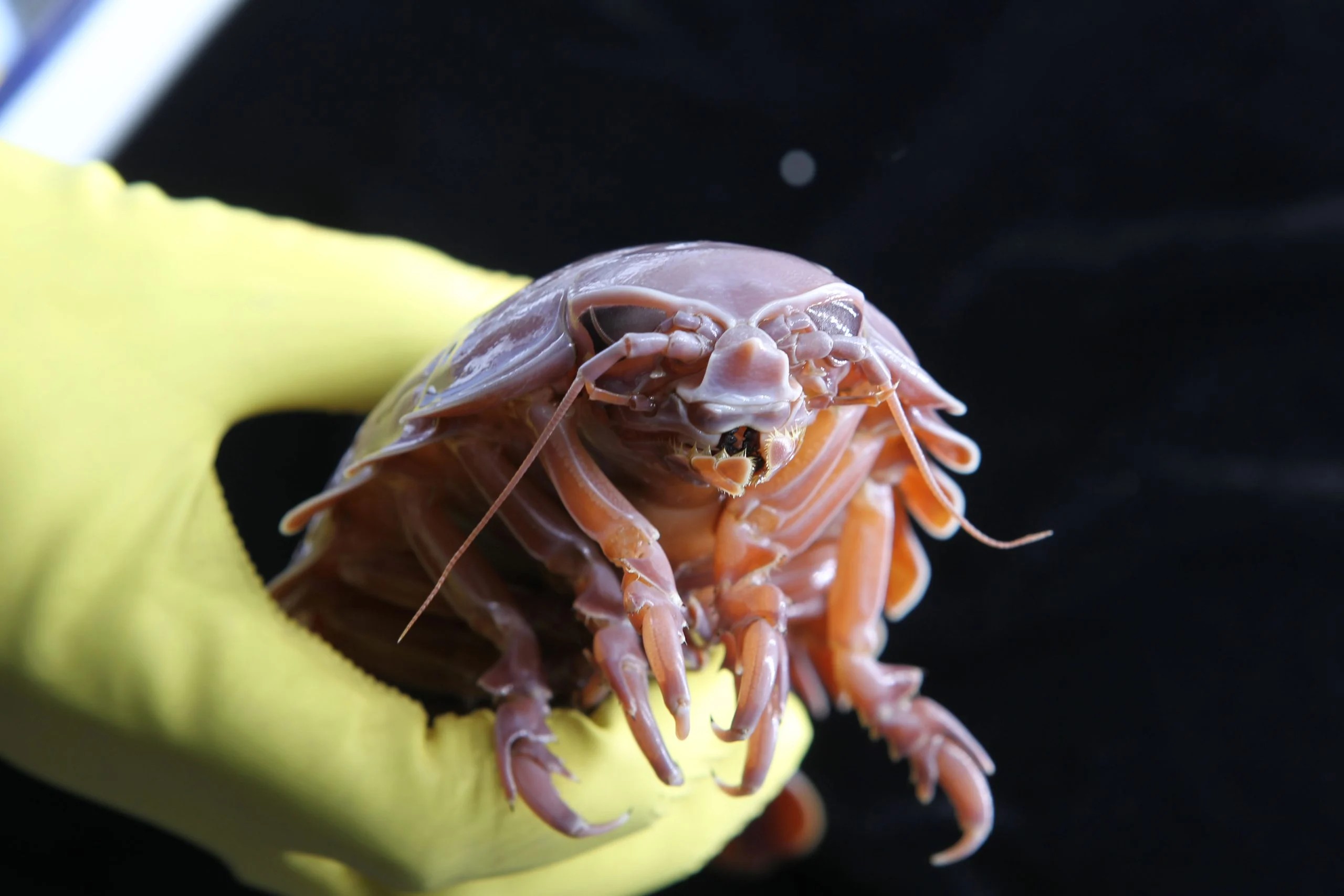
Five years without a meal. It sounds like a death sentence. For most animals, it is. The supergiant bathynomomid doesn’t care. It grows bigger than a football and lives in the dark.
Scientists have long been baffled by this contradiction. How do you get huge in a place with nothing to eat? The ocean floor is a desert. Feeding is random. Predators are rare, but so is lunch.
A team from the Chinese Academy of Sciences cracked the code. They used multiomics and functional tests to peek under the hood. The secret? An oversized stomach. A sluggish metabolism. Both working in tandem.
The findings landed in Cell.
The stomach as a warehouse
Think about the geometry. In deep-sea isopods, two-thirds of the body is stomach. Compare that to cousins living in shallow water or tide pools. Their digestive organs are tiny. These deep-dwellers carry around a massive tank.
When food appears, they gorge. They fill that stomach with a mud-like sludge. It is heavily digested. Fine. Thick. There are very few Firmicutes bacteria in there—bacteria that usually help break things down. Instead, they are packed with Chlamydiae. These microbes love lipid storage.
Increase revenue. Reduce expenditure.
It is a brutal efficiency. Eat everything at once. Then stop burning fuel.
The researchers looked at two species. Bathynomus jamesi at 898 meters. Bathynomus doederleini at 300 meters. Different depths, same strategy. Low basal metabolic rate (BMR). Slow digestion. The reserves last. For years.
A stolen gene saves lives
There is another piece to the puzzle. A gene called ND1.
Isopods didn’t evolve it themselves. They stole it. Horizontal gene transfer brought this bacterial snippet into the isopod genome. ND1 is a component of Complex I, part of the electron transport chain. It runs the energy grid.
Usually, foreign genes get rejected by a new host. ND1 cheated. It duplicated. It started expressing itself at extreme levels. How? Epigenetic tricks. Specifically, histone acetylation tweaks the gene to run hot when needed and cool when conserving energy.
The proof was in the model organisms. Zebrafish. Nematodes. Human 293T cells
Insert ND1 at room temperature, and metabolism spikes. Starvation tolerance drops. Makes sense. Your engine is redlining. You burn out fast.
Put them in cold water. Simulate the deep sea. ND1 suppresses energy metabolism. Mitochondrial activity plummets. In the fish, starvation tolerance jumped by 37 percent.
The cold acts like a switch. It flips the borrowed gene from an accelerator to a brake.
Living on the edge of survival
Gigantism is expensive. Being huge costs energy. The deep sea is cheap on energy supply. So, isopods solved a trade-off that should break evolution. They co-opted microbial tech to fine-tune metabolic depression.
This isn’t just a neat trick. It is a paradigm shift. Megafauna don’t just endure; they reshape energy allocation. They use bacterial genes to balance growth and starvation.
Jianbo Yuan, the first author, put it plainly. They decoded the mystery of ultra-long tolerance. They showed how life balances the book in the dark.
It raises questions. What else is hiding in the genome, borrowed from bacteria? How many animals are running on stolen parts? We assume evolution is slow and steady. Sometimes it is just theft and timing.
The deep is quiet. But it is full of secrets.