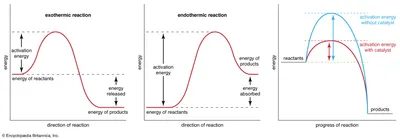
All ingredients from around the world are available. flour, eggs, heat. However, if you don’t get the starting point right, the cake won’t be finished. It’s going to be a mess. Simply put, this is activation energy. This is the minimum initiation required to move an atom or molecule from rest to reaction. Without it, nothing happens.
In chemistry, this is called a threshold. This is a specific energy level that a particle must reach in order to undergo a chemical change or physical motion. Think of it as an energy barrier. If the molecules are not strong enough to overcome this barrier, the reaction stops. Period.
Explanation of transition state theory
To really understand how this works, you need to learn about transition state theory. Here, the activation energy is defined as the difference in energy content between the activated configuration and the initial state.
Imagine the ball is in the valley. You have to push it up the hill to get it to the other side. That mountain top is in transition. The energy required for the ball to reach its highest point is the activation energy.
This concept is mathematically embodied in the Arrhenius equation. It seems scary, but this is just a pattern of how quickly things can happen.
k = A e ^ (- E a / R T )
Let’s break it down without using too much jargon.
- k is the reaction rate constant. Basically, it’s the speed of response.
- A is a prefactor. This describes how often the molecules collide. Every reaction is different.
- E a is called the activation energy.
- R is the universal gas constant. This is about 8.314 joules per kelvin per mole.
- T is the temperature in Kelvin.
This equation shows a direct relationship. As the activation energy increases, the rate constant decreases. The higher the obstacle, the slower the reaction.
It’s not just about chemicals
We usually talk about this in connection with mixing liquids or gases, but activation energy also applies to physical transport. Diffusion is an important example.
When particles diffuse from an area of high concentration to an area of low concentration, they must overcome an energy barrier. The diffusion coefficient D follows a similar exponential expression.
D = D 0 e ^ (-E a / R T )
Here D 0 is constant. The principles remain the same. The higher the diffusion activation energy, the slower the particles move.
How scientists measure it
You can’t read activation energy by looking in a beaker. Not listed on the bottle.
Scientists determine these values experimentally. Measure rate constants or diffusion coefficients at different temperatures. By plotting this information, we can work backwards to find the activation energy.
This is a process of observation and calculation. You change the temperature. Observe how the speed changes. Next, crunch the numbers to find the critical energy threshold.
Why you should be aware of this obstacle
Activation energy is not only understood by chemists in white coats. This explains why it sometimes happens quickly and sometimes takes years.
it explains why