
At first glance, the image looks like just another stock photo of the Blue Planet. Clouds swirl. Continents sit still. It’s familiar. But look closer. This isn’t from a massive observatory or a billion-dollar NASA probe. It comes from a camera no bigger than a smartphone, tucked inside a cube that weighs five kilos. The size? Roughly half a standard shoebox.
This tiny lens belongs to TRISAT-R. It’s a nanosatellite built by the University of Maribor in Slovenia. They didn’t do it alone. The European Space Agency (ESA) partnered with them. That partnership matters. It shows how academic institutions are stepping up in space tech.
The satellite launched in July 2022. The rocket? Vega-C. This wasn’t just any launch. It was the inaugural flight of Vega-C. The first time. Everything hangs in the balance on a maiden voyage. If that rocket failed, TRISAT-R would be lost to the void. It didn’t fail. It soared.
Now, it orbits Earth. Taking pictures. Capturing data. All from a package that fits in your trunk.
The Power of Small Satellites
Why does a five-kilogram satellite matter? Because space is becoming accessible. Not just for governments. But for universities. For startups. For anyone with an idea and a budget that doesn’t require a mortgage.
TRISAT-R proves that size doesn’t dictate capability. A shoebox-sized craft can carry advanced cameras. It can operate in the harsh environment of low Earth orbit. It can send back clear images of continents and oceans. This is democratization of space. In real time.
The University of Maribor didn’t just build hardware. They built a platform. One that ESA trusted. That trust is currency in space. It opens doors. Funding follows. Collaborations form.
Why TRISAT-R’s Launch Was Significant
The Vega-C maiden flight is the key context here. Aerospace engineers test rockets. They watch telemetry. They hold their breath. When Vega-C successfully carried TRISAT-R, it validated new propulsion systems. It proved reliability. And it put a student satellite into orbit.
That dual achievement is rare. Most inaugural flights carry government payloads. TRISAT-R was academic. It was small. It was high-risk. It succeeded.
This changes the landscape. If a university satellite can survive a maiden rocket flight, others can too. The barrier to entry drops. More cubesats will launch. More data will flow. More students will learn by doing.
The Real-World Impact
You might ask: who cares about pictures of Earth from a shoebox?
Data.
High-resolution imagery. Atmospheric readings. Environmental monitoring. These cubesats collect millions of data points. They track deforestation. They monitor urban sprawl. They observe weather patterns. All this info feeds into climate models. Into disaster response. Into agricultural planning.
TRISAT-R is one piece of a growing puzzle. Each small satellite adds a pixel. Together, they form a complete picture. A living, breathing map of our planet.
The technology is shrinking. The cost is dropping. The impact is rising.
We’re entering an era where space observation isn’t reserved for superpowers. It’s available to anyone with a vision. And a

The World’s Tinyest Eye in Orbit
Two cubic millimeters. That is all the space this camera occupies. To visualize it, picture the thin edge of a 20-cent euro coin. It is that small.
At first glance, you might wonder what a sensor of this size can possibly capture. The answer lies in altitude. These micro-cameras are mounted on a cubesat orbiting 6,000 kilometers above the Earth. The distance compensates for the miniature lens. The resulting image quality defies the physical limitations of the hardware.
The cubesat carries two of these micro-cameras. Having a pair allows for stereoscopic imaging or redundancy, a crucial design choice for deep-space or high-orbit missions where maintenance is impossible. This isn’t just about shrinking technology for the sake of miniaturization. It proves that high-resolution data acquisition no longer requires massive, expensive launch payloads.
When you combine such a tiny footprint with a high-altitude vantage point, you unlock a new class of observation. We are looking at a shift toward distributed, lightweight sensing networks. The implications for future satellite constellations are significant. Why launch one big eye when you can launch dozens of small ones?
The physics of optics remain unchanged, but the engineering application has. These devices challenge the assumption that size equals capability. They suggest a future where space-based imaging is ubiquitous, cheap, and scalable. The era of the bloated satellite might be ending.
Why Size Matters More Than You Think
The reduction in volume isn’t trivial. It changes how we build spacecraft. Less mass means lower launch costs. It means more room for other instruments or fuel. But beyond economics, there is a strategic advantage.
A cubesat with sub-cubic-centimeter cameras can be launched on rideshare missions. This democratizes access to space. You no longer need to be a government agency or a tech giant to put a sensor in orbit. You just need a budget and a good idea.
Consider the data return. Even with a small lens, capturing images from 6,000 km up requires sophisticated processing. The raw data is noisy. The algorithms have to work harder to reconstruct clarity. This pushes the boundaries of on-board computing and AI-driven image enhancement.
We are moving toward a model of “sensor swarms.” Imagine hundreds of these tiny units working in concert. They could track weather patterns, monitor deforestation, or map urban growth with a level of detail and temporal resolution that single large satellites cannot match.
The trade-off is resolution per frame. A smaller sensor gathers less light. In low-light conditions, these cameras struggle. But for daytime imaging from high altitudes, the trade-off is acceptable. The key is redundancy. If one camera fails, the others continue the mission.
The Technical Hurdle of Micro-Optics
Manufacturing a functional camera system under two cubic millimeters is an engineering nightmare. Standard lenses are too thick. Standard sensors are too wide. The solution lies in specialized materials and fabrication techniques.
Silicon photonics plays a role here. By etching optical components directly onto silicon chips, engineers can bypass the need for bulky glass elements. This integration reduces weight and power consumption significantly.
Power is another constraint. A cubesat at 6,000 km relies on solar panels and batteries. A tiny camera still needs energy to operate, process,
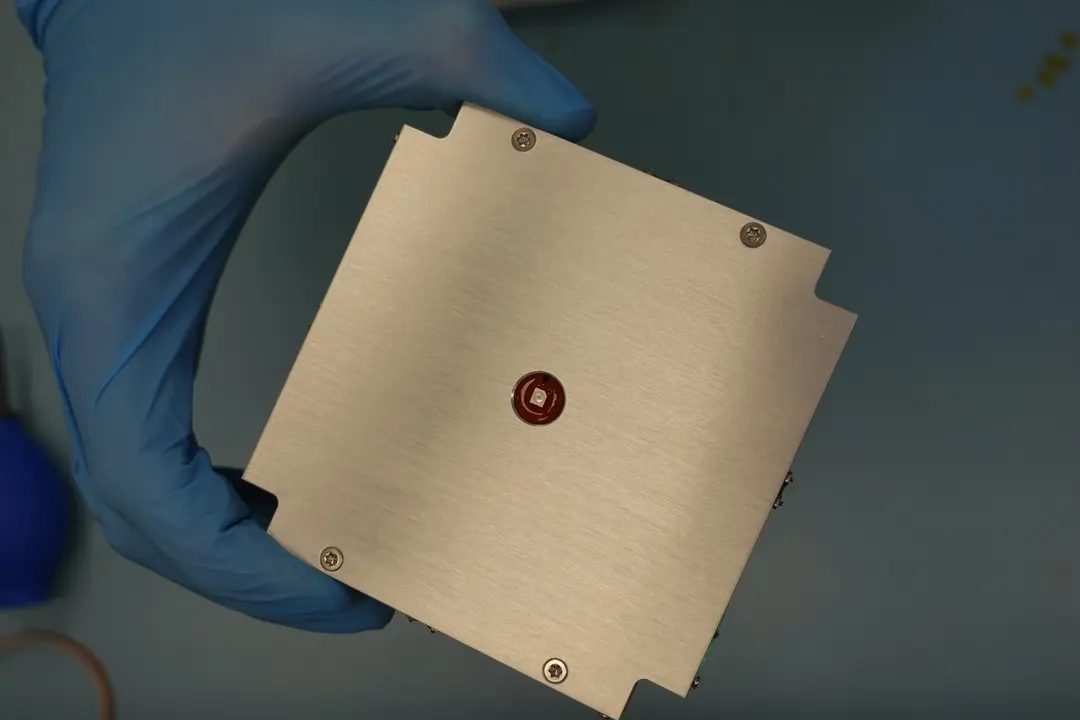
When Pixels Burn Out: The Black Sun Effect
The goal was simple enough. Capture instances of what’s known as the black sun effect, where blown-out highlights or crushed shadows create stark, unnatural zones on screen. It happens when sensors get hammered by intense light. The pixels saturate. They stop behaving like data collectors and start acting like overflow buckets.
The hardware used for this wasn’t high-end cinema gear. It was a 320×320 pixel matrix. Tiny. Crude by modern standards. Mounted behind a borosilicate glass lens. You know, the stuff Pyrex is made from. Cheap. Durable. Chemically resistant. But not particularly sharp.
So why does the image quality suffer? Because borosilicate glass, while great for resisting thermal shock in labs, doesn’t offer the optical perfection of modern camera lenses. It introduces distortions. Aberrations. Blur. You’re trying to capture a phenomenon defined by extreme contrast—a “black sun,” essentially, where light clips so hard it turns the surrounding area into void or white noise—and you’re doing it with a sensor that has less than a quarter of a megapixel.
“High saturation isn’t just about brightness. It’s about the sensor hitting its ceiling and flatlining.”
The result is a low-resolution mess. You get the effect, sure. The visual signature of pixel clipping is there. But the details? Gone. The black sun effect shows up as a harsh, binary statement. Either the pixel is maxed out, or it’s not. There’s no gradation. No subtle interplay of light and shadow. Just a hard cut where the camera’s limitations take over.
It’s a reminder that even the most interesting optical phenomena can be ruined by cheap glass. And small sensors. Mostly the sensors.

The headlines about quantum computers are getting louder. You’ve likely seen the buzz about qubits, entanglement, and superposition. But the real story isn’t in the physics labs in Geneva or Boston. It’s in how this technology will quietly reshape the world you live in. We are moving past the theoretical phase. The hardware is starting to work. And that changes everything.
The End of Brute Force
Traditional computers solve problems step-by-step. Quantum machines don’t. They explore many solutions at once. This isn’t just faster. It’s a different way of thinking.
Consider drug discovery. Today, testing new molecules takes years. Quantum simulation can model atomic interactions with precision we can’t match yet. That means finding cures faster. Cheaper. And with fewer failed trials.
“We are not just speeding up calculation. We are changing what is calculable.”
Where Security Meets Reality
Here is the uncomfortable part. The same power that finds drugs can also break encryption. Current encryption relies on math problems that are hard for classical computers. Quantum algorithms like Shor’s can solve those problems in minutes.
This isn’t a distant threat. It’s a countdown.
Companies are already moving toward post-quantum cryptography. You might notice new security protocols in apps soon. It’s not hype. It’s preparation. The transition will be messy. But ignoring it is impossible.
Batteries and Climate
Quantum effects are also helping us design better materials. Think about lithium-ion batteries. They rely on complex chemical reactions we don’t fully understand at the atomic level. Quantum simulations can model these reactions exactly.
Better batteries mean longer range for electric vehicles. Cheaper storage for renewable energy. This is where science meets street-level reality.
- Material Science: Simulating molecular structures for solar cells
- Chemistry: Optimizing catalysts for carbon capture
- Logistics: Solving complex routing problems for supply chains
The Human Element
It’s easy to focus on the silicon and the lasers. But quantum computing is a tool. Like the steam engine or the transistor. It amplifies human capability. It doesn’t replace human judgment.
The developers working on these systems are facing a massive learning curve. The talent gap is real. Universities are scrambling to update their curricula. If you’re interested in tech careers, this is a space to watch.
We’re not there yet. Full-scale error-corrected quantum computers are still years away. But the momentum is undeniable. The questions aren’t if it will happen. They’re when and how it will affect your wallet, your health, and your privacy.
Keep an eye on the pilot programs. The early adopters are already seeing results.