




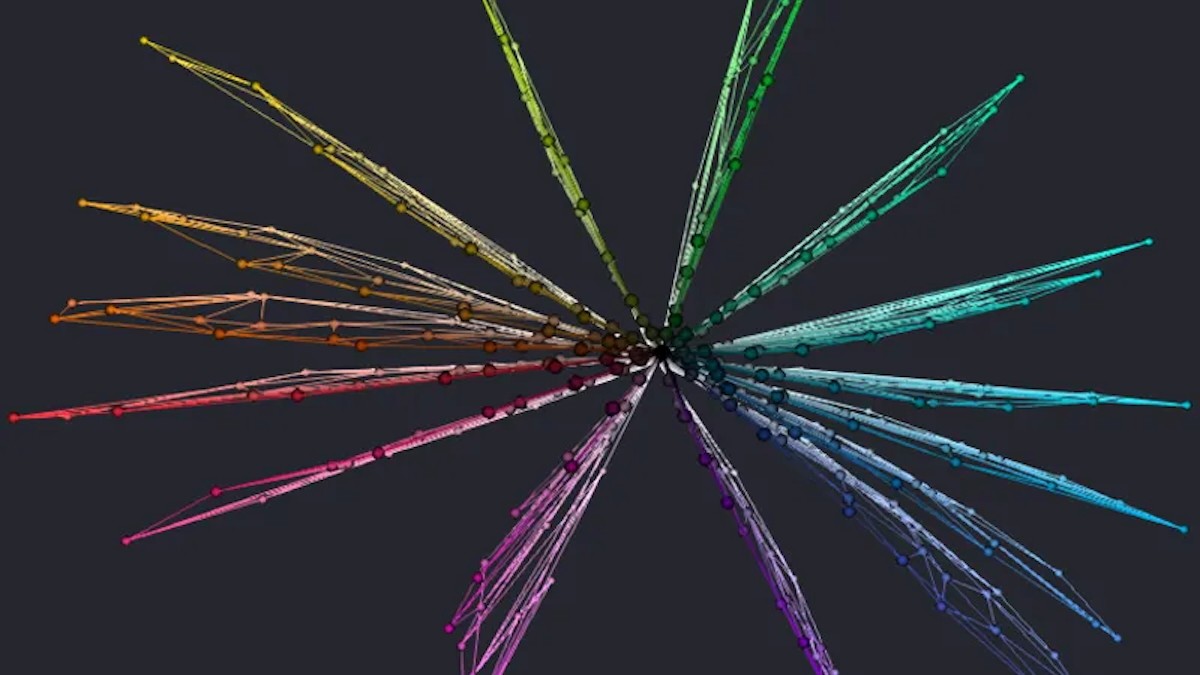
Researchers at Los Alamos National Laboratory have completed a key piece of work begun by physicist Erwin Schrödinger in the 1920s, resolving ambiguities in his mathematical definitions of color perception. The new study confirms that our basic perception of color distinctions is intrinsic, meaning it’s not shaped by cultural or learned experiences, despite variations in how we name colors. This finding doesn’t just refine a historical theory; it has implications for how we model visual data and understand the fundamental way humans process color.
The Historical Context: Schrödinger’s Incomplete Model
Schrödinger, famous for his “Schrödinger’s cat” thought experiment, also explored how we perceive color. His work built on the idea that color perception could be defined geometrically, using concepts from differential geometry. Mathematician Bernhard Riemann proposed that our mental “color spaces” are curved, not straight, meaning the shortest perceived distance between two colors isn’t always a straight line.
Schrödinger attempted to define color attributes (hue, saturation, and lightness) based on a color’s position relative to a “neutral axis” — a gradient of grays between black and white. However, he never formally defined this neutral axis, leaving a critical gap in his model. Despite this flaw, his framework remained influential for decades.
The New Research: Correcting the Geometry of Color
The Los Alamos team found that Schrödinger’s model couldn’t fully explain observed phenomena like the Bezold-Brücke effect (where changing light intensity alters perceived hue). To fix this, they moved beyond the Riemannian geometry Schrödinger used, defining the neutral axis based on the geometry of the color metric itself.
They also addressed the issue of diminishing returns in color perception — our tendency to perceive large color differences as less impactful than a series of smaller shifts. By replacing straight-line definitions with the shortest paths in perceptual color space (geodesics), they created a more accurate model.
Why This Matters: Beyond Theoretical Physics
This research isn’t just academic. The refined geometric framework provides a more robust foundation for modeling color in scientific visualizations, computer graphics, and even human-computer interaction. The team’s work represents the first complete realization of Hermann von Helmholtz’s vision: formal geometric definitions of color attributes derived entirely from perceptual similarity, without external influences.
“What we conclude is that these color qualities don’t emerge from additional external constructs such as cultural or learned experiences but reflect the intrinsic properties of the color metric itself,” explains lead author Roxana Bujack.
In essence, the study confirms that despite our subjective experiences with color, the underlying perception is rooted in the physics of how our eyes and brains process light. This reinforces the idea that some aspects of human perception are fundamentally consistent across cultures and individuals.