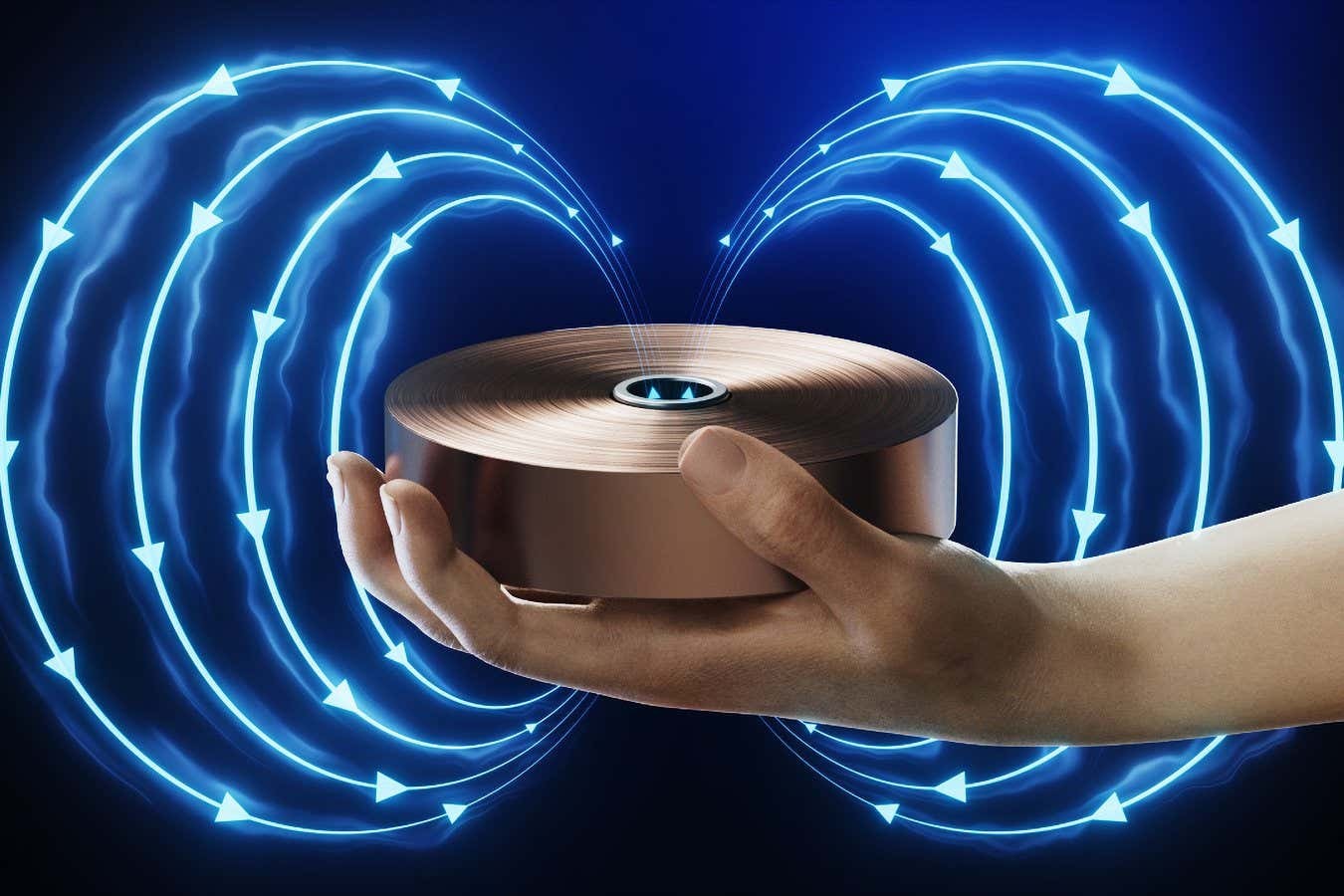
For the first time, researchers have created a miniature superconducting magnet that matches the strength of some of the world’s most powerful industrial magnets. This achievement represents a significant leap forward in magnet technology, potentially democratizing access to high-field magnetic applications previously limited by size and cost.
The Challenge of Strong Magnetic Fields
Strong magnets are critical for diverse fields including medical imaging (MRI), particle physics research, and experimental fusion energy. The most potent magnets traditionally rely on superconductors – materials that conduct electricity with virtually no resistance. However, these superconductors often require massive infrastructure: smaller versions still rival the size of a small vehicle, while the largest are comparable to multi-story buildings.
The New Miniature Magnet
A team at ETH Zurich, led by Alexander Barnes, has developed a superconducting magnet only 3.1 millimeters in diameter that competes with these larger systems in strength. The breakthrough came from coiling an ultra-thin tape of REBCO, a ceramic superconductor, and cooling it to extremely low temperatures. Through an iterative “fail fast” approach involving over 150 prototypes, the team finalized a design using either two or four pancake-shaped REBCO coils.
Performance Metrics
The resulting magnets generate fields of 38 to 42 Tesla – far surpassing the strength of typical refrigerator magnets (under 0.01 Tesla). For context, the current world record for steady magnetic fields is around 45 Tesla, but requires multi-ton equipment and up to 30 megawatts of power. Barnes’ magnet operates on less than 1 watt.
Implications and Future Applications
The immediate goal is to integrate this technology into nuclear magnetic resonance (NMR) spectroscopy. NMR is a technique used to determine the structure of molecules, but its accessibility is limited by the size and cost of current magnetic systems. By making high-field magnets smaller and more affordable, this innovation could open up advanced chemical analysis to a wider range of researchers.
Expert Perspective
Mark Ainslie at King’s College London confirms the significance: “Producing fields above 40 Tesla traditionally requires very large and expensive facilities… achieving similar field strengths in such a compact device is significant.”
However, further refinement is needed. Questions remain about magnetic field uniformity and precise control over electromagnetic behavior before widespread adoption. Nevertheless, this development suggests that high-field magnets may soon become more accessible to laboratories across various disciplines.
This advance promises to reshape how we approach high-field magnetic applications, making powerful tools available to a broader range of scientific and industrial users.