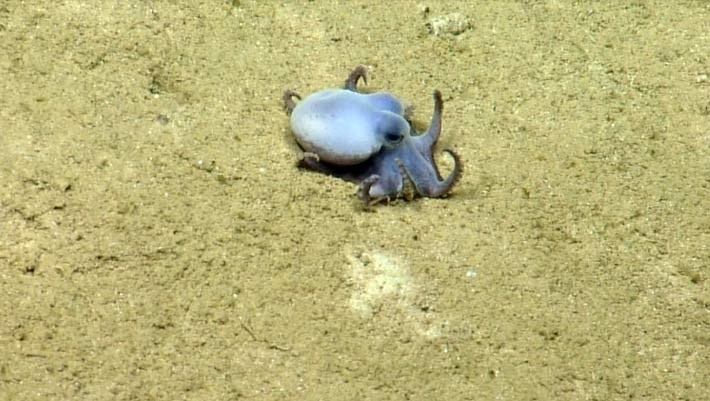
A single female octopus was hauled from 1,773 meters deep. She doesn’t belong there.
Or at least that’s what the old rules said.
For a long time, the family Megaleledonidae was easy to define. Big bodies. Cold water. Exclusively Southern Ocean. You know, Antarctica style. Simple. Clean. Boring.
Then they found Microeledone galapagensis.
She’s small. She’s tropical. She was snagged near Darwin Island in the Galápagos. The name makes sense if you know who Charles Darwin was.
This one find forces a rewrite of the family description. It turns out the definition was wrong.
Dr. Janet Voight, who curates invertebrates at the Field Museum, puts it bluntly: the deep eastern Pacific is basically a blank map for scientists. We’ve barely looked.
“Subsea vehicles provide exceptional but rare opportunities to see these animals. They reveal unexpected taxa.”
Unexpected. Yes.
The old diagnosis relied on Megaleledone setebos, a massive Antarctic beast. The new guy? Not big. Not Antarctic. Not even close.
The problem with rare things
You only had one specimen. Just her.
Cutting her open to check the beak and teeth was a no-go. Science isn’t just about naming; it’s about not destroying the only copy. So they used micro-CT scanning. It’s non-destructive. It lets you peer inside without making a mess.
Microeledone galapagensis ’s insides came into focus. The stomach. The eggs. All visible. No scissors needed.
Dr. Stephanie Smith from the same museum loved it. Seeing something no one else has seen is a thrill. But the real miracle was the image quality.
Usually, you need heavy-metal contrast agents to see soft parts in CT scans. Those agents would ruin the specimen. Or maybe the science. Here, the scan worked anyway.
“The 3D modeling was easy,” noted Dr. Alexander Ziegler.
No extra steps. No toxins. Just data.
Not a lone ranger
Here is the kicker. During the same dive by the research vessel Nautilus in 2015, the camera caught two other octopuses. Same species.
It wasn’t just her.
The waters near Darwin Island aren’t empty. There is a population there. Hidden in the dark. Waiting for a submarine.
Why does this matter? Because the Pacific Ocean is huge. If you smashed every piece of land on Earth into a single lump, it still wouldn’t cover the water. We have seen so little of it.
Voight feels lucky to work with these ghosts of the deep. They are beautiful. Rare. Unstudied.
The paper is out in Zootaxa. The textbooks need editing again.
How much else is out there, living in the dark, waiting to break a rule?