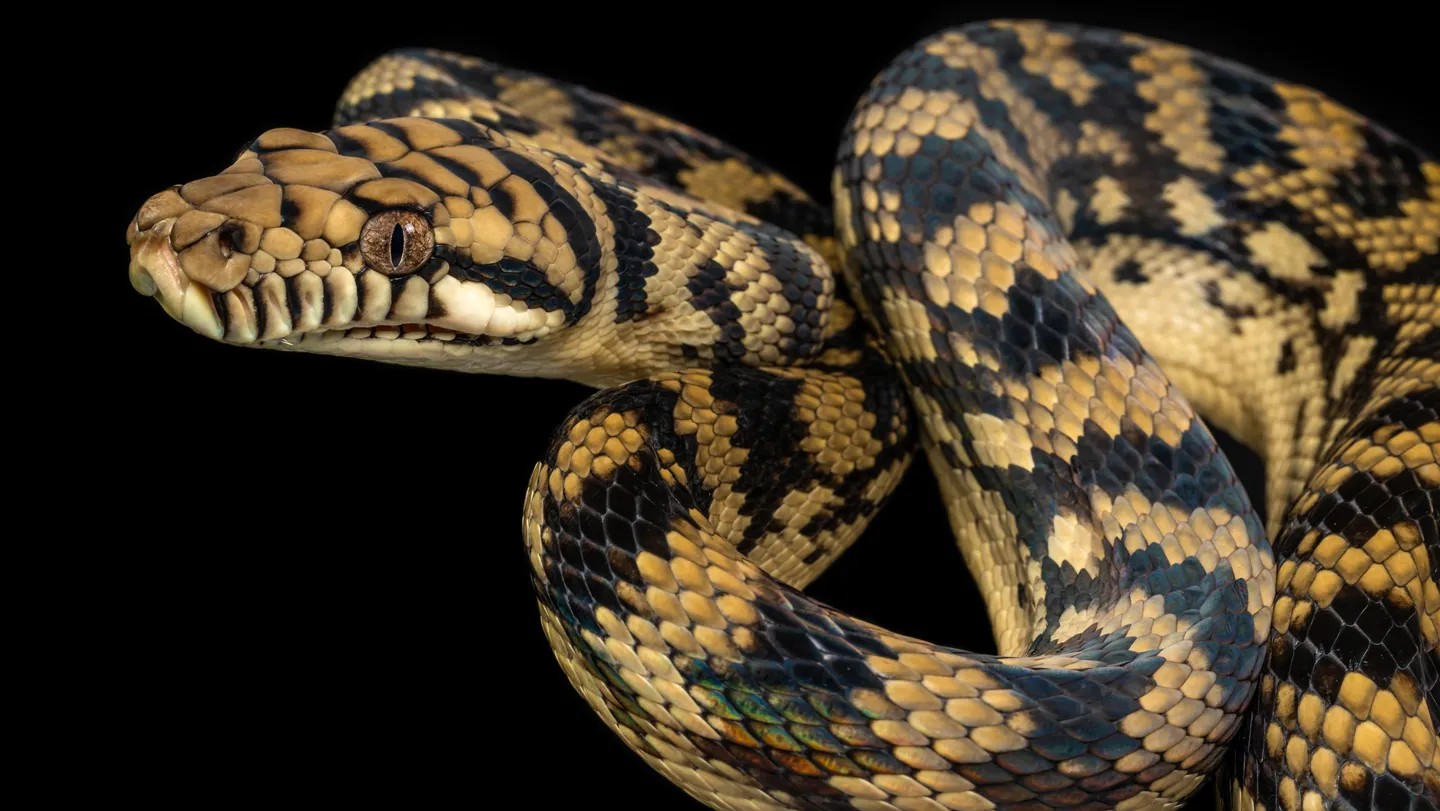
They don’t have legs.
You wouldn’t think they could climb a vertical wall or stand upright, but snakes do it anyway. A new study unpacks the physics behind these limbeless ascents, turning out some surprising mechanics about how soft bodies generate force against hard surfaces.
The setup
Researchers needed to figure this out.
Not just because it’s cool to watch a python hug a pole, but because robots need the data too. If engineers can understand how a snake distributes weight and finds purchase without joints, maybe a search-and-rescue robot could do the same.
They started with a bioengineer’s problem: how to simulate something that squishy. Snakes are complex. Their muscles contract, expanding their ribcage to grip surfaces, creating traction where there is none.
Friction is everything
Gravity is the enemy here. It pulls the python down, relentlessly. To climb, the snake needs force that opposes that pull.
It’s not just about gripping. It’s about angling the body so friction does the heavy lifting.
The team created a computer model. They ran scenarios where the snake’s body angle changed, looking at the interface between skin and wall.
It turns out, the snake creates loops. Or rather, S-shaped curves. Each curve acts like a little anchor point.
Robotic lessons
This matters for the roboticist.
Build a hard metal snake, and it slips. Build a soft one that can modulate pressure, and you have a machine that climbs trees, scales debris, moves through collapsed buildings.
The study showed that tactic matters more than raw power. A slight shift in angle, a specific strategy of contraction, lets the snake hold its position vertically without sliding down.
Is it elegant? Maybe. Is it useful? Definitely.
Open questions
The footage they analyzed shows snakes doing this all the time in the wild, unconcerned with physics textbooks.
They just climb.
We’re still figuring out exactly how their nervous system calculates the load on every segment in real-time. It’s messy, biological, imperfect engineering.
Which might be the only reason it works at all.
We have a robot that tries. The snake has a spine and a will.
The rest is still up in the air, or at least, on the wall. 🐍