
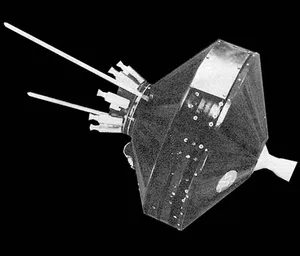

The Pioneer program stands as the foundation of American interplanetary exploration. These were the first unmanned probes the United States launched to study space beyond Earth’s immediate vicinity. While the initial batch focused on our lunar neighbor, the mission scope expanded rapidly. Later probes targeted planets and measured the invisible forces of interplanetary space.
The early years were rocky. Pioneers 0 through 4, launched between 158 and 1959, aimed to explore the Moon. None achieved full success. Some missed their targets entirely. Others fell short of orbit. Yet they gathered valuable data on the space environment. This groundwork proved essential for what came next.
Measuring the Solar Wind
By 1965, the focus shifted. Pioneer 6 left Earth’s orbit behind. It entered a solar orbit designed to study conditions between Earth and Venus. The mission succeeded far beyond expectations. It monitored solar wind and cosmic rays. It measured the Sun’s corona. It even tracked the tail of Comet Kohoutek.
The probe’s longevity became legendary. It transmitted data back to Earth for nearly thirty-five years. It was one of the oldest functioning spacecraft in history. Its instruments mapped the heliosphere’s structure. This data helped scientists understand how the Sun influences the entire solar system.
The Gas Giant Missions
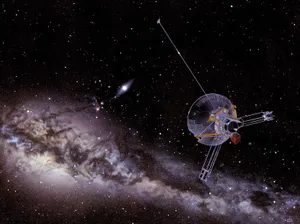
The mid-1970s brought a flurry of activity. Pioneer 10 launched in March 1972. It reached Jupiter in December 1973. It was the first probe to fly by the largest planet. The mission revealed a massive magnetic tail. This extended tail was an extension of Jupiter’s magnetosphere. Scientists had never seen such a structure up close.
Pioneer 11 followed closely. It launched in April 1973. It also visited Jupiter in December 1974. Then it headed north toward Saturn. Launched in 1973, the probe is also referred to as Pioneer-Saturn. In September 1979, it passed within about 20,900 kilometers of the ringed planet.
The images and data changed our understanding of Saturn. Scientists identified two additional rings. They also detected radiation belts within the magnetosphere. These findings were not just academic. They redefined what we knew about planetary systems.
A Message in a Bottle
Both Pioneer 10 and 11 carried something unusual. Each spacecraft had a gold plaque. The plaques featured a pictorial message. The goal was simple yet profound. If extraterrestrial beings ever found these probes, they would know who sent them. It was a beacon of human curiosity. A hope that we are not alone.
Venus and Its Atmosphere
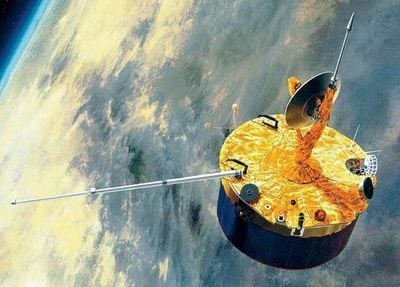
The program expanded again in 1978. Two spacecraft, Pioneer 12 and Pioneer 13, targeted Venus. Both arrived at the end of the year. The first was the Orbiter. It studied Venus’s clouds and atmosphere. It mapped more than ninety percent of the surface. Radar technology penetrated the thick clouds. This revealed terrain hidden from optical cameras.
The second craft was the Multiprobe. It carried one large and three small instrument packages. These were dropped into the