We assume we have fish figured out. They live in water. They breathe oxygen dissolved in that water. It is a safe, comfortable loop. Most fish fit this bill. But a small group of amphibious species has broken the rules. They evolved gills that can pull oxygen directly from the air.
There are about 11 genera of these water-walking, air-breathing oddities. You have likely heard of lungfish. Mudskippers are another example. These fish did not all come from the same ancestor. They evolved this trait independently. That suggests breathing air provides a massive survival advantage. It lets them escape competition. It lets them survive when the water runs dry or turns toxic.
The northern snakehead fish (Channa argus ) takes this advantage and weaponizes it.
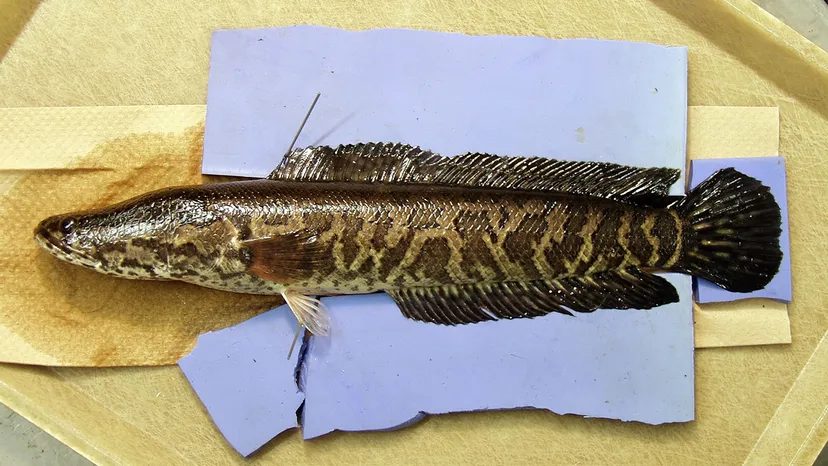
This species looks like a movie villain. It is native to parts of China, Russia, and Korea. It belongs to a group of 29 eel-like fish. They have long, tubular bodies. The scales are brown and black spotted. The head is flattened and snakes. The look is intimidating. But the real danger is not physical appearance. It is biological resilience.
“Snakeheads are aggressive predators that can survive in poor water quality conditions and even survive out of water for several days if they can stay moist,” says Scott Robinson, a fisheries manager with Georgia’s Wildlife Resources Division. “They have the ability to take oxygen from air or water with their gills. Since they can survive in poor conditions they are more likely to spread and persist than some other species of fish.”
They eat everything. They tolerate conditions that would kill most other fish. They can leave a pond entirely if it becomes unbearable. They wrigle overland to find better water. The young are surprisingly good at this overland travel. Adults struggle a bit more but still manage it. They live a long time. They handle wide temperature swings. They adapt to almost any aquatic habitat. They reproduce twice a year. In some places, their population doubles in just 15 months.
The Northern Snakehead as an Invasive Threat
In their native range, these fish are apex predators. They are feared. Outside that range, they are unstoppable.
Scientists are not entirely sure how the northern snakehead got into the wild in the United States. It was likely a mix of factors. The pet trade played a role. Fish markets contributed. Aquaculture was involved. They were farmed in Arkansas until the federal government banned it in 2002. Now, they have been found in 16 states. Georgia is the latest location.
“In October, 2019, an angler in Georgia reported catching one from a private pond,” Robinson notes. “Sampling revealed several adults and young fish from at least two different spawns in the pond and also downstream of the pond in a wetland area and a small tributary to the Yellow River. We suspect that one or more pairs of adults were illegally stocked or disposed of in the pond.”
Robinson believes they will spread further in that watershed. Why does this matter to you?
Invasive species always create problems. Snakeheads compete with native fish for food. They are voracious. They eat what native species need to survive. They eat the native fish themselves. They eat frogs. They eat lizards. They eat small animals that live near the water. Robinson also warns they may carry diseases that could infect other fish populations. It is a one-two punch of ecological damage.
Reporting and Removing Snakeheads
The solution is simple but strict. Do not dump aquarium fish into local waterways. Do not stock non-native fish anywhere.
“If someone catches or finds a snakehead, we ask that they kill the fish – do not return it to the water – and report it to their local Georgia DNR fisheries office,” Robinson says.
This rule applies to the catch. Kill the fish. Report it. In other states, contact your state fish and wildlife management agency or Department of Natural Resources. You can find the correct agency for your location on the Association of Fish & Wildlife Agencies website.
It is a simple protocol. But the snakehead’s ability to breathe air makes them nearly impossible to eliminate once they establish a foothold. They do not need the water to survive. They just need moisture.
In Japan, the northern snakehead is known as Raigyo. It translates to “thunder fish.” A fitting name for a creature that moves through water and air alike, striking without warning.
The question remains whether we can stop the spread. The fish has the tools to outlast us. It has the patience to wait for the next rain. We have the regulations. But enforcement is hard. The fish are slippery. Literally.