It is no accident that steel has become the backbone of modern infrastructure. This happened because someone figured out how to pump air through the molten iron fast enough to keep the whole thing from freezing in the process. This method is the Bessemer process, the first industrial method for mass production of steel.
Sir Henry Bessemer receives the name and patent. But the idea wasn’t just his. It was a clash of minds across the Atlantic.
In 1847, William Kelly, a businessman and scientist in Pittsburgh, began conducting experiments. His goal was simple, but radical: to remove impurities from pig iron by blowing air. His theory was that blowing air would do two things. First, oxygen would react with impurities and convert them into oxides, which precipitate as slag. Second, this chemical reaction would produce heat. This heat was critical. It prevented the molten mass from solidifying while working. It took several failures to prove it worked. Once this happened, he was able to quickly produce steel ingots.
Bessemer worked independently in Sheffield, England. By 1856, he had developed and patented the same method. Kelly had the science but no money to scale it. Bessemer had the capital to make it a commercial reality.
The process was not yet complete after the patent. It had to be refined to be useful. Robert Forester Mushet, another Englishman, solved the carbon balance problem. When the air injection was complete, he added a mixture of carbon, manganese and iron. This restored carbon levels and neutralized remaining impurities such as sulfur. Meanwhile, Goran Goransson, a Swedish iron master, redesigned the furnace itself. He made the converter reliable.
The result was cheap steel that was produced in large quantities. It hit the market in Great Britain and the United States. Suddenly, in construction and on the railways, there was a material that could withstand greater stress than iron. Tracks lasted longer. Bridges crossed larger gaps. The industrial world was changing.
Converter mechanics
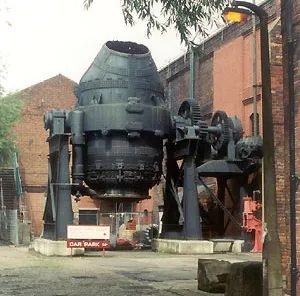
At the center of this revolution was the Bessemer converter. It looks like a huge cylindrical pot. It was originally about 6 meters high. The interior was lined with silicate fire-resistant material to withstand the heat.
Air is blown in through openings in the bottom. These are called tuyeres. The blast creates oxides. Silicon and manganese become part of the slag. Carbon oxides are carried along in the air stream. The whole change happens in a few minutes. They go from pig iron to steel that is ready for the forge or rolling mill.
Why the original design failed in Europe
There was a catch. The original converter could not handle phosphorus. Most British and European iron ores contained significant amounts of phosphorus. The siliceous lining couldn’t remove it. The steel remained brittle and defective.
The solution came from Sidney Gilchrist Thomas from England. He invented the Thomas-Gilchrist converter. Instead of an acidic silicate lining, a basic material such as burnt limestone was used. This chemical change allowed phosphorus to be removed. The process became feasible for European ores.
Another problem continued for a long time. The air stream left a small percentage of nitrogen in the steel. This deficiency was corrected only in the 1950s.
The rise and fall of the process
The open-hearth process was born in the 1860s. There was no nitrogen problem. It eventually surpassed the Bessemer process. The open-hearth was the dominant way for decades. It held this position until the middle of the 20th century.
Later, the open-hearth was replaced by a basic oxygen process. Ironically, this modern method is actually an extension and refinement of the Bessemer process itself.
The legacy isn’t just about machines. It’s in skyline. Every time you see a steel beam, you see the result between a penniless Pennsylvanian and a well-heeled Englishman. Science was shared. The credit was split. Steel was built.
We still use it. Not quite the same way. The ovens have changed. The control is now digital. But the basic idea remains the same. Blow air through the metal to change its nature. It is a violent process. It’s fast. And it works.
There is still debate about how best to manage nitrogen levels in modern steel production. Chemistry has become more precise. The scale has increased. However, the basic question has not changed. How do we make steel cheap enough to build the world, but strong enough to hold it together?
The answer started with a blast of air.