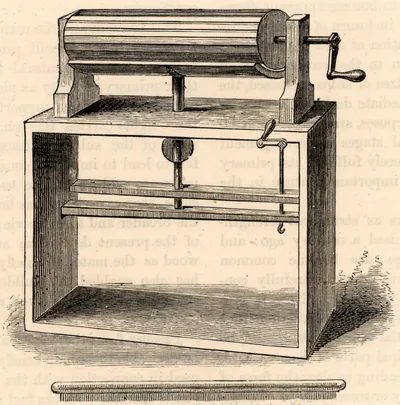
Lewis Paul died in London in 1759. Before that, he changed how we make clothes. He was an English inventor who came up with the first power spinning machine. He did not do it alone. John Wyatt helped him.
Paul came from a family of Huguenot refugees. His father died when Paul was young. This left him in the care of the Earl of Shaftesbury. It was a good connection. The Earl’s influence likely helped Paul get started.
Around 1730, Paul met John Wyatt. They began working together. Wyatt was skilled with machines. Paul had the ideas. Wyatt made them work. This partnership made sense. One person dreamed it up. The other built it.
They got a patent in 1738. The machine was simple but effective. It used rollers. Cotton or wool went through these rollers. The rollers spun at different speeds. Each pair moved faster than the last. This stretched the fibers. It made them strong and even.
This was a big deal. People had spun thread by hand for centuries. A machine could do it faster. It could do it more consistently. But it was not the end of the story.
The machine had limits. It could not handle thick yarn well. It worked best for finer threads. Later, Richard Arkwright would improve on this. He created the water frame. It was stronger. It used water power. It became the standard for a while.
Paul also invented a carding machine. He patented it in 1748. Carding prepares fibers. It removes tangles. It aligns them before spinning. Both inventions mattered. They were steps toward modern textiles.
We might not know Paul’s name today. Arkwright gets more credit. But Paul started the process. He showed that machines could spin thread. That idea spread. It changed everything.
Why does this matter now? We wear spun fabric every day. The process began with machines like Paul’s. It started as a small step. A few rollers. A bit of wool. Then it grew. It grew into factories. It grew into global trade.
Paul’s life ended in London. But his work did not. The first power spinning machine was just the beginning. It set the stage for the Industrial Revolution. Without it, we might still be spinning by hand. Or we would have waited longer.
The story of textiles is not just about cloth. It is about people. Inventors. Partners. Ideas that stick. Paul had an idea. Wyatt built it. Others improved it. The cycle continues.
We rely on these old machines. We take them for granted. But they solved real problems. They made clothing more affordable. They made it more available. They changed how we live.
Paul’s legacy is in every thread. Every button-up shirt. Every pair of jeans. The rollers turned. The fibers stretched. The world changed. It started with a partnership. It started with a patent. It started with a man who had an idea.