




Museums lie.
They show us the highlight reel. The shiny bones, the painted portraits, the carefully labeled vials that tell a clean, linear story of human progress.
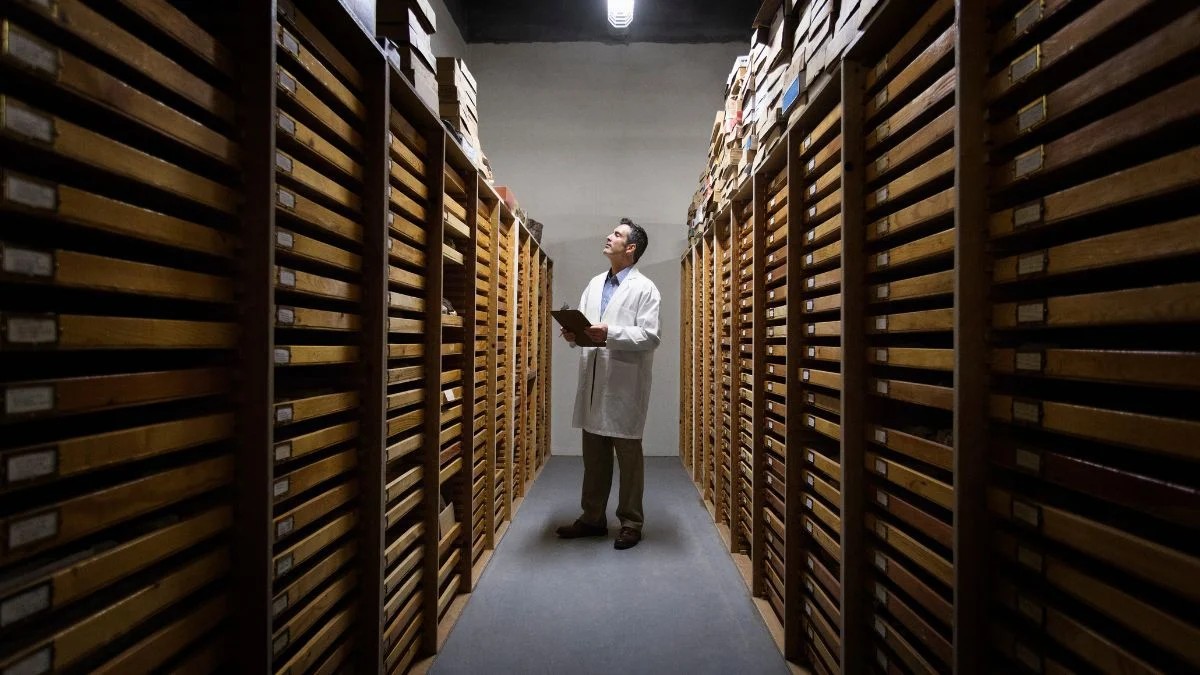
But walk behind the curtain. Into the cold, dark warehouses where the air smells of dust and old paper. Here, humanity has accumulated a mountain of things too heavy to display and too numerous to understand.
Most of us never see this.
For scientists, though, this clutter is the real prize.
“Even old collections… can bring new scientific information.”
Decades pass. Technologies advance. Methods that seemed like the height of sophistication in 1920 are now primitive.
That is why the most important discoveries today often happen not in the field, under the blazing sun or freezing rain, but in the quiet hum of a museum storage closet. Someone new picks up a box. They look closer. They ask a question the previous century didn’t know to ask.
The Whale’s Secret
For years, archaeologists had cataloged hundreds of prehistoric artifacts from Western Europe. Specifically, from the Magdalenian period, roughly 19,00 to 1400 years before the common era.
These items sat in museum basements, tagged and shelved, essentially forgotten.
Until a team sat down with modern dating techniques and a serious amount of patience.
They looked at about 150 specific tools. All made from whale bone.
Old news? Not quite. These are the earliest known tools of their kind.
Jean-Marc Pétillon, an archaeologist from the University of Toulouse-Jean Jaurus, called ScienceAlert with the results. The tools told a new story about the whales of the Bay of Biscay. They showed how early humans didn’t just fear the sea, they processed its remains with deliberate craft.
It was never about the tools themselves. It was about who finally bothered to look.
Sky Metal on the Ground
The Treasure of Villena isn’t hiding in a closet.
It sits in Spain. Discovered in 1963, it’s one of Europe’s finest examples of Iberian Bronze Age goldsmithing. Three thousand years old. Revered by historians, displayed with care, yet somehow… incomplete.
For six decades, two specific pieces confused scholars. A bracelet and a small, brown hemisphere. They were dull compared to the gleaming gold surrounding them. What was that metal? Iron, yes, but early. Too early.
Iron smelting hadn’t hit that region yet.
So in 2024 researchers did some testing.
The answer fell from the sky. Literally.
The brown material wasn’t earthly ore. It was iron from a meteorite.
Before humans figured out how to forge steel, they were already using gifts from the cosmos to craft jewelry. It makes the object less about wealth and more about cosmic luck. You find a rock burning through the atmosphere, you chip it off, and suddenly you have the strongest metal in the world.
The Ghosts of Alaska
In the interior of Alaska, deep inland, someone dug up some bones.
Seventy years ago, everyone assumed it was a woolly mammoth. Big bones. Cold place. Makes sense, right?
So they left them alone.
In 2022 a new program began studying these “mammoths.” Radiocarbon dating was applied. The result?
Not extinct. The animal had lived long after mammoths disappeared from the face of the Earth.
Worse—or rather, more wonderfully—mitochondrial DNA comparison showed the bones didn’t belong to one land animal at all. They belonged to two.
Two whales.
More than a thousand years old.
Found over 250 miles from the nearest coastline.
How?
Researchers shrug. The bones traveled inland. The animals died in the ocean. The link between those two facts remains stubbornly silent.
It is a reminder that our confidence in history is often just a guess wearing a lab coat.
Darwin and Lasers
Sometimes the secret isn’t the specimen. It’s the jar it lives in.
Charles Darwin collected hundreds of specimens over his lifetime. He preserved them in fluids. Sealed them tight. Left them to his heirs.
Two centuries later, scientists have a problem.
They don’t know which fluids he used. Different jars had different solutions. Some preserve better. Some degrade faster. Opening the jars to check?
Too risky. The delicate remains might be destroyed.
So, in early 2026—wait, yes, the future is here—scientists published a method that solved the dilemma without breaking a single seal.
Laser light.
Shined through the glass. Analyzed the spectrum.
Darwin was methodical. He used different fluids for different types of animals.
This simple discovery saves the specimens. Knowing what’s inside allows for precise long-term care. It turns out the man who changed biology also inadvertently created a chemistry test for future generations to take.
Opal Herds
Australia has a weird trick up its sleeve.
Silica-rich waters seep through rock, replacing fossilized bone with shimmering opal. The process takes millions of years. The result is gems that glow like trapped rainbows.
Beautiful. Also, problematic.
Valuable stones disappear. They get hoarded. Traded privately. Lost. Unstudied.
A collection discovered in 1985 fell into this pattern. It sat for thirty years. Donated in 2015, finally picked apart by paleontologists in 2019.
What were they?
A jumble. Four distinct animals, at least. All the same species. Unknown until this moment.
Named Fostoria dhimbangun. They lived in herds during the mid-Cretaceous. They died together, likely in a catastrophic event, and their bodies stayed packed together as the silica poured in.
They turned to gemstone, locked in a final embrace.
Most of their brothers and sisters probably melted down into someone’s engagement ring without anyone knowing.
The Brain in the Shell
The Burgess Shale is the fossil nerd’s dream. 508 million years old. Layers of sediment so fine they capture soft tissue, gut contents, eyes.
Paleontologists have been pulling shards from there since 1912.
Most specimens end up in storage. Archived. Waiting.
Enter Stanleycaris hirpex.
A strange little critter. Three eyes. A radiodont, relative to modern arthropods, though looking very distant from today’s crustaceans.
Hundreds were found. Most looked the same: shells with spines.
In 2022 two decades after their discovery, Joseph Moysiuk at the University of Toronto looked deeper. Not just at the shells, but inside.
In 84 out of 268 specimens, the brain was preserved.
Exquisite detail.
Visual processing centers connected to those big central eyes. Nerves threading into appendages.
Moysiuk said we could see the wiring diagram of evolution.
“We can even make out fine details…”
It challenges how we think about the birth of the complex nervous system.
We assume we are done. Done looking. Done digging.
But the museum basement doesn’t care about our deadlines.
It keeps accumulating. Layer upon layer. Mistake upon mistake upon treasure.
Somewhere, right now, a box labeled “Miscellaneous Bones” or “Damaged Glass” is sitting on a metal shelf. Inside it, an answer waits for the wrong question.
Until the right person comes along.