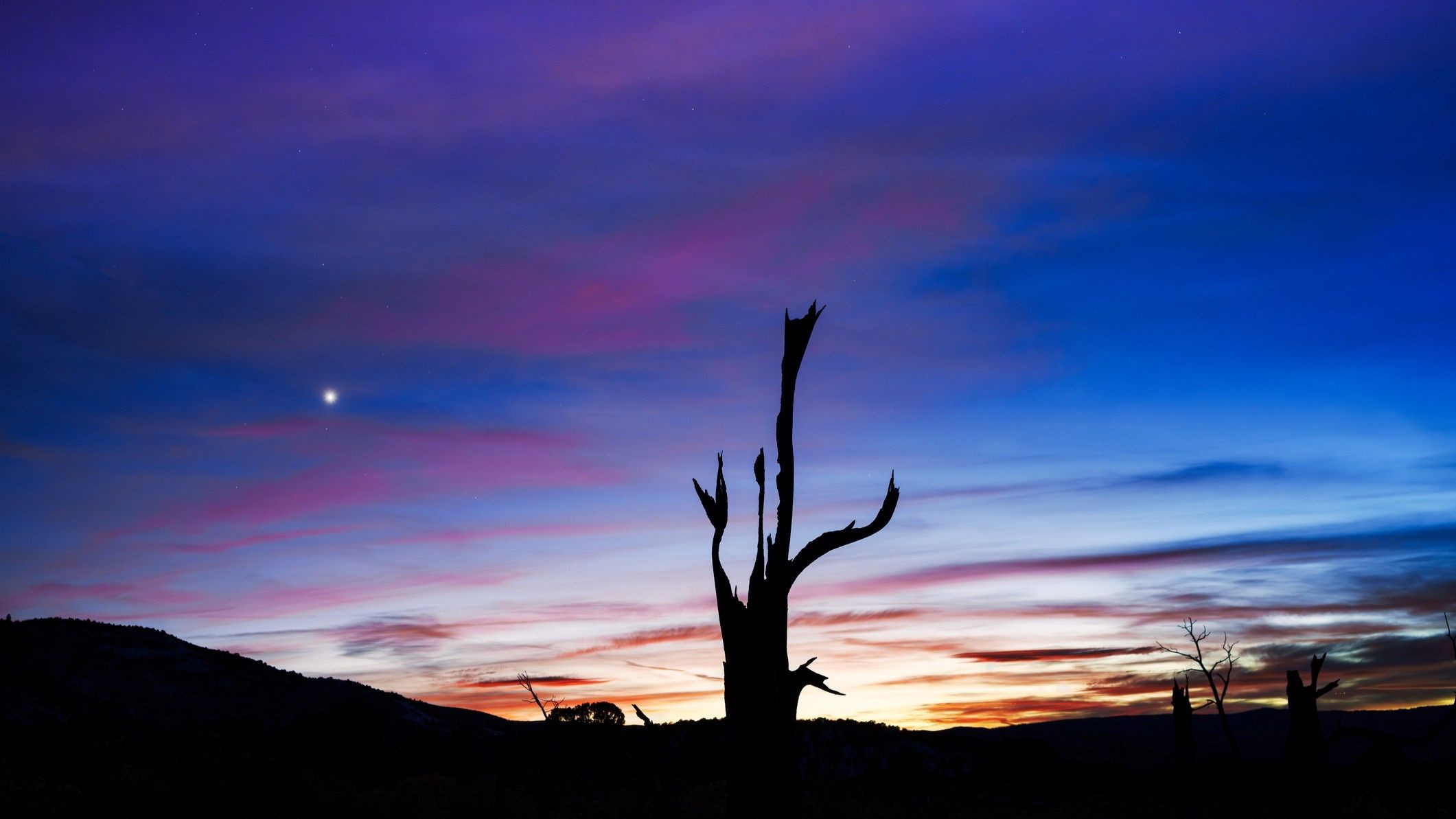
April offers a prime viewing opportunity for two of the brightest planets visible from Earth: Venus and Jupiter. While other planets remain hidden in the dawn’s glare, these celestial bodies put on a spectacular show in the evening sky.
Venus: The Evening Star
Venus, often called the “sister planet” due to its similar size to Earth, is low in the west-northwest sky for roughly two hours after sunset. Throughout April, Venus climbs slightly higher each week, becoming easier to spot as its disk grows larger in telescopes. On April 18th, a slender crescent moon will appear near Venus, and on April 23rd, Venus will pass within 3.5 degrees of the Pleiades star cluster, providing a stunning binocular view. Notably, on the same evening, Venus will be exceptionally close to Uranus, allowing for easy identification of the greenish world with just binoculars or a small telescope.
Jupiter: The Giant in the South
Jupiter dominates the southern-southwestern sky at dusk and remains visible long into the night. Accompanied by the “Twin Stars” of Gemini (Pollux and Castor), Jupiter is a brilliant beacon easily visible to the naked eye. Its massive size makes it a rewarding target for telescope users, offering clear views for hours after sunset. A crescent moon will appear 3 degrees above Jupiter on April 22nd, adding to the spectacle.
The Morning Challenge: Mercury, Mars, and Saturn
The remaining bright planets — Mercury, Mars, and Saturn — are difficult to observe due to their low positions on the eastern horizon and the brightening dawn sky. Mercury reaches its greatest elongation on April 3rd, but remains low and challenging to spot without binoculars. Mars, at magnitude +1.2, is even harder to find in the twilight. Saturn slowly rises higher by month’s end, but still requires early-morning searching before the sky brightens. Observers closer to the tropics may have better luck spotting these morning planets. On April 16th, a rare grouping of Saturn, Mercury, Mars, and a narrow crescent moon will be visible from the tropics.
Why this matters: The visibility of planets changes throughout the year due to Earth’s orbit around the sun. April offers a particularly favorable alignment for Venus and Jupiter, making them easy targets for both casual observers and serious astronomers. The difficulty in seeing Mercury, Mars, and Saturn highlights the challenges of observing faint objects against bright backgrounds.
In conclusion: April’s evening sky presents a captivating opportunity to witness the brilliance of Venus and Jupiter, while the morning planets require patience and favorable conditions for observation. Clear skies and a pair of binoculars will enhance the experience for all stargazers.