




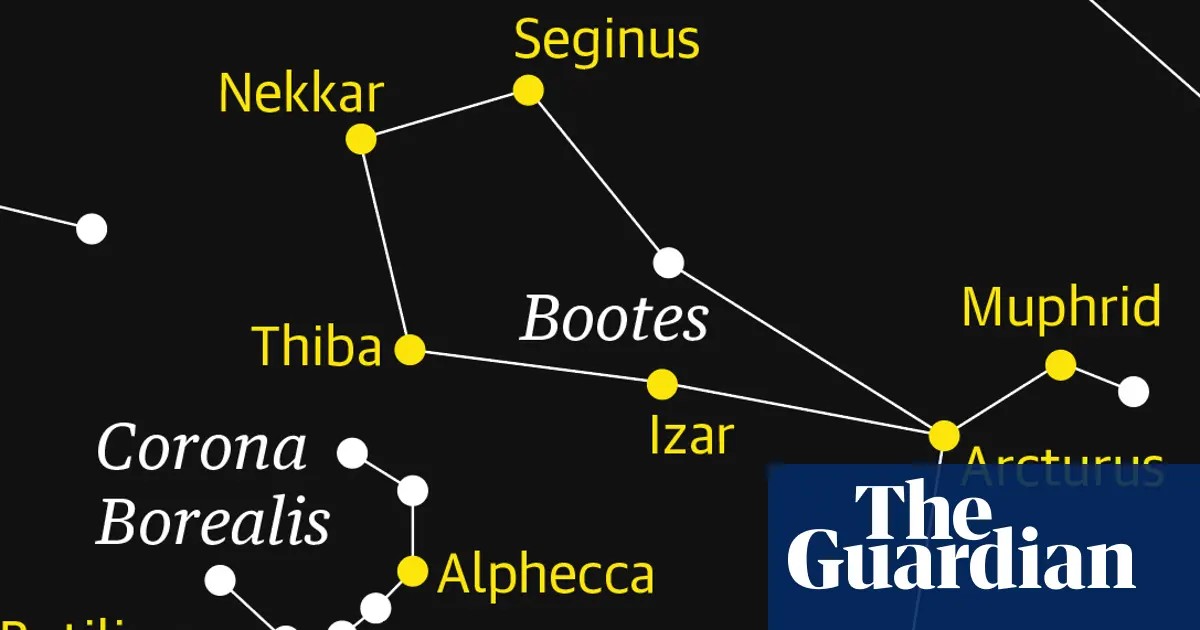
As the spring season progresses in the Northern Hemisphere, a prominent celestial figure is reclaiming its place in the night sky. The constellation Boötes, known as “the Herdsman,” is currently rising in the eastern sky shortly after dusk, offering a prime viewing opportunity for amateur astronomers.
How to Locate Boötes
Finding Boötes is relatively straightforward if you know where to look. Astronomers often use a technique known as “star hopping” to navigate the heavens.
- Find the Plough: Locate the familiar asterism known as the Plough (part of the Great Bear, Ursa Major).
- Follow the Arc: Trace the curve of the Plough’s handle downwards.
- Follow the Glow: This arc will lead your eyes directly to Arcturus, a brilliant orange star that serves as the anchor for the constellation.
Arcturus is the fourth-brightest star in the entire night sky, making it an unmistakable beacon for anyone looking eastward during the late evening.
A Legacy Written in the Stars
Boötes is not merely a modern astronomical landmark; it is a fixture of human history and mythology. While it is one of the 48 original constellations cataloged by the Greek astronomer Ptolemy in the second century, its roots are much deeper.
- Ancient Babylon: Thousands of years ago, Babylonian observers associated this region of the sky with the god Enlil, a deity credited with separating heaven from Earth to make the world habitable for humanity.
- Greek Mythology: In the Greco-Roman tradition, the figure is depicted as a herdsman or ploughman. Across various mythic interpretations, Boötes consistently serves as a symbolic protector of rural life and the agricultural cycle.
Viewing Tips and Seasonal Context
Because we are currently several weeks past the spring equinox, Boötes rises during twilight. This timing is ideal for observers, as the constellation reaches a high, prominent position in the sky by late evening, well after the sun has set and true darkness has settled.
Note for Southern Hemisphere Observers: While the constellation is a centerpiece of the northern spring, those observing from the Southern Hemisphere will see Boötes appearing much lower on the northern horizon.
Summary
The rising of Boötes marks a seasonal shift in the night sky, bridging ancient mythological traditions with modern celestial observation. By following the arc of the Plough to the bright glow of Arcturus, anyone can connect with this ancient “herdsman” of the stars.